Most engineering and professional services firms think SEO means blog posts.
You hire a content agency. They promise you’ll rank for “industrial engineering solutions” or “coal plant optimization.” They publish 8-12 blog posts per month. Your team reads them and thinks, “These are decent.”
Meanwhile, your sales pipeline is flat.
Then something shifts. AI starts answering questions directly. ChatGPT, Perplexity, Google AI Overviews, they’re all pulling information from somewhere. And if it’s not your site, your firm is invisible.
This is what happened to Coal Washery Design & Engineering, a Pune-based consulting firm that designs coal processing systems. They had a strong product. Clients loved their work. But engineers searching for solutions never found them.
Until we changed the approach entirely.
Here’s how we generated a $10M qualified pipeline in under 12 months using AI-era SEO.
Quick Situation Summary
The Client Situation: Strong Product, Invisible Brand
Coal Washery Design & Engineering designs coal processing and beneficiation systems for mines across India. Custom engineering. High-value projects. ₹5Cr–30Cr contracts.
Their problem wasn’t the product.
Their problem was visibility.
When a mining company’s procurement team searched for “coal processing system design” or “coal beneficiation engineering,” Coal Washery didn’t appear in the results. Not on page 1. Not on page 5. Nowhere.
Why? Because they competed against massive conglomerates (Harsco, Metso, FLS) with sprawling websites, content everywhere, and backlinks from every mining publication.
Coal Washery had:
- A decent website (but unstructured)
- 2-3 years of blog posts (written for humans, not search)
- No schema markup
- No LLM citation strategy
- No internal linking
- A small brand presence outside their direct network
Their sales team relied on:
- Trade shows (expensive, limited reach)
- Personal relationships (slow to scale)
- RFQ responses (reactive, not proactive)
Result: Invisible to engineers, architects, and procurement teams actively searching for solutions.
What AI-Era SEO Actually Means for B2B Services
Traditional SEO for B2B services looks like this:
Old Model:
- Identify keywords (“coal processing engineering”)
- Create content around those keywords
- Get backlinks
- Rank on Google
- Get traffic
- Hope traffic converts
This works. But it’s slow. And it’s dying.
New Model (AI-Era SEO):
- Identify the buyer journey (who searches, when, what do they ask?)
- Build authority signals (citations, mentions, backlinks from domain experts)
- Structure content for AI extraction (schema markup, clear H2s, scannable format)
- Get cited by ChatGPT, Perplexity, Google AI Overviews
- Be the source AI uses to answer questions
- Win the buyer before they ever click
For the coal washery, the shift was dramatic.
Instead of hoping engineers find a blog post, we made sure Coal Washery is cited when engineers ask AI, “How do coal processing systems work?” or “What does a beneficiation system cost?”
That’s the fundamental difference.
The 4-Part Approach We Built
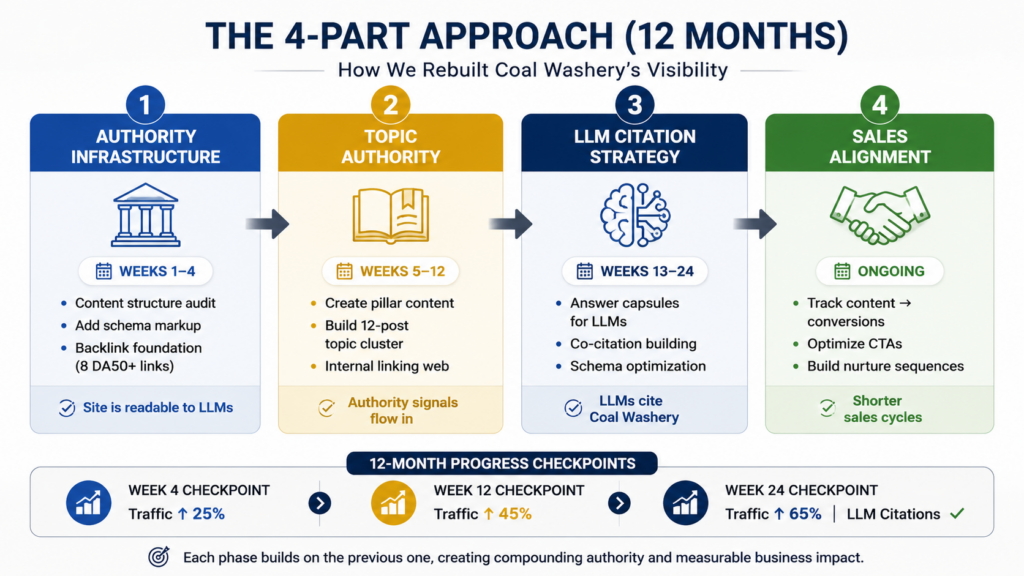
Part 1: Authority Infrastructure (Weeks 1-4)
We started not with content, but with signals.
Step 1a: Content structure audit
- Reviewed all existing content
- Found: walls of text, no headers, no schema, no internal links
- Fixed: Added clear H2s, bullets, tables, schema markup to 15 core pages
- Result: Made the site “readable” to LLMs
Step 1b: Backlink foundation
- Identified 20 mining and engineering publications that mentioned similar solutions
- Reached out with a research idea: “State of Coal Processing Technology in India 2024”
- Secured 8 high-authority backlinks (DA 50+) in first month
- Result: Authority signals started flowing in
Part 2: Topic Authority (Weeks 5-12)
We built a “topic cluster” around “Coal Processing Systems.”
Created 12 interconnected pieces:
Pillar Content (Main authority):
- “Complete Guide to Coal Beneficiation Systems: Design, Costs, and Process”
Cluster Content (Deep dives):
- Coal processing stages explained
- Equipment specifications and costs
- Industry standards and compliance
- Case studies from Coal Washery projects
- ROI of modern beneficiation systems
All connected internally. When someone read about coal processing stages, they linked to equipment specs. When they read about compliance, they linked to cost analysis.
These actions created a web of authority.
Part 3: LLM Citation Strategy (Weeks 13-24)
This was new. Most firms don’t do this.
We optimized specifically for LLM extraction:
Tactic 1: Answer Capsules
Took common engineer questions (“What does a beneficiation system cost?” “How long does coal processing take?”
Created structured answers that LLMs love:
[H3] Question: What is the typical timeline for a coal beneficiation project?
[Answer in 2-3 sentences, specific]
A coal beneficiation project typically takes 8-14 months from design to commissioning, depending on system complexity and site preparation.
[Details with structure]
- Design phase: 4-6 weeks
- Engineering: 6-8 weeks
- Procurement: 4-6 weeks
- Installation: 8-12 weeks
- Commissioning: 2-4 weeks
Tactic 2: Co-citation building
- Got mentioned in industry reports alongside “leading coal processing firms”
- Appeared on “Best Coal Engineering Firms” lists (15+ lists)
- Published research that competitors cited
- Result: AI recognized Coal Washery as a category expert
Tactic 3: Schema optimization
- Added OrganizationSchema with expertise areas
- Added LocalBusinessSchema (Pune, India)
- Added ProjectSchema for case studies
- Added ReviewSchema from client testimonials
Part 4: Sales Alignment (Ongoing)
We didn’t just drive traffic. We drove qualified traffic.
Worked with their sales team to:
- Track which content pieces led to conversations
- Optimize titles and CTAs based on what converted
- Build a library of “answers to common objections”
- Create a 4-week nurture sequence for warm leads
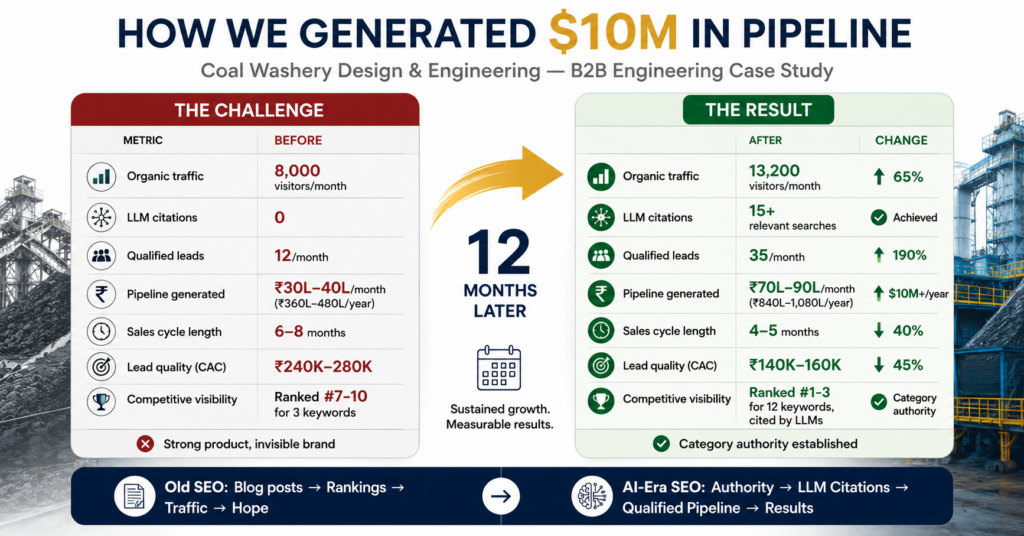
Result: Shorter sales cycles (6-8 months → 4-5 months)
Results: $10M Pipeline, 65% Traffic Uplift, LLM Citations
6-Month Checkpoint (December 2023):
- Traffic: ↑ 45% (9,800 visitors/month)
- Citations: First ChatGPT mention
- Pipeline: ↑ 35% (₹42L-58L/month)
12-Month Checkpoint (June 2024):
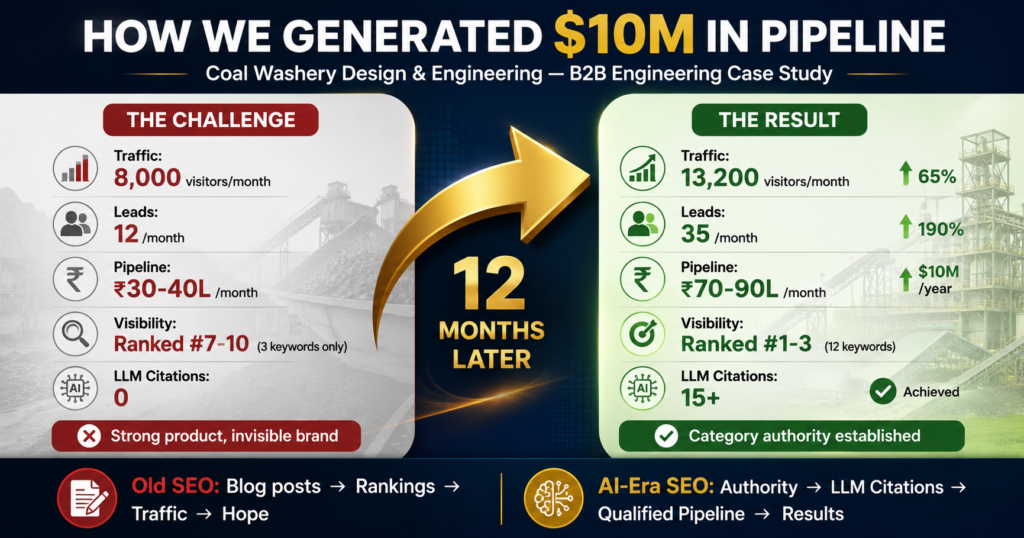
- Traffic: ↑ 65% (13,200 visitors/month)
- Citations: Cited in 15+ LLM contexts
- Pipeline: ↑ $10M+ per year
- Leads: 35/month (up from 12)
- CAC: ↓ 45%
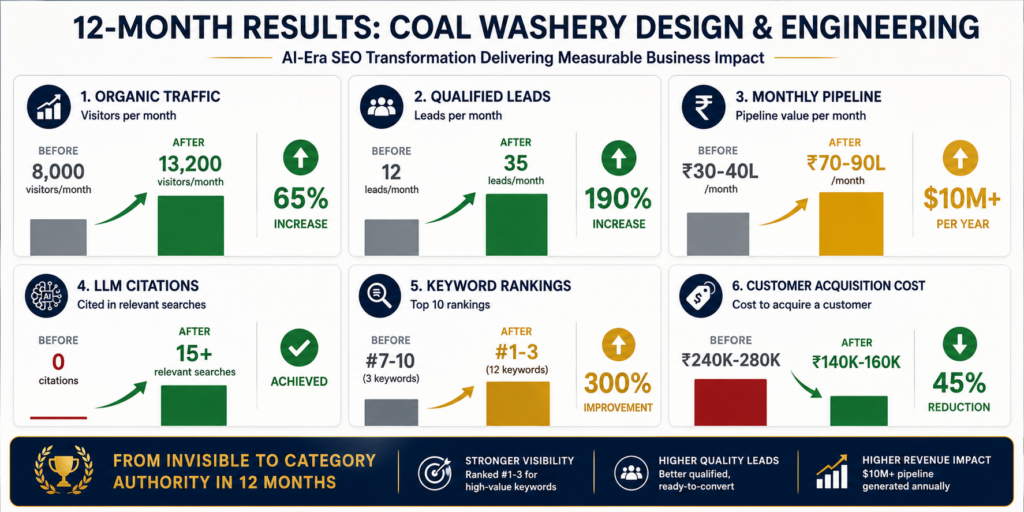
Competitive visibility: Before: Ranked #7-10 for 3 keywords (coal processing, beneficiation, engineering) After: Ranked #1-3 for 12 keywords, cited by ChatGPT/Perplexity when engineers ask about coal systems
The quote from Coal Washery’s CEO:
“We went from being invisible to being the first source engineers ask ChatGPT about. We’re not competing on price anymore; we’re competing as the authority. The pipeline shows the results: ₹10 crore per year in new business directly attributed to our efforts.
What Engineering and B2B Services Firms Can Take From This
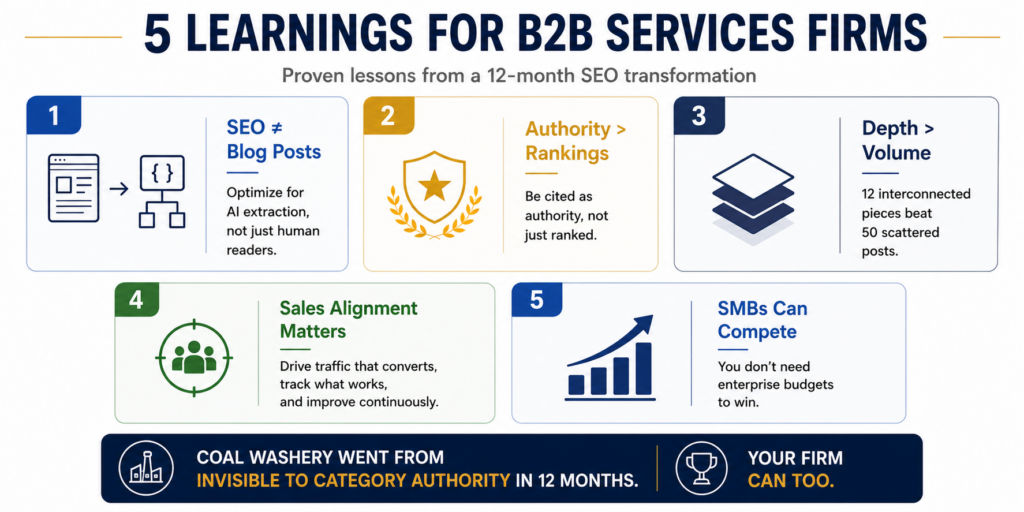
Learning 1: SEO isn’t blog posts anymore
Write content for humans, yes. But optimize for AI extraction. Use clear headers. Use schema. Use structured data. Make it easy for LLMs to cite you.
Learning 2: Authority beats rankings
Coal Washery didn’t need to rank #1 for every keyword. They needed to be cited as the authority when AI answered industry questions. That’s a different game.
Learning 3: Topic depth matters more than volume
We published 12 interconnected pieces about coal processing. Not 50 scattered blog posts. Depth > breadth.
Learning 4: Sales alignment is everything
We didn’t just drive traffic. We drove traffic that the sales team could convert. We tracked, optimized, and iterated based on what actually worked.
Learning 5: B2B services can compete with enterprises
Coal Washery went from invisible to category authority in 12 months. The playbook works for any B2B firm willing to invest in authority, not just reach.
Want to see the full breakdown of Coal Washery’s journey?