AI citations aren’t random. They follow a pattern.
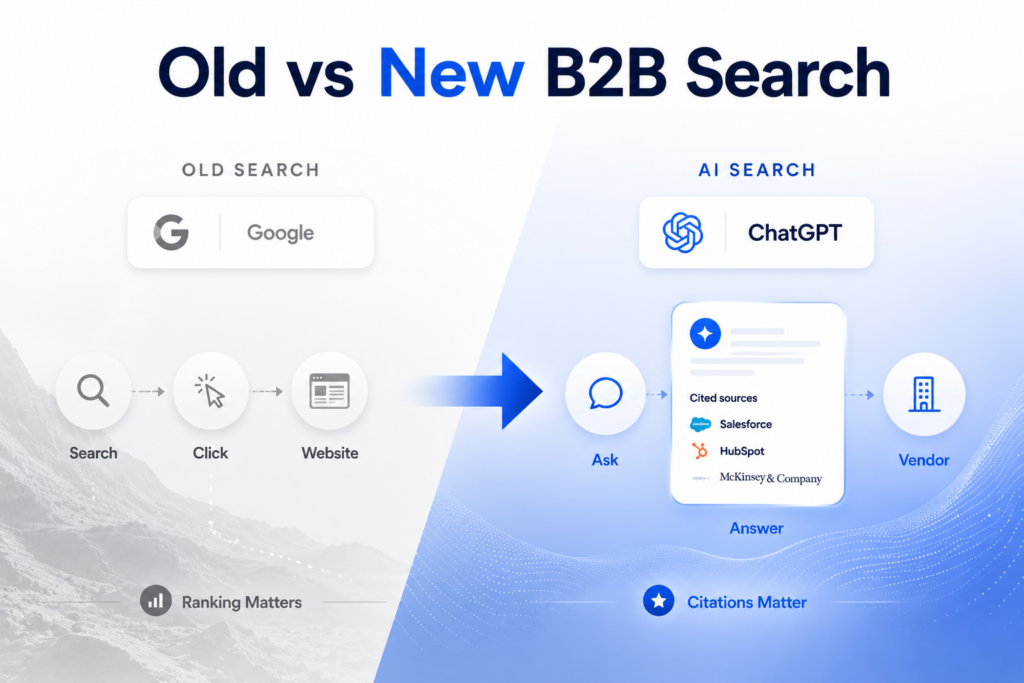
You ask ChatGPT, “What’s the best CRM for construction companies?” The AI generates an answer citing Salesforce, HubSpot, and Procore. Not random choices. Those companies show up because they fit a pattern that LLMs recognize:
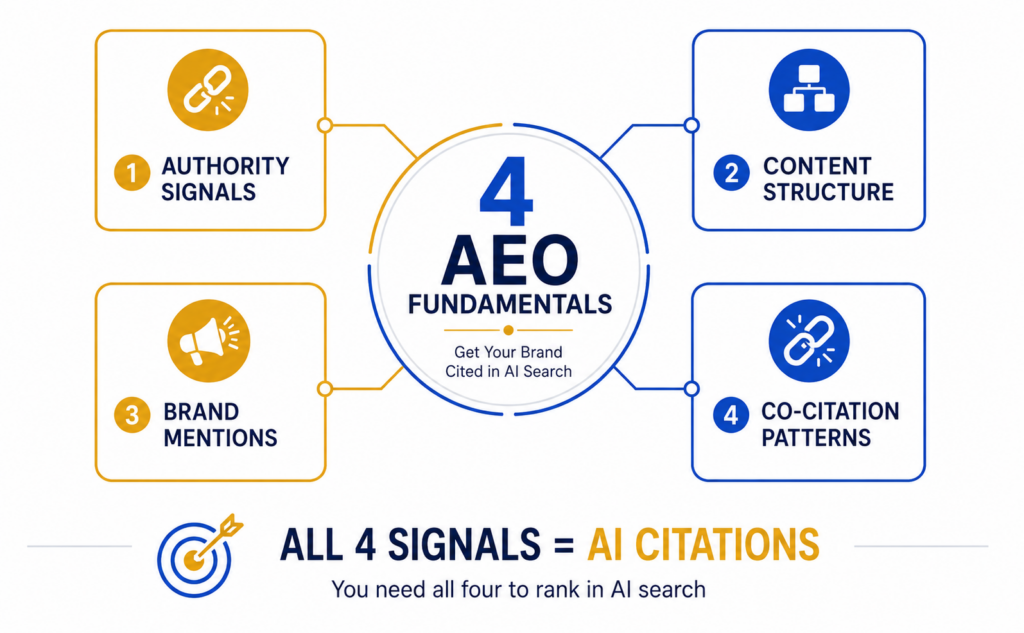
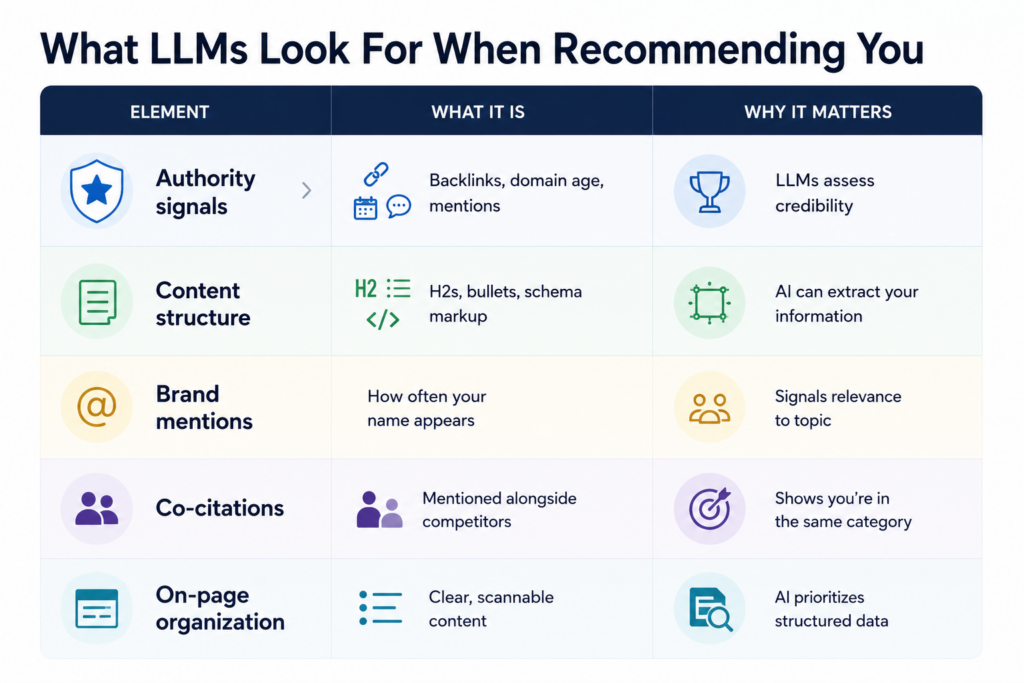
- Authoritative. They have backlinks and mentions from trusted sources.
- Structured. Their websites are organized in a way AI can extract information easily.
- Frequently mentioned. Across the web, these brands come up together in discussions.
- Cross-referenced. They’re cited by other authoritative sources.
Your brand might be better than what ChatGPT cites. But if you don’t fit this pattern, AI won’t know you exist.
Here’s the playbook for getting cited.
See what AEO means and why it matters
Quick Citation Framework (Table)
How Do LLMs Generate Citations
Language models don’t read like people. They process patterns
When you train an LLM on billions of web pages, it learns which sources are often cited together, which sources have authoritative backlinks, and which sources are cited in multiple contexts.
When you ask a question, the LLM responds:
Step 1: Identify Topic You ask: “What is the best sales tool for B2B SaaS?” LLM acknowledges, “Query is on B2B sales tools.”
Step 2: Searches for relevant sources in its training data LLM: Sources that mention B2B sales tools? Results: Over 10,000 sources
Step 3: LLM: Ranks sources using authority signals. “Which of these are the most authoritative?” Ranking factors: backlinks, mentions, domain authority, and co-citations
Step 4: Select the top 3-5 sources for LLM: “.I will reference these sources as they are authoritative on this topic.”
Step 5: Generates an answer from the LLM. “According to these sources, the best sales tools are...”
The big takeaway? LLMs don’t evaluate quality the way humans do. They use signals to determine who’s in charge.
So, you don’t need to have the “best” product to get cited. You need authority signals. LLMs get them.
How Do LLMs Generate Citations
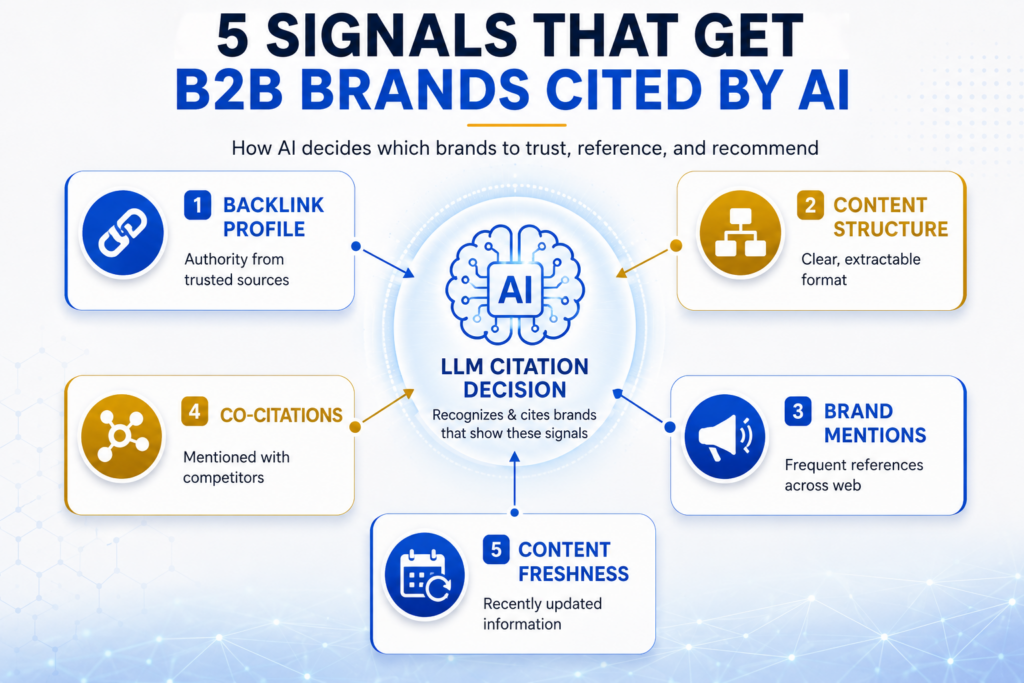
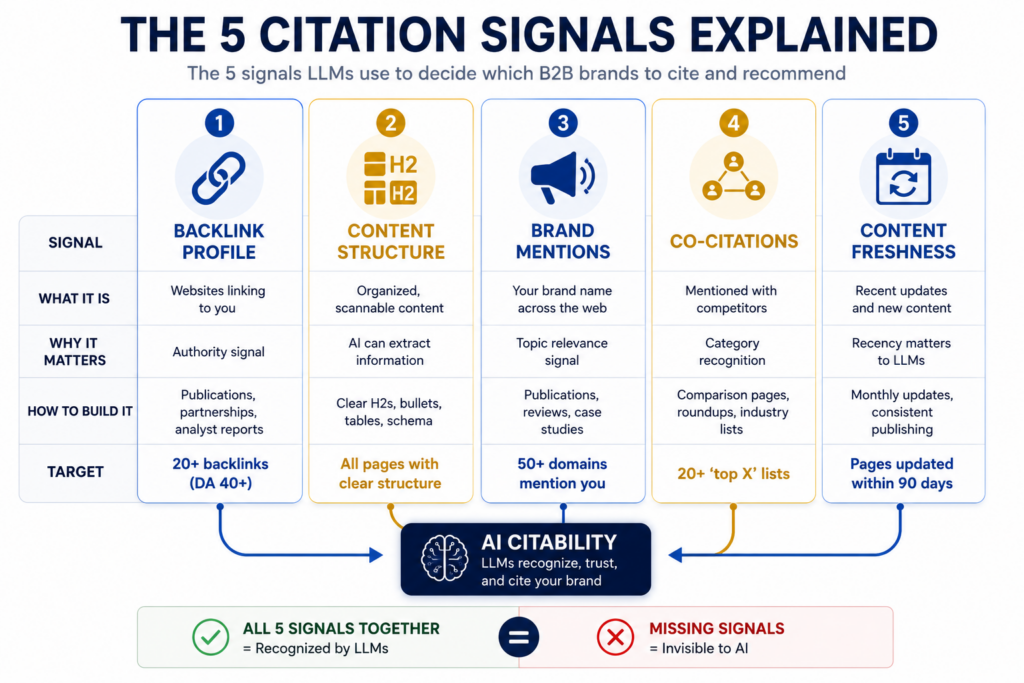
There are 5 specific signals that lead LLMs to cite your brand.
Signal 1: Backlinks
What it is: Links from other sites to your site
Why it matters: Backlinks are the strongest authority signal. An LLM interprets backlinks as “Other authoritative sources trust this brand.”
How to make it:
- Work with complementary companies (they link to you)
- Get featured in analyst reports (Gartner, Forrester)
- Publish research others cite and link to
Target: 20+ backlinks from authoritative domains (DA 40+)
Signal 2: Content Structure
What it is: Your content’s scannability and structure
Why it matters: LLMs can only cite you if they can get clean info from your site. Extraction failure = walls of text.
How to build it:
- Use clear H2 and H3 headers (not just bold text)
- Organize information into bullets and lists
- Use tables for comparisons
- Add schema markup (tells AI what information is)
Example structure that works:
What is [Topic]?
[Define clearly in 1-2 sentences]
[H2] Key Benefits
- Benefit 1 [explanation]
- Benefit 2 [explanation]
- Benefit 3 [explanation]
[H2] How to [Action]
- Step 1
- Step 2
- Step 3
[H2] Pricing
[Table with pricing tiers]
Target: Every page has clear H2s, bullets, and scannable structure
Signal 3: Brand Mention Frequency
What it is: How often your brand name appears across the web
Why it matters: LLMs assess topic relevance partly by co-occurrence. If your brand appears frequently in discussions about your category, LLMs recognize you’re relevant.
How to build it:
- Get mentioned in industry publications (aim for 20+ mentions/month)
- Encourage customers to mention you (case studies, reviews, testimonials)
- Appear on industry comparison pages (be listed on “best X” roundups)
- Co-author content with industry influencers (they mention you)
- Participate in industry discussions (comments, forums, Reddit)
Target: Your brand appears in 50+ unique domains within your category
Signal 4: Co-Citation Patterns
What it is: Being mentioned alongside competitors and category leaders
Why it matters: LLMs recognize categories partly through co-citation patterns. If you’re always mentioned with the leaders, you’re part of the group.
How to build it:
- Get on comparison pages where you appear with competitors
- Seek industry roundups (“Top 10 sales tools for SaaS”)
- Trade mentions with peers (they mention you, you mention them)
- Become a category standard (like how “Slack” is the category for messaging)
Target: Your brand appears in 20+ “top X” lists alongside competitors
Signal 5: Content Freshness & Updates
What it is: How recently you update your content and publish new information
Why it matters: LLMs prioritize recent information. Outdated content = less likely to be cited.
How to build it:
- Update core pages monthly (refresh stats, add new info)
- Publish new content consistently (at least 2x/month)
- Add publication dates to all content
- Include current year in examples and case studies
- Update old posts with new data
Target: Every page updated within last 90 days
Content Structure That Gets Extracted
This area is where most B2B brands fail.
You write excellent content. But it’s formatted for humans, not for AI extraction.
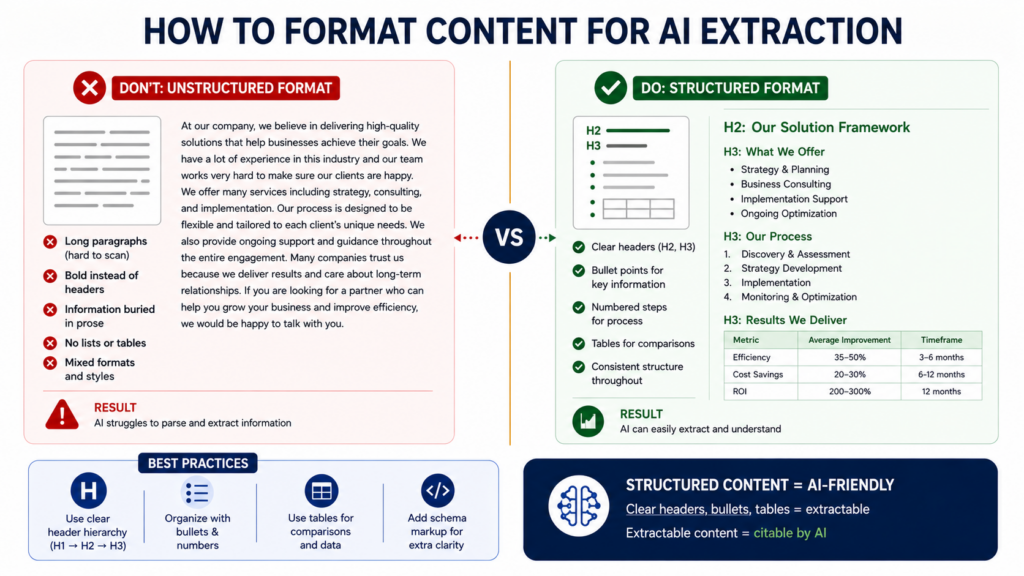
What NOT to do:
- Long paragraphs (AI struggles to parse)
- Bold text instead of headers (AI doesn’t recognize hierarchy)
- Information buried in prose (AI can’t extract)
- Mixed formats (some lists, some prose, some tables)
What TO do:
Use clear header hierarchy:
[H2] Main Topic
[H3] Subtopic 1
[H3] Subtopic 2
[H3] Subtopic 3
Use structured formats:
Bullets for lists:
- Item 1
- Item 2
- Item 3
Numbers for processes:
- Step one
- Step two
- Step three
Tables for comparisons:
| Feature | Option A | Option B |
Use schema markup:
Schema tells AI: “This is a definition, this is a price, this is a
product feature, this is a comparison.”
Without schema: AI guesses
With schema: AI knows
Real example (formatted for AI extraction):
[H2] What is Sales Engagement?
Sales engagement is the process of using technology and strategy to facilitate meaningful buyer conversations throughout the sales cycle.
[H3] Key Components
- Communication: Multi-channel outreach (email, phone, social)
- Personalization: Messages tailored to buyer context
- Tracking: Understanding which interactions drive results
- Timing: Reaching prospects at the right moment
[H3] Industry Benchmark
| Metric | Baseline | Optimized |
|---|---|---|
| Response rate | 5-10% | 20-30% |
| Sales cycle | 4-6 months | 2-3 months |
| Close rate | 15-20% | 30-40% |
Off-Page Signals That Matter (Mentions, Backlinks, Schema)
You can’t control everything on your site. You also need signals across the web.
Mention strategy:
Target: Get mentioned in 50+ industry contexts within 6 months
How:
- Contact industry publications with story ideas
- Contribute guest posts (authors get bylines, links)
- Get interviewed on podcasts (mentions + backlinks)
- Sponsor industry communities (get mentioned in recap posts)
- Participate in industry research (get cited in reports)
Expected: 5-10 new mentions/month from outreach
Backlink strategy:
Target: 5-10 high-quality backlinks (DA 40+) per month
How:
- Publish research others cite (industry benchmarks, surveys)
- Create comparison resources (competitors link to you)
- Build partnerships (partners link to you)
- Earn press coverage (media outlets link to you)
- Contribute to industry databases (you get backlinked)
Expected: By month 6, 30-50 high-quality backlinks
Schema markup strategy:
Target: Add schema to all key pages
How:
- Product schema (for product pages)
- Organization schema (for homepage)
- Article schema (for blog posts)
- Breadcrumb List schema (for navigation)
- FAQPage schema (for FAQ pages)
Tool: Use Google’s Structured Data Testing Tool to verify
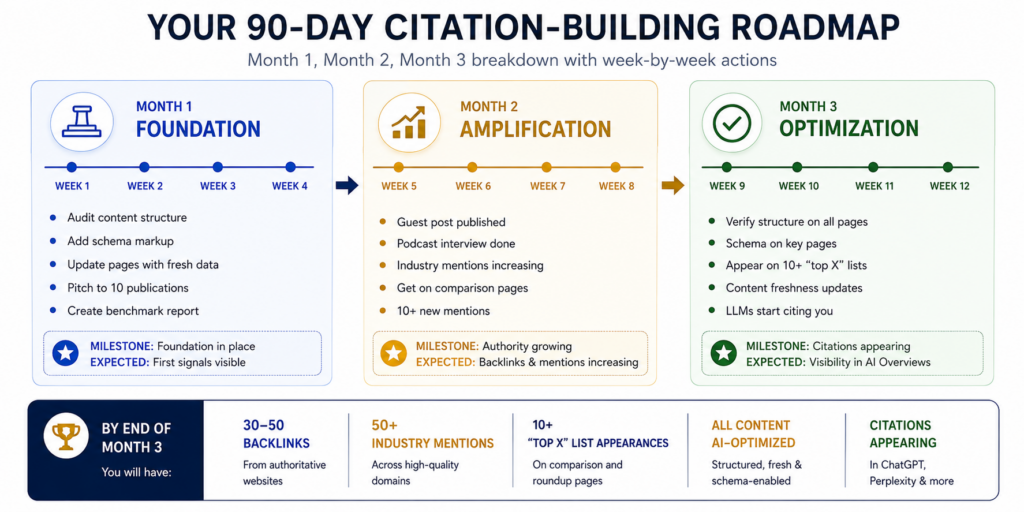
A 90-Day Citation-Building Plan
Month 1: Foundation (Establish authority signals)
Week 1-2:
- Audit your content structure (are H2s, bullets, tables clear?)
- Add schema markup to 5 key pages
- Update homepage with current info
Week 3-4:
- Reach out to 10 industry publications (pitch guest posts)
- Create a “State of the Industry” report or benchmark
- Update 5 core pages with fresh data
Expected result by month 1: Foundation in place, first signals visible
Month 2: Amplification (Build mentions and backlinks)
Week 5-6:
- Guest post published (+ backlink + mention)
- Podcast interview recorded (+ mention)
- Industry benchmark report published (gets cited, linked)
Week 7-8:
- Identify 5 “top X” lists where you should appear
- Reach out to authors (request to be included)
- Get mentions in 10+ industry discussions
Expected result by month 2: Backlinks and mentions increasing, authority growing
Month 3: Optimization (Ensure LLMs can extract you)
Week 9-10:
- Verify all pages use clear H2 structure
- Ensure schema markup on all key pages
- Add content freshness (update old posts)
Week 11-12:
- Verify you appear on competitor comparison pages
- Get featured in 2-3 industry roundups
- Publish new definitive guide on your category
Expected result by month 3: LLMs recognize you as authoritative and start citing you in answers
By the end of Month 3, you should see:
- ✓ 30-50 backlinks from authoritative sites
- ✓ 50+ industry mentions
- ✓ Appearance on 10+ “top X” lists
- ✓ All content optimized for AI extraction
- ✓ First citations appearing in ChatGPT/Perplexity when your category is discussed
- ✓ Brand visibility increasing in AI Overviews
How to Know It's Working
Signal 1: Check ChatGPT
Search your category in ChatGPT: “What’s the best [your category] for [your market]?“
If you’re cited, you’re winning. If you’re not, you’re invisible.
Signal 2: Monitor brand mentions
Use tools like:
- Google Alerts (free)
- Mention.com (mentions)
- Ahrefs (backlinks)
- Semrush (visibility)
Track weekly. You should see:
- Mentions trending up (5-10/week by month 2)
- Backlinks trending up (2-3/week by month 2)
- Brand search volume stable/growing
Signal 3: Ask your customers
In customer interviews, ask: “How did you discover us?“
If more say “ChatGPT recommended us” or “You showed up in Perplexity,” it’s working.
Ready to build your AI visibility? Get your AI Visibility Audit: where does your brand stand today in ChatGPT, Perplexity, and Google AI Overviews?