Your Google ranking for “b2b marketing agency” is rank #7.
You’re excited. Good visibility. High intent keyword.
Then you ask ChatGPT the same question.
You’re not in the top 5 answers. You’re not mentioned at all.
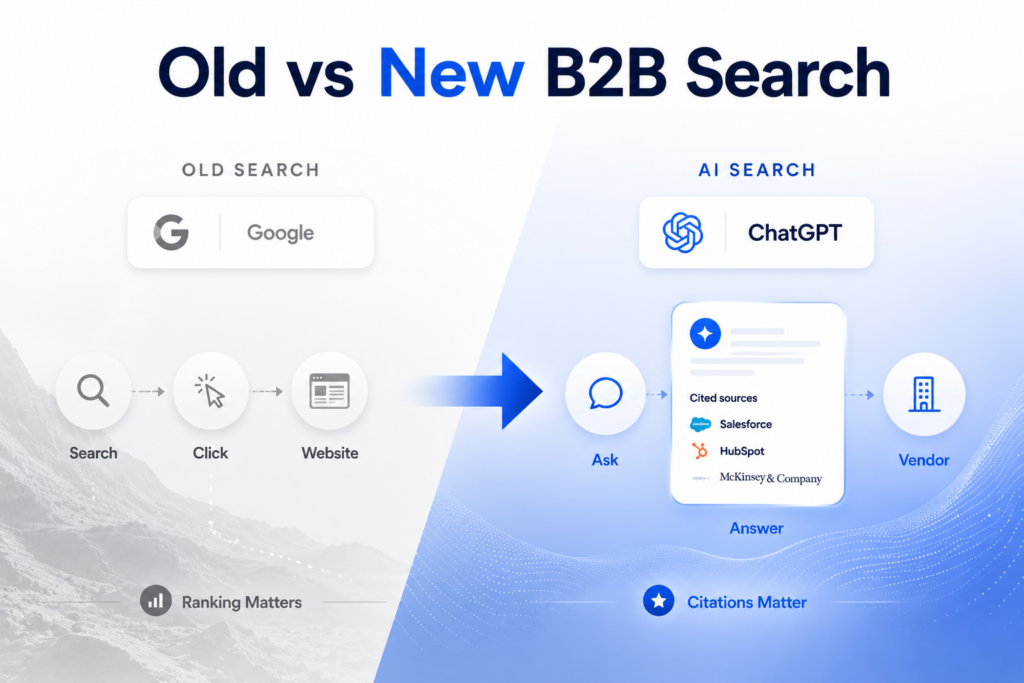
Welcome to the problem: Google metrics no longer predict B2B visibility.
You can rank #3 in Google and be invisible in ChatGPT, Perplexity, and Claude. The buyer is using AI. AI doesn’t see you.
This is the shift happening in 2026: AI search visibility is becoming more important than Google search visibility.
Here’s how to measure it and why the metrics you’re tracking are already obsolete.
Why Google Search Metrics Are Becoming Obsolete for B2B
Let’s be direct: For B2B, the buyer journey is moving to AI.
When a founder has a problem, they ask ChatGPT or Perplexity first. They don’t Google it.
When a VP of Sales needs a playbook, they ask Claude or ChatGPT. They don’t search Google.
Google’s traditional metrics (ranking position, click volume, and organic traffic) no longer predict business value for B2B.
Example:
A B2B SaaS company ranks #1 for “how to build an SDR team” on Google.
The page gets 3,000 visits/month from Google.
But ChatGPT never cites them. Perplexity never includes them.
Result: No pipeline from that page. The ranking is a vanity metric.
Meanwhile, another company isn’t ranking in Google at all. But they’re cited in ChatGPT 2-3x/week.
They get 0 organic traffic. They generate ₹40L in pipeline per month from AI citations.
The shift:
Traffic from Google = visibility in a declining search channel
Citations by AI = visibility in the emerging search channel
The 5 Metrics That Actually Predict AI Search Visibility
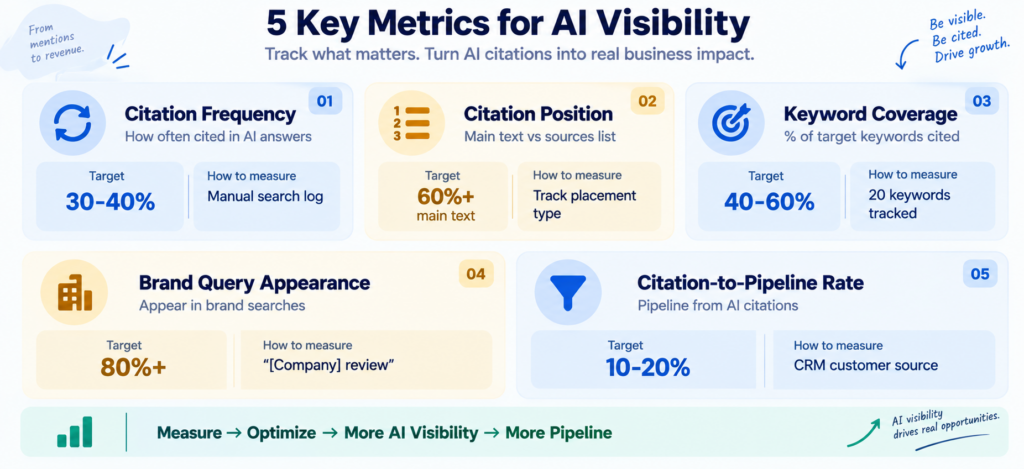
Metric 1: AI Citation Frequency
Definition: How often your brand/content is cited in AI search answers
How to measure:
- Manually search ChatGPT / Perplexity / Claude for your keywords (10-20 searches over 2 weeks)
- Track if you appear in the top 3 cited sources
- Record frequency (1x/week, 3x/week, daily)
Target: Your brand should appear in 30-40% of AI answers for your target keywords.
Why it matters: Citation frequency is the #1 predictor of pipeline from AI. More citations = more awareness = more pipeline.
Example: Search “b2b demand generation best practices” in ChatGPT 10 times. If you’re cited in 3-4 of those answers, you have a 30-40% citation frequency. Healthy.
Metric 2: AI Citation Position
Definition: Whether your content appears in the top answer or buried in the sources list
How to measure:
- When cited in an AI answer, note if you’re in the main text or just the sources list
- Main text = higher value (prospect reads it)
- Sources list = lower value (prospect might not click)
Target: 60%+ of your citations should be in the mainstill a positive outcome answer text
Why it matters: Being cited in the sources list is still a positive outcome. But being cited in the main text means the AI is actually using your content to answer the question. That’s visibility.
Metric 3: Keyword Coverage for AI Citation
Definition: How many of your target keywords get you cited?
How to measure:
- List 20 target keywords for your business
- Search each in ChatGPT / Perplexity / Claude
- Track how many result in your citation (in top 3 sources)
- Calculate: # of keywords you’re cited for / total keywords = coverage %
Target: 40-60% keyword coverage
Why it matters: If you’re only cited for 10% of your target keywords, your AI visibility is narrow. You’re strong on 1-2 topics but invisible on others.
Example: You target “demand gen,” “pipeline building,” “marketing KPIs,” and “AI search strategy.”
You get cited for “demand gen” and “pipeline” but not the others.
Coverage: 50% (2 of 4). This is a gap you can fix with content on the missing topics.
Metric 4: Brand Query Appearance
Definition: When someone searches your company name, do AI engines cite you?
How to measure:
- Search “[Your Company Name] review” in ChatGPT / Perplexity
- Search “[Your Company Name] alternative” in each AI engine
- Track if you appear in answers (you should, since it’s your brand)
Target: 80%+ appearance in brand-related queries
Why it matters: If someone knows your name and asks AI about you, you should appear. If you don’t, your content isn’t structured for extraction.
Metric 5: Citation-to-Pipeline Rate
Definition: Of the pipeline you generate, how much is attributed to AI citations?
How to measure:
- Ask new customers in onboarding: “How did you first hear about us?”
- Option: “AI search engine (ChatGPT, Perplexity, Claude)”
- Track: # of customers citing AI / total new customers = AI pipeline %
Target: 10-20% of new pipeline from AI search
Why it matters: This is the only metric that directly connects AI visibility to business outcomes.
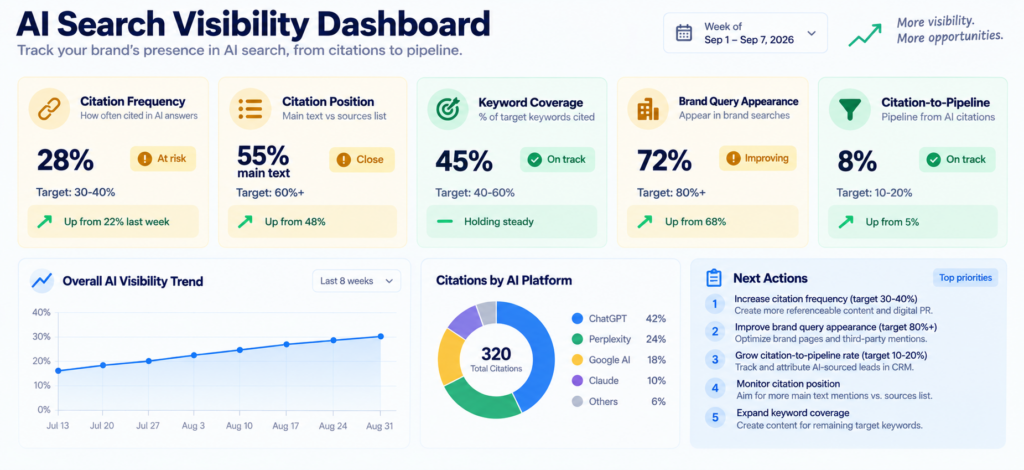
How to Build an AI Search Visibility Dashboard
You need one place to track these metrics weekly.
What to track:
| Metric | Target | Frequency | Tool |
|---|---|---|---|
| Citation frequency (key keywords) | 30-40% | Weekly | Manual search log |
| Citation position (main text%) | 60%+ | Weekly | Manual search log |
| Keyword coverage | 40-60% | Monthly | Spreadsheet |
| Brand query appearance | 80%+ | Monthly | Manual search log |
| Citation-to-pipeline % | 10-20% | Monthly | CRM data |
How to set it up:
Week 1: Create a spreadsheet with your 20 target keywords. List ChatGPT, Perplexity, and Claude as columns.
Week 2: Search each keyword in each AI engine. Mark if you appear (Y/N) and if it is in the main text or sources.
Week 3: Calculate metrics. Set targets.
Week 4: Repeat weekly for citation frequency, monthly for the rest.
Time commitment: 2-3 hours per week for tracking
The Competitive Window Is Closing (Act Now)
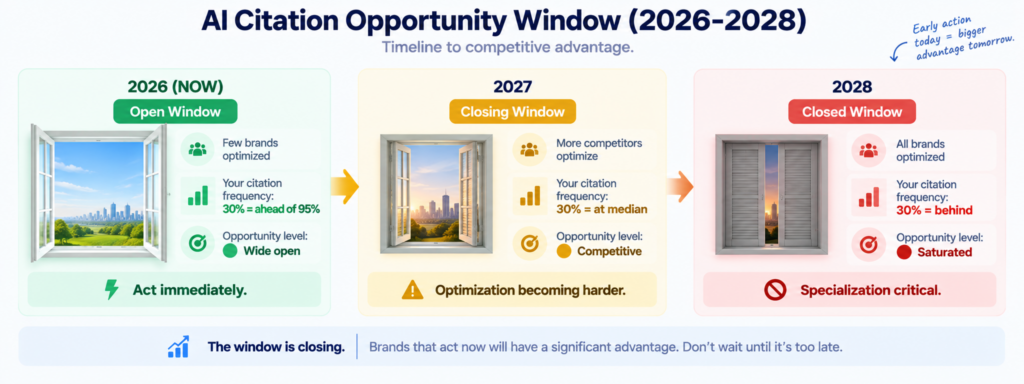
Here’s why timing matters:
Right now (2026), AI search is young. Few brands have optimized for it.
Citation frequency: Most brands get 5-10%. You can reach 30-40% with focused effort.
By 2027-2028:
- More brands will optimize
- AI algorithms will become more sophisticated
- The window to dominate will close
The math:
If you’re cited 30% of the time in 2026, you’re ahead of 95% of brands.
If everyone optimizes and you’re still at 30% in 2028, you’re at the median.
Action now = massive advantage later
How to Use These Metrics to Improve Visibility
Don’t just track. Act.
If citation frequency is low (below 20%):
- Your content isn’t AI-extractable
- Fix: Add FAQ sections, answer capsules, and clear H2s with direct answers
- Reference Post 21 (Schema Markup) for extraction optimization
If the citation position is low (mostly sources list, not main text):
- Your content is cited but not used for the main answer
- Fix: Make your opening paragraphs answer the question directly (not after 3 paragraphs of setup)
- Lead with insight, not context
If keyword coverage is low (below 40%):
- You’re strong on some topics but weak on others
- Fix: Audit which keywords you’re not cited for. Create content for those gaps
- Reference Post 15 (AI Content Strategy) for topic cluster planning
If brand queries don’t cite you:
- Your company information isn’t structured
- Fix: Add the organization schema and ensure your About page has clear company info
- Make sure the schema matches your website content
If citation-to-pipeline is low (below 5%):
- You’re getting citations but not converting them
- Fix: Make sure your CTA is clear in cited content. Add a call-to-action that routes to conversation
Real Question You Can Steal
Use this question to measure AI visibility right now:
Open ChatGPT and search:
“What is the best approach for building a B2B demand generation system from scratch? Who are the leading agencies/experts in this space?”
If you’re cited, congratulations. You have AI visibility.
If you’re not, here’s what to do:
- Look at who IS cited
- Analyze their content (structure, format, length, keywords)
- Create similar content on your own site
- Optimize for extraction (schema, FAQ, answer capsules)
- Re-test in 60 days
What Comes Next in 2027
As AI matures, expect:
More attribution: “Source: Amplio Luma, Rating: 4.8/5, Founded: 2022”
AI will cite more than just content. It will cite company info, ratings, andprofile. reviews.
Personalized answers: Different users will see different citations based on their profile.
This scenario means micro-positioning matters. A founder searching “scaling SDR team” might see different sources than a VP of Sales.
Specialization is critical: By 2027, being cited matters less. Being cited by the RIGHT buyer matters more.
This means your AI visibility strategy needs to target specific buyer personas, not just “more citations.”
The Prompt You Can Use Starting Today
Here’s a prompt you can use in ChatGPT to test this:
“I’m a [your role] at [your company]. We’re trying to [your challenge]. Here are my constraints: [constraints]. What’s the best approach? Who should I be reading or talking to?”
Run this prompt.
See what ChatGPT recommends.
If it recommends you, that’s fantastic.
If it doesn’t, analyze the answers it gives and optimize your content to match.
That’s AI search visibility in practice.
AI search visibility is the competitive advantage of 2026-2027. Measurement is the foundation.
Let’s audit your AI visibility and build your strategy.