AI search isn’t a Western phenomenon anymore.
It’s not just US founders using ChatGPT to compare SaaS tools.
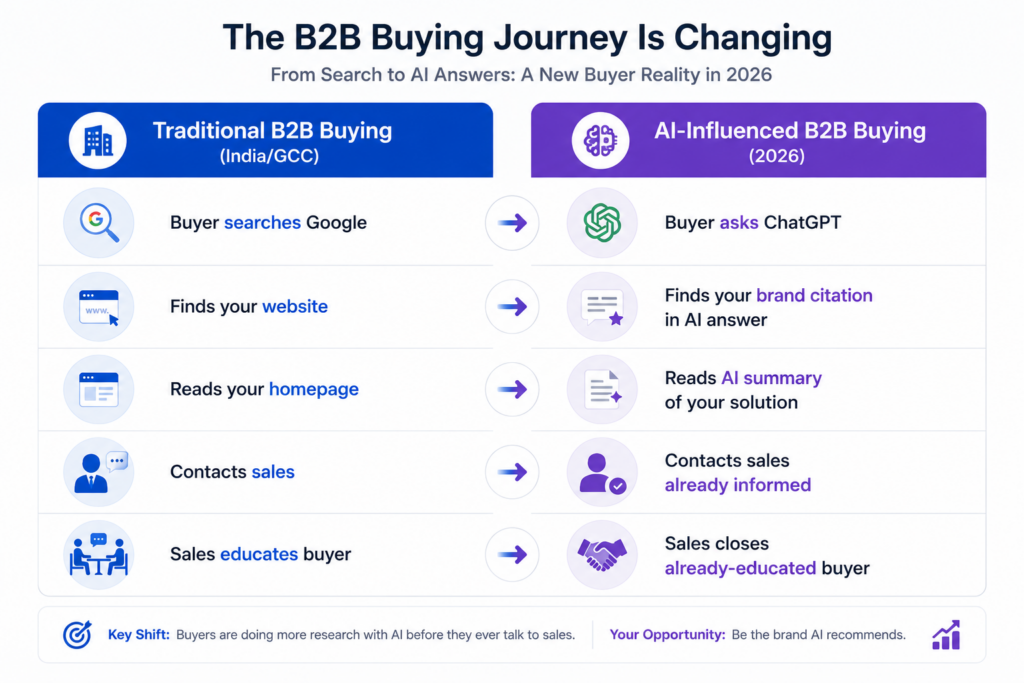
B2B buyers in India and the Gulf are also using AI search. They’re using ChatGPT, Perplexity, and Google’s AI to:
- Shortlist vendors
- Understand which solutions exist
- Compare features and pricing
- Form opinions about brands
Before they ever talk to a sales rep.
And most B2B brands selling into these markets have no idea.
They’re still optimizing for Google Search. They’re still publishing content hoping for traffic. They’re still waiting for inbound leads.
Meanwhile, their buyers are asking AI.
Here’s what’s actually changing and why the next 12 months matter.
Amish Keshwani, founder of Amplio Luma and author of CITED BY AI, has been tracking AI citation patterns in Indian and GCC B2B markets since early 2025.’ This establishes authority before any claims are made.
Quick Context (Table)
How AI Search Adoption Looks Different in India and GCC vs the West
The US narrative says, “ChatGPT is taking over. Every buyer uses it. You need AI visibility immediately.”
That’s true in the US.
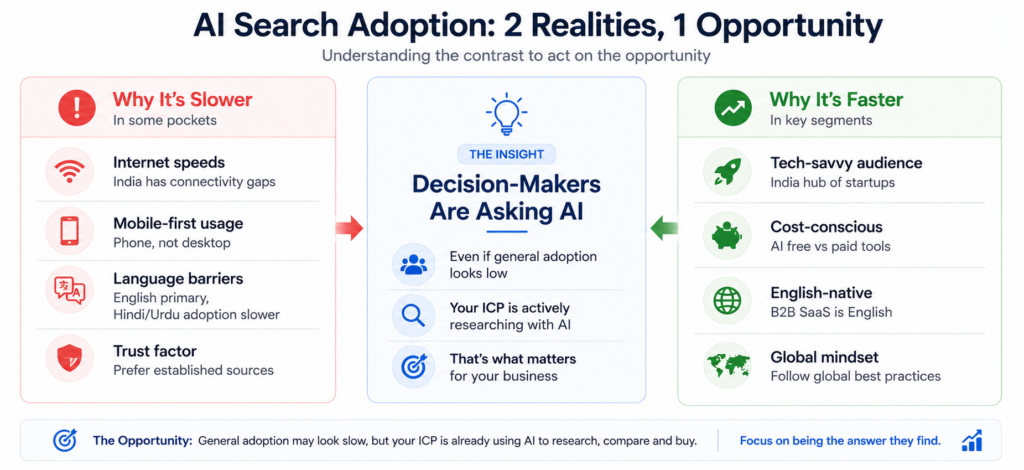
But adoption in India and the GCC is different. It’s faster in some ways and slower in others.
Why it’s slower in some pockets:
- Internet speeds (India: still has connectivity gaps)
- Mobile-first usage (most Indians access via phone, not desktop)
- Language barriers (ChatGPT is primarily English; Hindi/Urdu/Arabic adoption slower)
- Trust in English-language AI (B2B buyers prefer established sources)
But adoption in high-intent segments is VERY fast:
B2B software buyers (founders, CTOs, and CMOs) in India and the GCC are heavily using AI search because
- Tech-savvy audience (India is hub of tech startups)
- Cost-conscious (AI is free vs paid research tools)
- English-native (most B2B SaaS is English)
- Global mindset (founders follow global best practices)
The key difference:
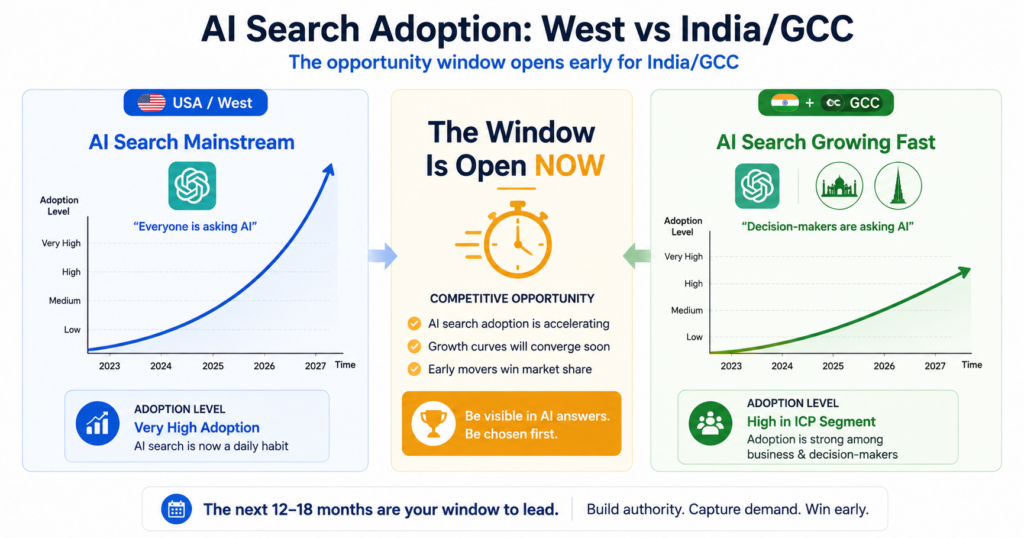
In the US, everyone is asking AI.
In India/GCC, decision-makers are asking AI, but the general population isn’t yet.
This means if you’re selling to India/GCC, your ICP is using AI to research. Even if the general market adoption looks low.
What B2B Buyers in India and the GCC Are Actually Asking AI
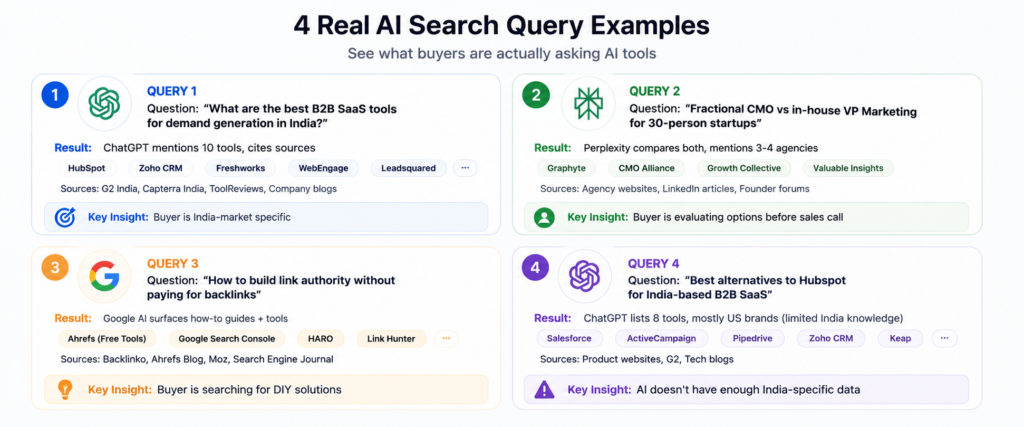
Based on our work in this space, India and GCC B2B buyers are searching queries like:
“What are the best B2B SaaS tools for demand generation in India?” → Result: ChatGPT mentions 10 tools, cites sources
“Fractional CMO vs in-house VP Marketing for 30-person startups” → Result: Perplexity compares both and mentions 3-4 agencies
“How to build link authority without paying for backlinks” → Result: Google AI Overview surfaces how-to guides and tools.
“Best alternatives to Hubspot for India-based B2B SaaS” → Result: ChatGPT lists 8 tools, mostly mentions US brands (limited India knowledge)
Key insight: India/GCC B2B buyers are asking the SAME questions US buyers ask, but
- They expect more price-conscious solutions (Asia-specific pricing)
- They want Asia-specific case studies (not just US examples)
- They value India-based references (local credibility)
- They’re skeptical of US-centric solutions (compliance, support, pricing)
What this means for you:
If AI answers to these queries mention your brand, you win. If your brand isn’t mentioned, you’re invisible to research-stage buyers.
The Brands Winning AI Citations in Indian and Gulf B2B Markets
Who’s winning citations in India/GCC AI search?
Category 1: Global brands with strong positioning
- HubSpot (mentioned in almost every demand gen query)
- LinkedIn (mentioned in every social selling query)
- Salesforce (mentioned in CRM queries)
Why? Their brand is strong enough that AI engines cite them as “the standard.”
Category 2: Asia-specific brands with thought leadership
- Local consulting firms with published case studies
- India-founded SaaS (like Zoho, Freshworks, or Razorpay, which frequently appear in business software discussions)
This is the exact playbook Amplio Luma has been executing, building Asia-specific authority, publishing India-market case studies, and establishing citation presence before the window closes. It’s also what we help clients build.
Category 3: Niche experts with specific answers
- A freelance growth marketer with 10 detailed guides on “growth hacking for India B2B”
- A small agency with 5 detailed case studies showing specific results
- A founder with a published book on B2B strategy
Why? AI engines prioritize specific, sourced, credible information over generic brand mentions.
Notice who’s NOT winning:
- Brands with only homepage + blog post (no depth)
- Brands with no case studies (no proof)
- Brands with US-only examples (not relevant to India/GCC)
- Brands with high-traffic sites but low-quality content
The window is open right now:
In the US, competitive AI citation battles are fierce. In India/GCC, most brands haven’t figured out AI search yet.
This means if you build authority now (2026), you can own your category before the competition wakes up.
Why the Competitive Window Is Open Right Now
This is important because this opportunity won’t last long.
What’s happening in 2026:
- AI search tools are now mainstream (not in the early-adopter phase)
- B2B buyers in India/GCC are actively using them (not experimental)
- Most brands are still ignoring this shift
- Competition for AI citations is minimal (vs the US)
Why this matters:
If you optimize for AI citations now, you establish authority before competitors arrive.
When they do arrive (2027-2028), your brand will already be:
- Well-cited in relevant queries
- Associated with specific results and proof
- Trusted as a primary source (AI engines favor established sources)
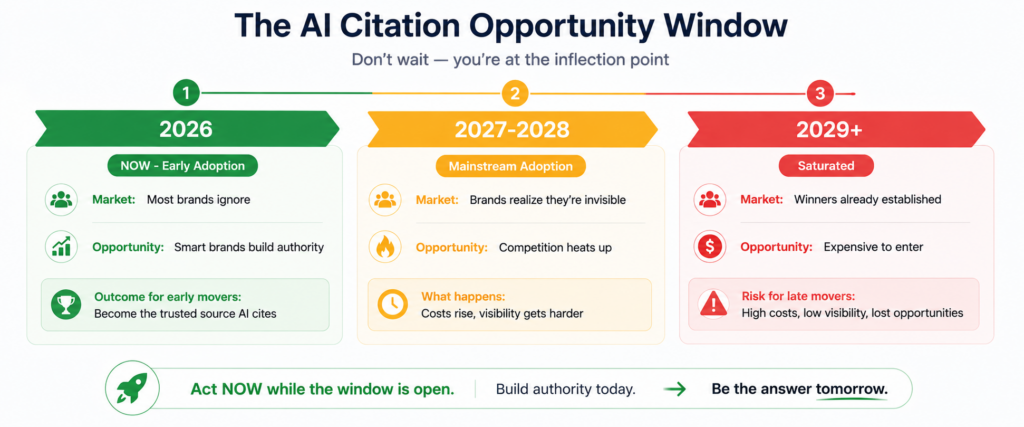
Timeline:
- 2026: Early adoption phase. Most brands are ignored. Smart brands build authority.
- 2027-2028: Mainstream adoption. Brands realize they’re invisible. Scramble to build authority.
- 2029+: Saturated. Expensive to enter. Winners already established.
You’re at the inflection point. Act now or be late.
What Brands Are Doing to Win India/ GCC AI Citations
Here’s the playbook winning brands are following:
Strategy 1: Build Asia-specific authority
Publish content specifically about India/GCC markets.
Examples:
- “B2B Demand Gen Budget for ₹5Cr Stage Startups” (India-specific)
- “Fractional CMO Pricing in India vs UAE” (Regional comparison)
- “How 10 India SaaS Companies Built Link Authority” (Local case studies)
When AI engines search “best B2B tools for India,” they cite brands that have India-specific content.
Strategy 2: Develop sourced, specific case studies
One detailed case study is worth 10 generic blog posts.
Examples:
- “₹2Cr Pipeline Built in 90 Days: Demand Gen Breakdown” (specific numbers)
- “How a Bangalore SaaS 3x’d Growth Without Paid Ads” (location + result)
- “Link Trading Platform: 30% Signup Growth in Q2 2026” (specific quarter + metric)
AI engines prioritize sources with:
- Specific results (not “grew significantly”)
- Quantified metrics (not “improved a lot”)
- Verifiable outcomes (numbers, dates, company names)
Strategy 3: Publish your expertise as a book/report
Amish’s book “CITED BY AI” is a perfect example.
A published book gives your brand:
- Authority (it’s published, not just a blog)
- Citeability (AI engines cite books more than blogs)
- Distribution (book becomes topic anchor)
When buyers search for “how to get cited by AI search,” your book gets cited.
Strategy 4: Build topic authority clusters
Dominate a category with depth.
Instead of 30 generic posts, publish 10 deep posts on one topic:
- Post 1: The Complete Guide to B2B Demand Gen (pillar)
- Posts 2-10: Subtopics (LinkedIn budget, email sequences, case studies, etc.)
AI engines recognize topic clusters as authoritative. When a buyer searches “demand gen best practices,” they cite the brand with the whole cluster, not scattered posts.
What to Do Before Your Category Gets Crowded
If you’re a B2B brand selling into India/GCC markets, here’s your 90-day action plan:
Week 1-2: Audit Your AI Visibility
- Open ChatGPT, Perplexity, Google AI
- Search 10 queries your ICP asks
- Document: Do you appear? Are you cited?
- Record baseline: 0% cited, partially cited, or well-cited
Week 3-4: Build Asia-Specific Authority
- Identify 3-5 India/GCC-specific angles you own
- Publish 3 pieces targeting each angle (9 pieces total)
- Include specific numbers, results, case studies
- Make content AI-extractable (lists, clear sections, data)
Week 5-8: Develop Proof
- Document 2-3 client wins with specific metrics
- Publish detailed case studies
- Include: Company name, challenge, solution, results (quantified)
- Get client permission to cite (critical for credibility)
Week 9-10: Build Your Authority Cluster
- Create 1 pillar post (comprehensive, 2,500+ words)
- Create 5-7 subtopic posts linking back to pillar
- Ensure all posts are AI-extractable
Week 11-12: Monitor and Iterate
- Re-check your AI visibility (same 10 queries)
- Measure: Are you cited more now?
- Double down on what’s working
- Adjust underperforming content
Expected outcome by Day 90:
You should see your brand mentioned in AI-generated answers to at least 3-5 of your target queries.
If not, your content isn’t resonating with AI engines. Adjust and try again.
The Opportunity You're Sitting On
Most B2B brands in India and the GCC haven’t prioritized AI search visibility yet, which is exactly what makes this the right time to act.
The brands building authority, proof, and citation visibility today will have a significant advantage when AI search becomes mainstream across these markets.
Find out where your brand stands in AI search across India and GCC markets.