The company had traffic. They had MQLs. What they didn’t have was a pipeline.
For a 50-person B2B AI sales tool, that’s a death sentence.
They were generating 300-400 MQLs per month. The CMO celebrated the volume. The VP of Sales pulled his hair out. 85% of those MQLs were garbage, wrong company size, wrong timeline, never intended to be bought.
Real SQLs (Sales Qualified Leads)? 5-10 per month. Conversion to customer? 2-3%.
The pipeline was flat. The CEO was asking uncomfortable questions. The marketing spend was at risk.
Then we diagnosed the problem: They were optimising for the wrong metric.
Here’s what we changed, and the numbers that followed.
Quick Situation Summary
The Client Situation (Before)
Company: 50-person B2B AI sales tool
Business Model: Outbound sales platform with AI-powered prospecting
Problem: Pipeline stalled despite growing traffic and MQLs
Metrics before:
- Website traffic: 15,000 visitors/month (healthy)
- MQLs: 400/month (looks good on a spreadsheet)
- SQLs to sales: 5-10/month (decimated by sales filtering)
- Customer acquisition cost (CAC): High (wasting money on unqualified leads)
- Pipeline growth: Flat (not moving month-to-month)
What the numbers actually said:
The marketing team was hitting its goals (400 MQLs target ✓). But sales were frustrating. They spent 80% of their time on unqualified conversations. Prospects didn’t have a budget. Didn’t have a timeline. Didn’t actually need the solution.
CEO to CMO: “Traffic is up, MQLs are up, but why is the pipeline flat?”
CMO to Sales: “You’re not qualifying leads properly.”
Sales to CMO: “These aren’t leads. They’re noise.”
Both were right. But the real problem was upstream: Marketing was optimizing for the wrong metric.
Root Cause: Optimizing for the Wrong Metric
The company’s lead-scoring model was based on engagement:
- Downloaded a whitepaper? +5 points
- Open an email? +3 points
- Visited pricing page? +10 points
- Attended a webinar? +15 points
Hit 30 points = MQL. Automatic hand-off to sales.
The problem: None of those behaviours predict buying intent.
Someone downloads a whitepaper could be:
- A researcher from a competitor (gathering intel)
- A student writing a paper (not in target market)
- An analyst evaluating the category (maybe interested, maybe not)
- An actual prospect in discovery (might buy in 12 months)
All of them count as MQLs. All get handed to sales. All waste sales time.
What was actually missing:
The model had zero signals of intent. It never asked:
- Does this company have a stated pain point we solve?
- Do they have an allocated budget?
- Is there a timeline (this quarter, next quarter)?
- Can they actually make the decision?
Sales knew this. They had been telling marketing for 6 months: “Most of these aren’t qualified.”
Marketing kept responding: “But they fit the ICP and engaged with content.”
Two different definitions of “qualified.” Two teams pointing fingers.
The Revenue Engine Approach We Implemented
We diagnosed the problem in a 30-minute call. The fix was simple: Align on one definition of qualified, the sales definition.
Step 1: Interview sales to redefine qualified (Week 1)
We asked the sales team: “When you say someone is qualified, what do you mean?”
Answers:
- “They mentioned budget in conversation”
- “They said they need to decide this quarter or next quarter”
- “They described a specific problem we solve”
- “They asked about pricing or requested a demo”
So we built a new scoring model around those signals.
Step 2: Rebuild the lead-scoring model (Week 2-3)
Old model: Engagement = Qualified
New model: Explicit intent signals = Qualified
New scoring:
- Mentions budget: +10 points
- Mentions timeline: +10 points
- Mentions specific problem: +15 points
- Requests demo or pricing: +20 points
- Had a conversation with SDR: Automatic SQL (skip scoring)
Way harder to automate. Required manual evaluation. That’s good — it forced rigor.
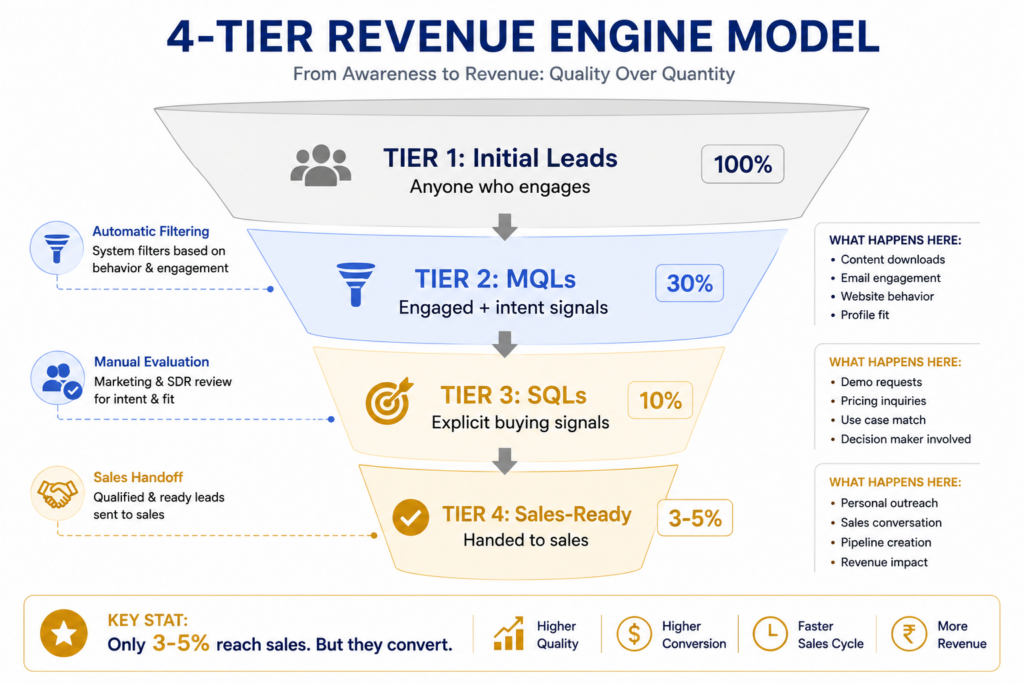
Step 3: Restructure lead management (Week 4)
- Tier 1: Initial leads (anyone who engages)
- Tier 2: MQLs (engaged + intent signals)
- Tier 3: SQLs (explicit buying signals)
- Tier 4: Sales-ready (all 3 signals + handoff)
Sales only got Tier 3 leads. No more noise. No more unqualified handed-offs.
Step 4: Measure and iterate (Ongoing)
Tracked:
- MQL → SQL conversion by source (which channels produce high-quality MQLs?)
- SQL → Customer conversion (which lead characteristics predict closes?)
- Time to close (faster after filtering early)
- CAC by source (which channels deliver efficient customers?)
After 30 days: Data showed which sources produced the best MQLs. We doubled down on those. Killed the low-quality sources.
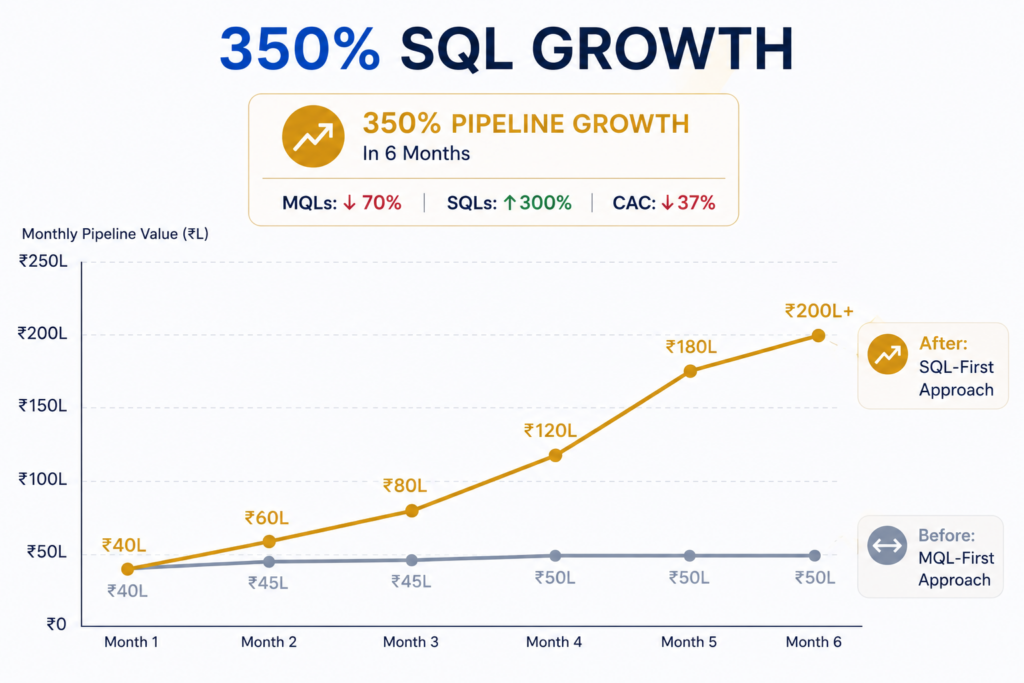
Results: 350% SQL Growth, 37% CAC Reduction
Month 1-2: First signals visible
- MQL volume dropped 30% (as intended filtering out noise)
- SQL conversion rate jumped from 2-3% to 12%
- Sales satisfaction increased (“These are actually qualified”)
Month 3-4: Inflection point
- MQL volume down 50-60% (continuing to filter)
- SQL conversion rate hit 18-20%
- Pipeline started growing for first time in 6 months
Month 5-6: Full results
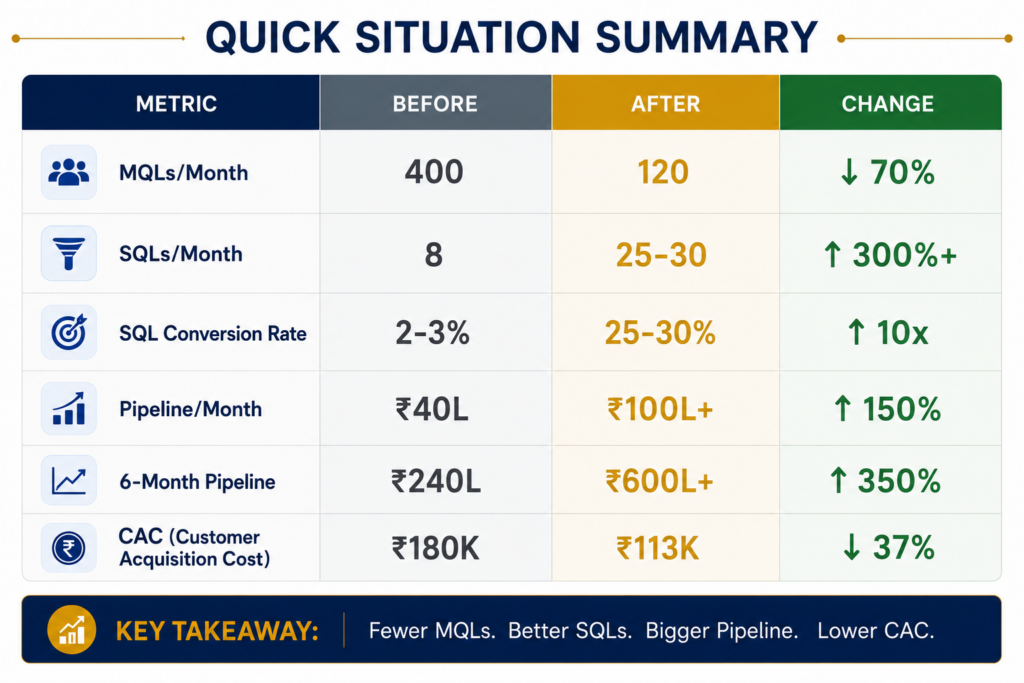
- MQLs: Down from 400/month to 120/month (70% reduction ✓)
- SQLs: Up from 8/month to 25-30/month (300%+ increase ✓)
- SQL Conversion Rate: 25-30% (10x improvement vs old model ✓)
- Pipeline: ₹40L/month → ₹100L+/month (150% increase per month ✓)
- 6-Month Pipeline Total: ₹600L+ (vs ₹240L before = 350% growth ✓)
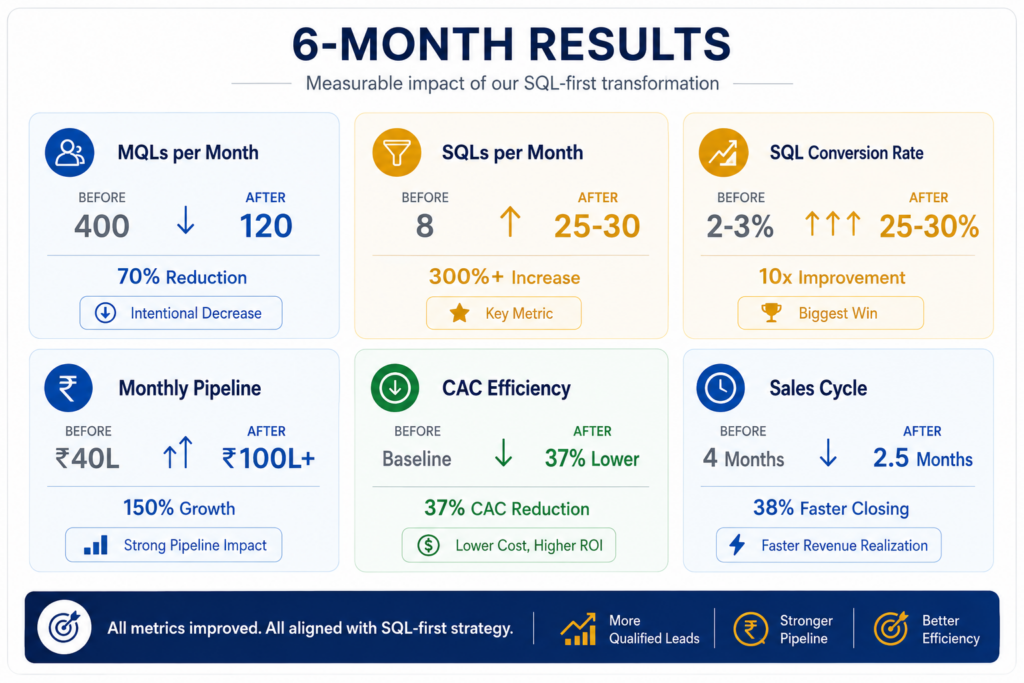
- CAC: Reduced 37% (fewer wasted conversations, faster closes)
- Sales Satisfaction: “These leads actually convert. For the first time, sales and marketing are aligned.”
The Quote: What Changed
VP of Sales:
“For the first time, marketing and sales agreed on what ‘qualified’ meant. We went from spending 80% of our time on unqualified conversations to focusing on real opportunities. The pipeline didn’t just grow, the quality of conversations changed. These are actual deals.”
Key Learnings (What We Learned from This Win)
Learning 1: Volume doesn’t mean quality
The company was generating 400 MQLs/month. That looked like success. But 85% were unqualified. Lower volume + higher quality trumps high volume + low quality every single time.
Action: Stop counting MQLs. Start counting SQLs. Measure MQL → SQL conversion rate by source. Optimize for quality, not volume.
Learning 2: Align on ONE definition of qualified
Marketing and sales had different definitions. Marketing said “engaged with content = qualified.” Sales said “mentioned budget + timeline + problem = qualified.”
Sales were right.
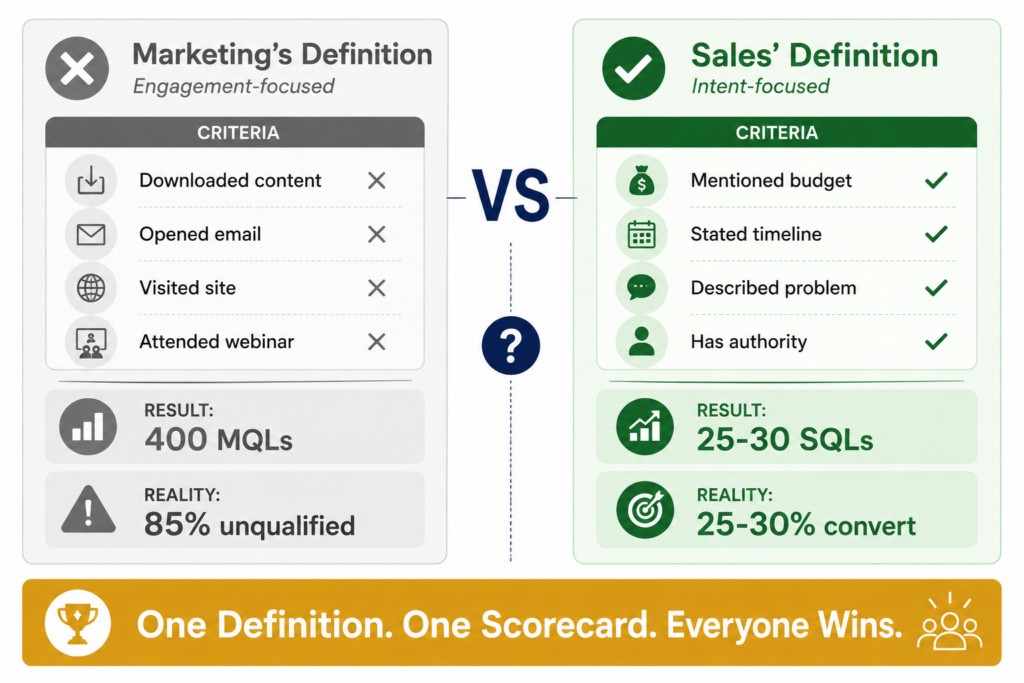
Action: Interview sales. Find out their real definition of qualified. Build your model around it. Make marketing and sales agree on one scorecard.
Learning 3: Engagement ≠ Intent
Downloading content, opening emails, visiting pricing pages, none of that predicts buying intent. Intent is explicit: “I need to solve this. I have a budget. I’m deciding this quarter.”
Action: Stop scoring for engagement. Score for intent signals. Look for language that shows decision-making urgency and budget awareness.
Learning 4: Shorter sales cycles, faster closes
When you send sales only actual opportunities, deals close faster. The sales team didn’t waste 80% of their time qualifying. They sold.
The average sales cycle went from 4 months to 2.5 months.
Action: Shorter sales cycles = less CAC drag = higher margins. Better lead quality directly improves unit economics.
Why This Works (And Why Most Companies Don't Do It)
This approach works because it aligns incentives.
Marketing is measured on MQLs. Sales is measured on closed deals. Different metrics = different behavior.
When you flip marketing’s KPI from “MQLs generated” to “SQLs delivered that convert,” behavior changes immediately.
Most companies don’t do this because:
- It’s uncomfortable (you have to admit the old metric was wrong)
- It requires manual work (you can’t fully automate intent scoring)
- It shows lower volume in the short term (marketing looks worse before it looks better)
But the companies doing this are the ones winning.
If this looks like your pipeline problem, high MQLs, low SQLs, flat revenue, let’s talk. We’ll spend 30 minutes diagnosing your lead quality gap and show you exactly what changed this company’s pipeline.