Most B2B marketing teams optimize for MQLs because they’re easy to count. You hit the target, 500 MQLs this month and you can celebrate. But MQLs and revenue are not the same thing. And your sales team knows it.
You’re generating leads. Marketing Qualified Leads. They fill out forms, download papers, and click emails. By every marketing metric, they’re engaged. Then they hit sales, and 85-90% go dark. Sales says they’re unqualified. You say they’re the wrong criteria. Meanwhile, the pipeline stalls.
The problem isn’t your marketing team. The problem is the metric.
The companies winning right now aren’t optimizing for MQL volume. They’re optimizing for SQL quality. And the difference is dramatic. One company we worked with shifted from MQL-first to SQL-first, generating 350% more pipeline in six months without increasing marketing spend.
Here’s what changed.
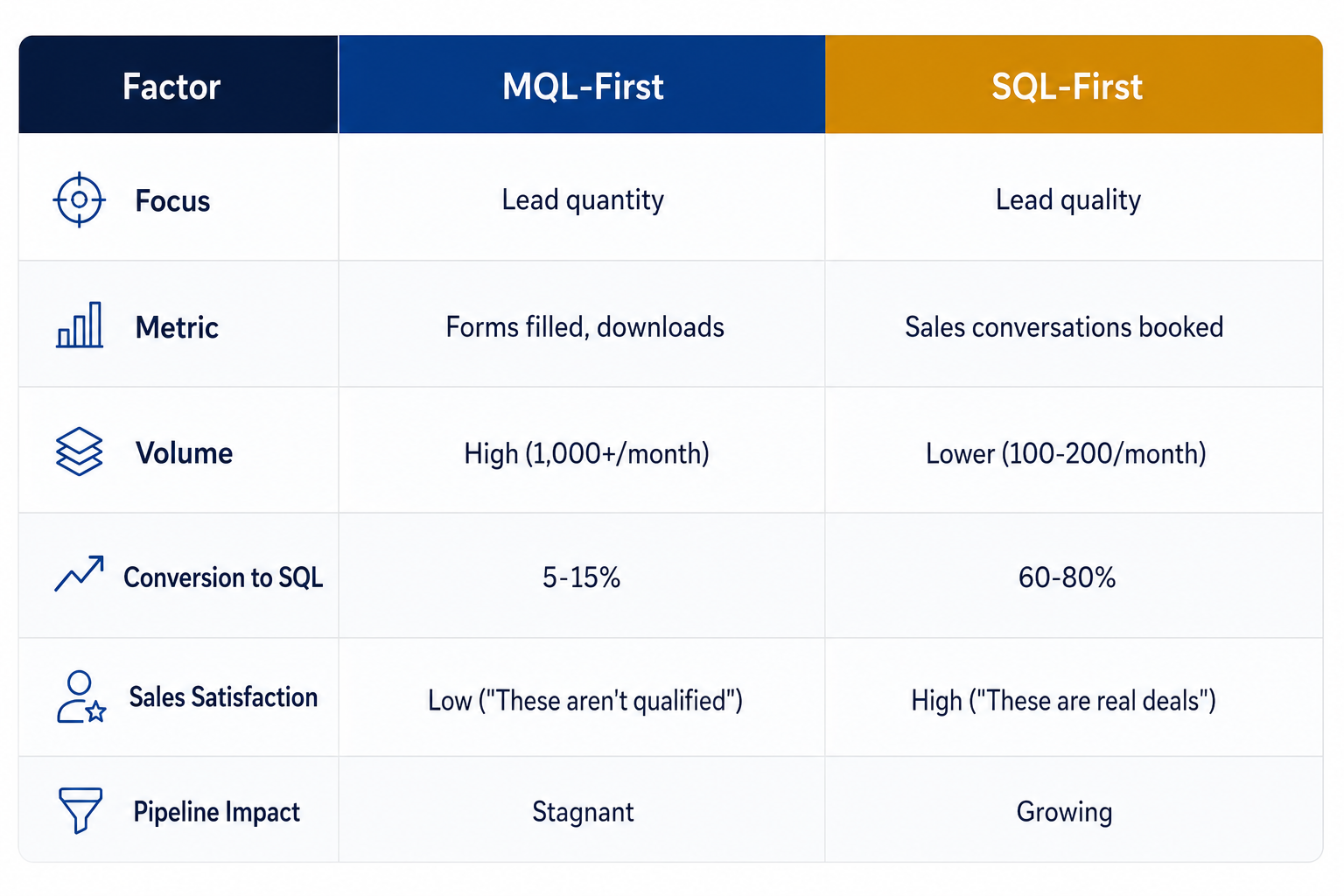
Quick Comparison Table
What MQLs and SQLs Actually Mean
Let’s define these clearly.
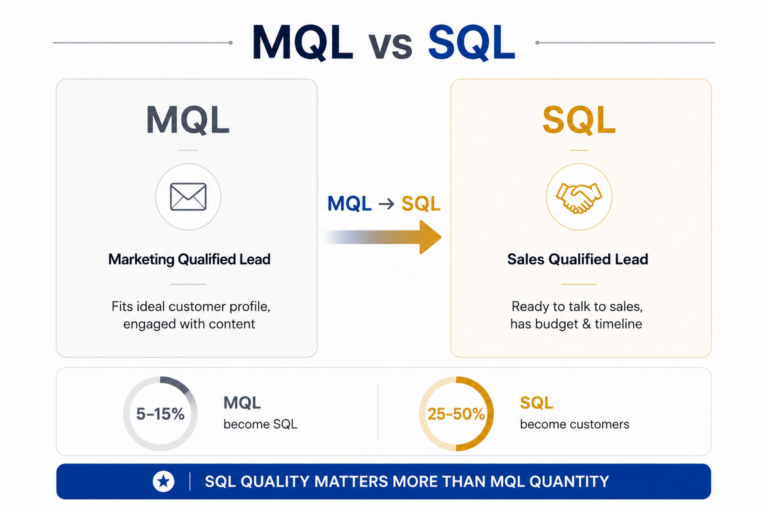
MQL = Marketing Qualified Lead
A marketing-qualified lead is someone who:
- Fits your ideal customer profile (company size, industry, role)
- Engaged with your content (downloaded something, attended webinar, opened emails)
- Meets the criteria YOUR MARKETING TEAM decided was “qualified”
Examples: A VP of Sales at a 50-person SaaS company who downloaded your “guide to demand gen” is an MQL. A marketing manager who signed up for your newsletter is an MQL. They engaged and fit the profile.
The problem: Engaging with content ≠ buying readiness.
SQL = Sales Qualified Lead
A sales-qualified lead is someone who:
- Fits your ideal customer profile
- Has shown explicit buying intent (asked about pricing, requested a demo, mentioned a timeline)
- Has decision-making authority (or access to it)
- Has a stated business problem you solve
Examples: A VP of Sales who scheduled a 30-minute call to discuss your outbound sales platform is an SQL. A marketing manager who filled out a “request a demo” form with their budget in hand is an SQL. They’re ready to have a sales conversation.
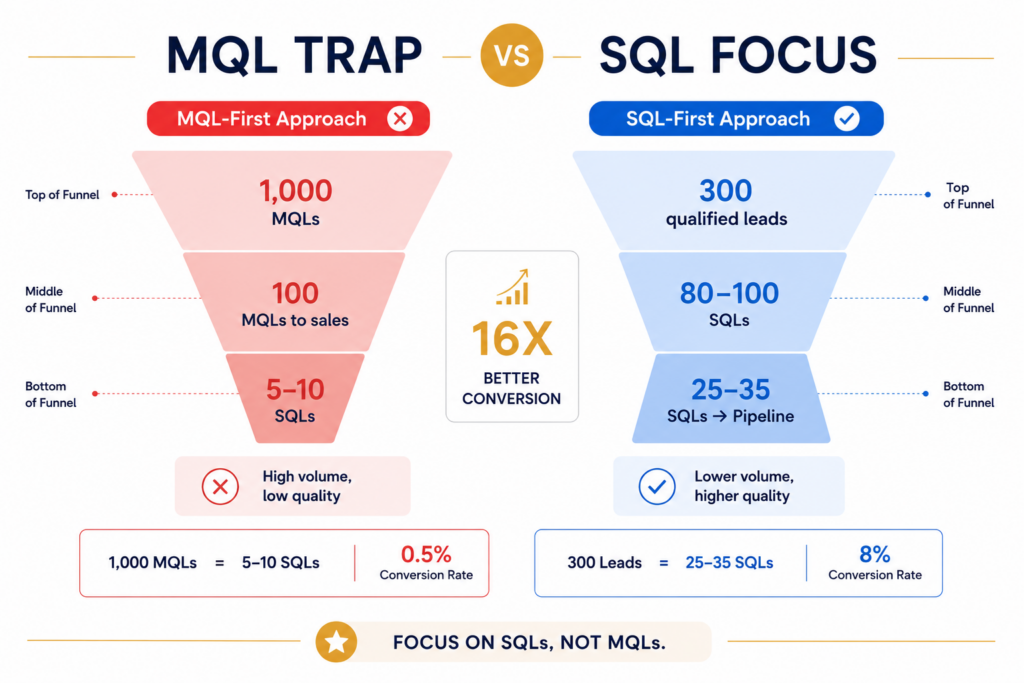
The reality: SQL-to-customer conversion is 25-50% (depending on qualification rigor). MQL-to-customer is 2-5%.
The gap is massive.
Most B2B marketing teams obsess over MQL volume. They measure success by “MQLs generated.” They celebrate hitting 1,000 MQLs in a month. Sales gets those 1,000 and finds 850-900 are unqualified: wrong company size, wrong timeline, or never intended to buy.
The other 100-150 are actual conversations. Those become SQLs.
So when marketing says “We generated 1,000 MQLs,” what they really delivered was 100-150 actual sales conversations. That’s a 10-15% conversion rate. And everyone blames everyone else.
The MQL Trap (And Who Set It)
How did B2B marketing teams get stuck optimizing for MQLs? Simple: MQLs are easy to measure.
You can count MQLs. A form submission is an MQL. A webinar attendance is an MQL. An email open followed by a click is an MQL. Your marketing automation platform tracks all of it. You can measure, report, and celebrate.
You cannot measure intent. You cannot measure readiness to buy. You can guess, but you can’t prove it.
So marketing teams built scoring models that said, “If someone has 20 engagement points, they’re qualified.” Engagement is easy to track. Points are easy to assign. The model is clean, mathematical, and objective.
The problem: Engagement is not intent.
Someone downloading your ebook could be:
- A researcher doing competitive analysis (no intent to buy)
- A student researching the topic (not even in target industry)
- A competitor spying on you (definitely not buying)
- An actual prospect in early discovery (might buy in 18 months)
All of them count as MQLs. All generate engagement points. All hit your 20-point threshold.
Who set this trap?
Marketing tech vendors. They built platforms that measure engagement, since engagement is easier to track than intent. Then they sold this data to marketers: “Here’s your MQL report.” And marketing teams built their KPIs around it.
Sales got tired of chasing unqualified leads. They built their own criteria: “A lead is qualified if they mention budget, timeline, and a specific problem.”
Now you have two definitions of “qualified”: marketing’s (engaged) and sales’ (intent to buy). And they don’t match.
The companies winning are the ones who said, “We’re going to align on ONE definition of qualified, and it’s sales’ definition. Marketing’s job is to deliver leads that sales says are qualified.”
How to Redefine Lead Quality With Sales
Here’s the uncomfortable truth: Your sales team is right about MQLs.
They’ve been telling you all along that most of your MQLs aren’t qualified. You probably haven’t been listening because the data contradicts it. Your marketing automation platform says you generated 500 MQLs. Sales says 450 were garbage.
One of you is wrong. And it’s marketing.
The fix: Stop letting marketing define qualified. Let sales do it.
Step 1: Ask sales to define what “qualified” actually means for them.
Not what marketing thinks is qualified. What they would actually call a SQL (Sales Qualified Lead).
The answers will probably be:
- “A conversation where they mention a specific pain point we solve”
- “Someone with explicit budget allocated”
- “A stated timeline (this quarter or next quarter, not ‘sometime’) “
- “Someone who can actually make the decision or influence it.”
Step 2: Build a lead scoring model around THOSE criteria, not engagement.
Stop scoring for downloads. Stop scoring for email opens. Start scoring for:
- Mention of budget (10 points)
- Mention of timeline (10 points)
- Mention of a specific problem (15 points)
- Request for demo or pricing (20 points)
- Conversation with sales (= automatic SQL, skip the scoring)
This model is much harder to automate. You can’t code it entirely in your marketing platform. You need manual evaluation. That’s OK. That’s actually good.
Step 3: Align with sales on lead handoff criteria.
A lead doesn’t hit “SQL” status in your system until sales agrees it’s an SQL. Not when it hits a point threshold. When sales says, “This is qualified.”
This means:
- Marketing still generates awareness and engagement
- But qualification happens through explicit sales evaluation
- Not through a black-box algorithm
Step 4: Measure MQL-to-SQL conversion rates by channel and traffic source.
If LinkedIn ads generate 50 MQLs and 15 become SQLs (30% conversion), that’s great. If organic search generates 200 MQLs and 5 become SQLs (2.5% conversion), something’s wrong with the source.
Now you can optimize the sources that produce qualified leads, not just engaged leads.
Building a Pipeline-First Scoring Model
A pipeline-first scoring model flips the entire approach. Instead of asking “Is this lead engaged?” you ask “Will sales want to talk to this person?”
Here’s what it looks like:
Tier 1: Lead (Initial Engagement)
- Anyone who engages with your content
- No scoring threshold
- They’re in your funnel, but not yet qualified
Tier 2: Marketing Qualified Lead (Intent Signals)
- Visited pricing page multiple times
- Downloaded multiple assets (not just one)
- Attended a webinar AND requested follow-up
- Signed up for a free trial or demo request
- Only 20-30% of initial leads reach this tier
Tier 3: Sales Qualified Lead (Explicit Buying Signals)
- Mentioned budget in communication
- Mentioned timeline (this quarter, next quarter)
- Asked specific product questions indicating evaluation
- Fit clear customer profile on key criteria
- Only 5-10% of MQLs reach this tier (50%+ of your SQLs)
Tier 4: Sales Ready (Hand to Sales)
- When a lead reaches Tier 3 AND meets minimum threshold of explicit signals
- Sales development rep (SDR) or AE takes over
- Lead enters sales pipeline
The metric that matters: How many leads from each tier convert to customers.
Tier 3 → Customer conversion: 20-40% Tier 2 → Customer conversion: 5-10% Tier 1 → Customer conversion: 1-2%
Most companies obsess over Tier 1 volume. Winners obsess over Tier 3 quality.
What this approach means for your team:
- Marketing’s job: Drive Tier 1 and Tier 2 volume efficiently
- Sales’s job: Evaluate and convert Tier 3 to customers
- Everyone’s job: Align on what Tier 3 looks like
What the Shift Looks Like in Practice (Case Study: 350% SQL Growth)
We worked with a B2B AI sales tool (50 people, $3M ARR) that was stuck in the MQL trap.
The situation:
- Marketing was generating 300-400 MQLs per month
- Sales was converting 5-10 of them to customers
- Sales spent 80% of time on unqualified conversations
- Pipeline growth stalled
The marketing team was crushing it on metrics: high volume, strong engagement. But sales was frustrated. The CEO was frustrated. Marketing budget was at risk because “leads don’t convert.”
What we changed:
- Redefined “qualified” with sales (explicit signals only: budget, timeline, pain point)
- Rebuilt the scoring model to reward intent, not engagement
- Created SQL tier — leads only moved to SQL when they showed all 3 signals
- Shifted marketing focus from MQL volume to SQL quality
The results:
- MQL volume dropped from 400/month to 120/month (down 70%)
- SQL conversion rate went from 2-3% to 25-30% (10x improvement)
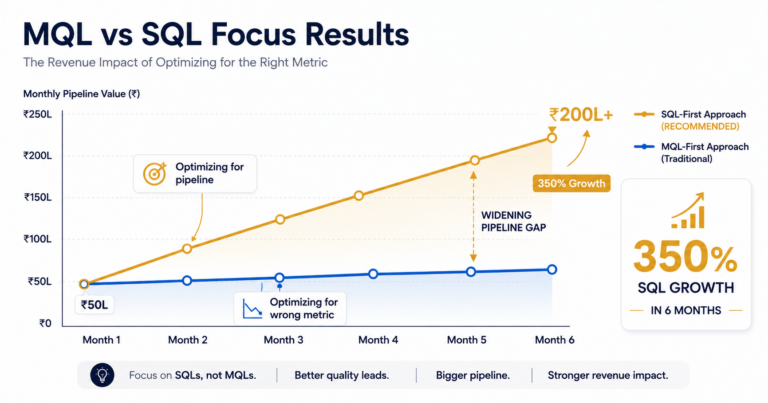
- Pipeline grew from ₹40L/month to ₹100L+/month (150% growth)
- Sales conversion rate improved (focused on real opportunities)
- Sales cycle time fell from 4 months to 2.5 months
- Over 6 months: 350% SQL growth, same marketing spend
See how we rebuilt a pipeline engine from MQL-first to SQL-first 350% growth
The dramatic difference: They stopped optimizing for the wrong metric.
What they told us: “Our sales team finally stopped complaining about lead quality. Because the leads we send them actually convert. For the first time, marketing and sales aligned on what ‘qualified’ means. And everything changed.”
Three Things to Check This Week
You don’t need a 90-day overhaul to start. Just check three things:
- Ask your sales team directly: “What percentage of our MQLs do you consider actually qualified?”
If they say 20% or less, you have an MQL definition problem. Not a demand gen problem.
- Look at your last 50 MQL-to-customer conversions. What do the winners have in common?
Did they mention budget? Timeline? A specific problem? Note the pattern. That pattern is what actually qualifies a lead. Build your new scoring around it.
- Pull up your MQL → SQL conversion rate by channel (LinkedIn, organic, webinar, etc.)
Which sources produce the highest-quality MQLs? Double down on those. Kill the channels that produce 1-2% SQL conversion.
These three checks take 2 hours and will show you exactly where the problem is.
If your sales team is drowning in unqualified leads, this is the exact problem we solve at Amplio Luma. Let’s spend 30 minutes diagnosing your lead quality gap; no pitch, just diagnosis. See how we helped the AI sales tool generate 350% more pipeline.
See the full B2B demand gen playbook for 15-100 person companies