Demand gen advice is written for two audiences: enterprise with $500K+ budgets or solo founders bootstrapping on a shoestring.
There’s almost nothing for you.
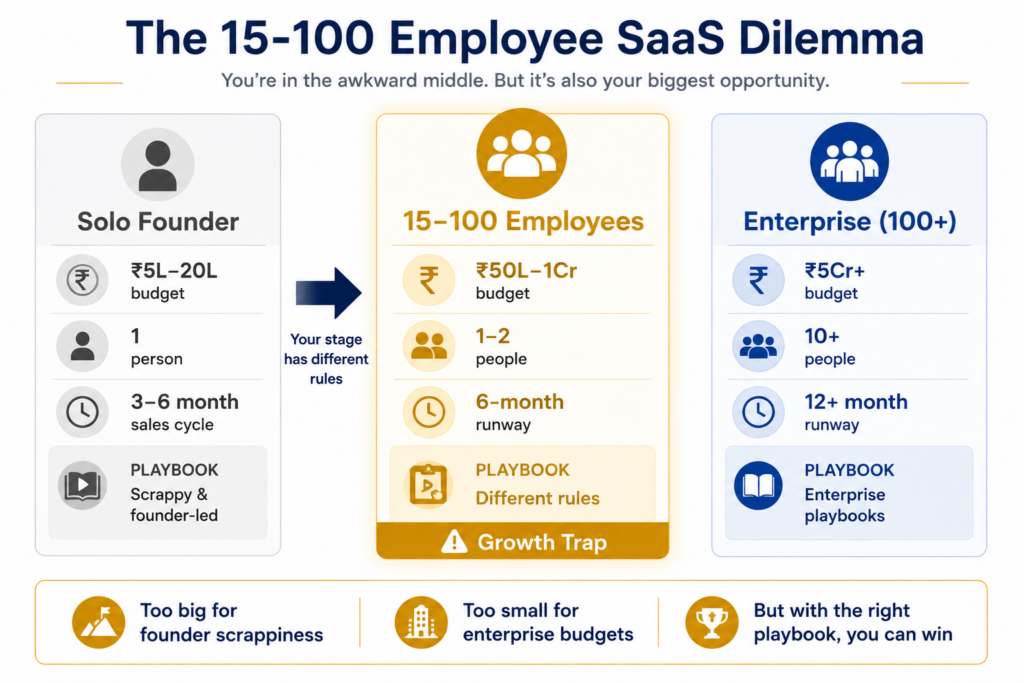
You’re 30 people. You have an annual marketing spend of ₹50L–1Cr. You have 6 months to prove the pipeline before the board asks uncomfortable questions. Your competitors are raising Series A and spending 3x what you have. Your older peers already own the market.
You’re in the hardest spot in B2B SaaS. Too big to scrappy. Too small to enterprize. Too resource-constrained to follow the playbooks written for better-capitalized companies.
This post is for you.
Here’s the playbook that actually works at 15–100 employees. Not some theoretical framework. Real channels. Real budgets. Real sequencing.
Quick Stage Context
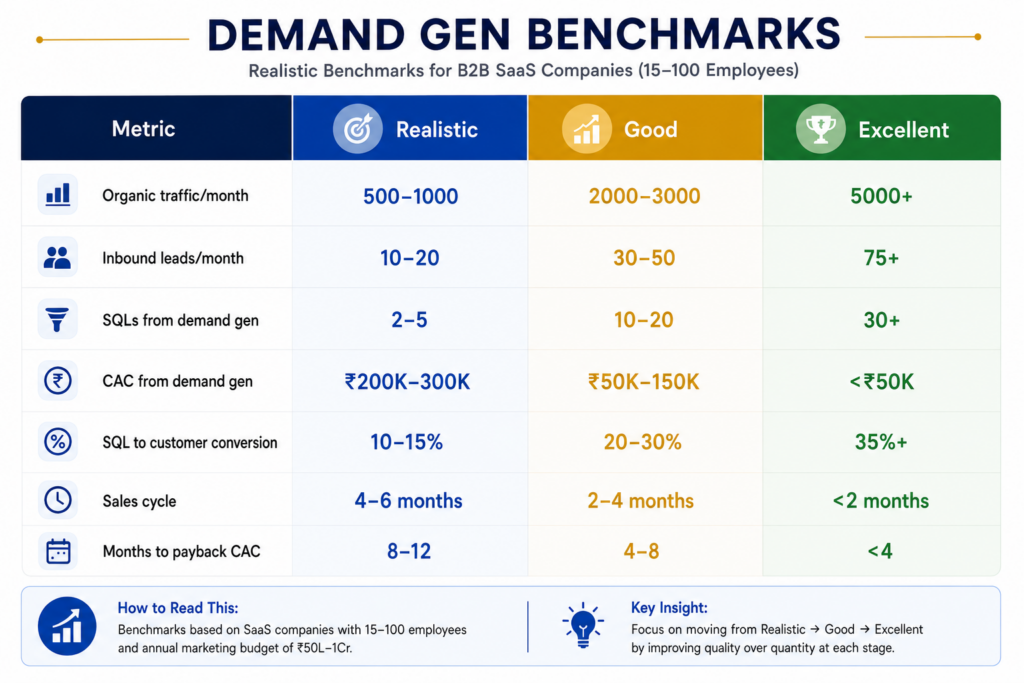
The 15–100 Employee Growth Trap
You’ve hit product-market fit. You have revenue. You have traction. Now you need a pipeline to scale.
But you’re stuck in a trap.
The trap has three parts:
- You’re too big for founder-led sales.
As a solo founder, you could sell yourself. You knew the pain points. You had high closing rates. Now there are 15 people and the founders aren’t selling anymore. You need a sales team.
The sales team makes $150K+/year. Fully loaded, closer to $250K. That’s real money at your stage.
- You’re too small for most demand gen channels.
Most paid channels (paid search, ABM platforms, and podcast sponsorships) have minimum budgets of ₹50L/year and only work if you spend to saturation.
With ₹50L–1Cr total, you can’t saturate any channel. You have to be selective.
- Your competitors are well-funded.
They raised Series A. They’re spending ₹3-5Cr on marketing. They own the demand space already.
You can’t out-spend them. You have to out-think them.
The trap: If you follow enterprise demand gen playbooks, you’ll bleed cash with no results. If you follow founder playbooks, you won’t scale fast enough. Competing on spending will quickly drain your funds.
The solution: A different playbook designed for this stage.
What Channels Work at This Stage (And What's Hype)
Not all channels work at 15–100 employees. Not because they’re bad channels, but because they require minimum spend or scale to work. Here’s what actually works at your stage.
TIER 1: Channels That Work NOW (Invest here first)
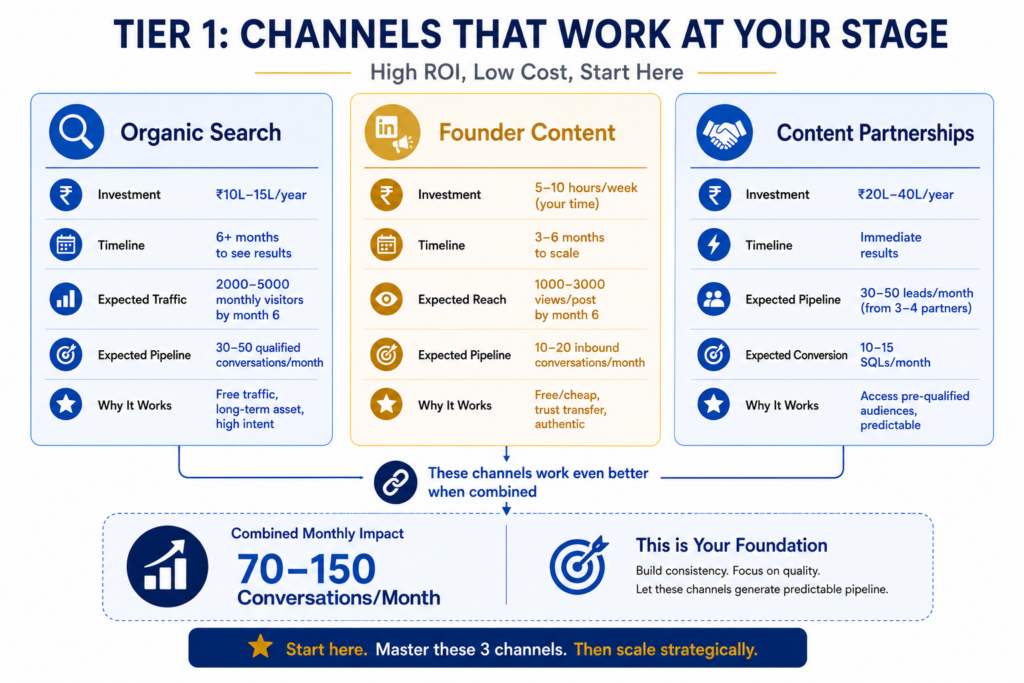
- Organic Search (SEO)
Why it works:
- Free traffic (only cost is content creation)
- Long-term compounding asset (works 6+ months in)
- Your competitors aren’t owning all the keywords yet
- High intent (people searching “best CRM for startups” are buying)
What to invest:
- ₹10L–15L/year for content creation (4-8 posts/month)
- Hiring a content freelancer or managing in-house
Realistic timeline:
- Months 1-3: No meaningful traffic
- Months 4-6: 500-1000 monthly visitors
- Months 6-12: 2000-5000 monthly visitors
Expected pipeline:
- 2-5% of organic traffic converts to lead form submission
- 5-10% of leads become SQLs
- Example: 2000 organic visitors → 100 leads → 10-15 SQLs
Your benchmark: Aim for 3000+ organic visitors/month by month 9. That’s roughly 30-50 qualified conversations per month.
- Founder + Early Employee Content (LinkedIn)
Why it works:
- Your co-founder or early employees have networks
- Trust is highest when it comes from humans, not companies
- Organic reach on LinkedIn is still viable for founders
- Costs almost nothing (time, not money)
What to invest:
- 5–10 hours/week of founder + team member time
- Content calendar (3-5 posts/week from 2-3 people)
Realistic timeline:
- Months 1-2: 100-200 views/post (cold start)
- Months 3-6: 500-1000 views/post (network warming up)
- Months 6+: 1000-3000 views/post (regular followers)
Expected pipeline:
- 1-3% of engaged viewers click through to the website
- 10-20% of clicks convert to a lead form
- Example: 2000 monthly views across posts → 30-50 clicks → 3-10 leads
Your benchmark: Each team member posting 2-3x/week should generate 10-20 inbound conversations per month combined.
- Content Partnerships & Sponsorships (Niche communities)
Why it works:
- Access to pre-qualified audiences (no cold start)
- Cost per lead is predictable
- Builds authority without brand building
- Communities value education over ads
What to invest:
- ₹20L–40L/year for 3-4 partnerships
- Weekly content contributions or sponsorships
Examples of communities:
- Niche Slack communities (startup CTOs, marketing ops, etc.)
- Niche newsletters (Product Hunt, Refind, industry-specific)
- Webinar partnerships with complementary companies
- Industry forums + communities
Expected pipeline:
- CPL (cost per lead): ₹5K–15K depending on audience quality
- 1 in 10 leads becomes SQL
- Example: ₹30L spent → 200-300 leads → 20-30 SQLs
Your benchmark: Target 3-4 high-quality partnerships that deliver 10-15 leads each per month.
TIER 2: Channels That Work IF POSITIONED CORRECTLY (Invest selectively)
- Paid Search (Google Ads) But only for decision-stage keywords
Why it CAN work:
- High intent (people searching “solutions” keywords)
- Predictable cost
- Fast results
Why most 15–100 startups fail at it:
- Minimum viable spend is ₹50L/year for any statistical significance
- Most valuable keywords have high CPCs (₹500–2000 per click)
- You need a high-converting landing page (requires design + testing)
- Takes 3-4 months to optimize for profitability
How to do it right:
- Start with 5-10 highest-intent keywords (e.g., “CRM for construction startups”)
- Budget: ₹15L–20L/year (small but sustainable)
- Focus on categories where you have competitive advantage
- Test landing pages aggressively
Expected pipeline:
- CPC (cost per click): ₹300–1000 depending on the keyword
- Conversion to lead: 5–10%
- Lead to SQL: 10–15%
- Example: ₹20L spent → 500 clicks → 30-50 leads → 3-8 SQLs
Your benchmark: Aim for CPA (cost per acquisition) of ₹50K–150K. Anything above that is burning cash.
- Influencer + Partner Relationships (Selective)
Why it works:
- Leverages other people’s audiences
- Credibility transfer (if the partner has credibility)
- Relatively low cost at your stage
Why it’s risky:
- Most influencer partnerships are scams (micro-influencers with fake followers)
- Hard to track ROI
- Takes 2-3 months to see results
How to do it right:
- Partner with 2-3 people who have actual authority in your niche
- Content collaboration (they create content featuring your product)
- Commission-based (pay based on results, not upfront)
- Track everything with UTM codes
Expected pipeline:
- Per influencer partnership: 5–15 high-quality leads/month
- 20-30% of leads become SQLs (high quality)
- Example: 3 partnerships → 15-45 leads → 3-15 SQLs
Your benchmark: Spend ₹10L–20L/year on influencer partnerships, only with people in your space.
TIER 3: Channels That DON’T Work Yet (Avoid until 100+ people)
- ABM (Account-Based Marketing) Skip it
- Requires minimum ₹1Cr+ spend to work
- Needs a dedicated ops team to execute
- Wrong stage for you
- Paid Social (Facebook/LinkedIn ads) Avoid
- Untargeted (B2B buying committees, not individuals)
- High CPCs for decision-makers
- Rarely converts at 15–100 stage unless you already have a huge database
- Sponsorships (Conferences, webinars) Too expensive
- Minimum ₹50L per sponsorship
- ROI is 12+ months out
- Better to sponsor communities than events
Building a Minimal Demand Gen Stack
You don’t need tools. You need a process.
Most startups buy:
- Marketing automation platform (HubSpot, Marketo)
- CRM (Salesforce, Pipedrive)
- Analytics tool (Mixpanel, Amplitude)
- Landing page builder (Unbounce, Instapage)
- SEO tool (SEMrush, Ahrefs)
Total cost: ₹50L+/year.
You’ll be out of business before these tools pay for themselves.
Minimal demand gen stack (₹5L–10L/year):
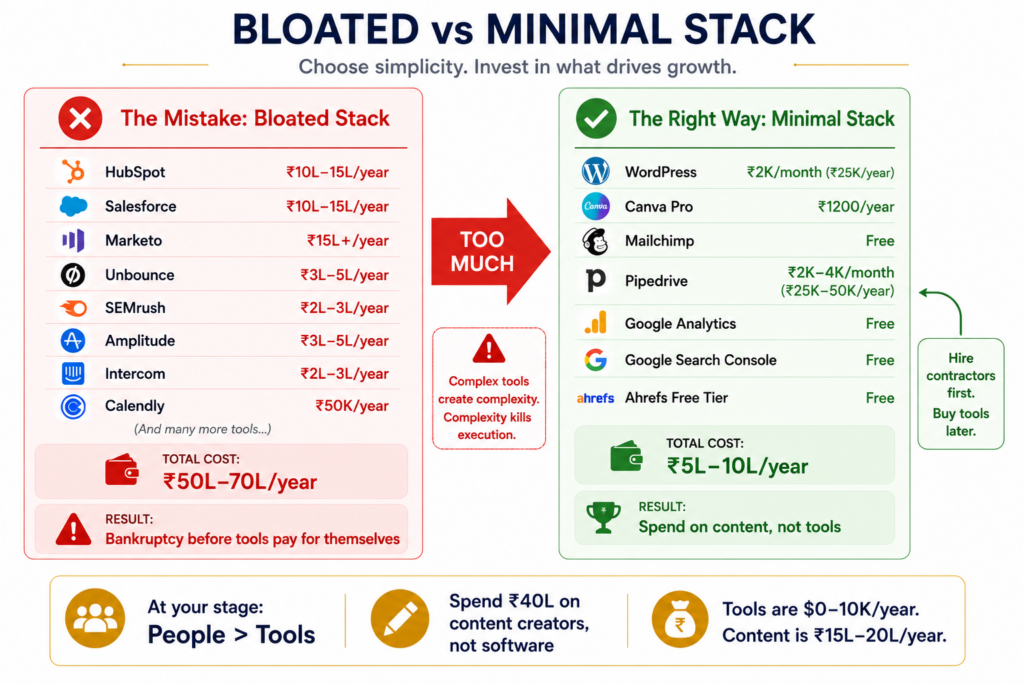
- Content management:
- WordPress (free or ₹2K/month for hosting)
- Canva Pro (₹1200/year for design templates)
- Email marketing:
- Mailchimp (free up to 500 contacts)
- Or use your CRM’s email tool
- CRM:
- Pipedrive (₹2K–4K/month) or Notion + Airtable (free–₹5K/month)
- Just pick one. Perfect is the enemy of good.
- Analytics:
- Google Analytics 4 (free)
- Don’t buy Mixpanel or Amplitude yet
- SEO tracking:
- Google Search Console (free)
- Ahrefs has a free tier for keyword research
- Ad management (if you run paid ads):
- Google Ads (self-serve)
- LinkedIn Campaign Manager (self-serve)
- Don’t hire an agency yet
Total stack cost: ₹5L–10L/year
You’ll spend more on content (₹15L–20L) than on tools.
That’s correct. At your stage, people > tools.
How to Sequence Investment: Paid, Content, Outbound
You have ₹50L–1Cr. How do you allocate it?
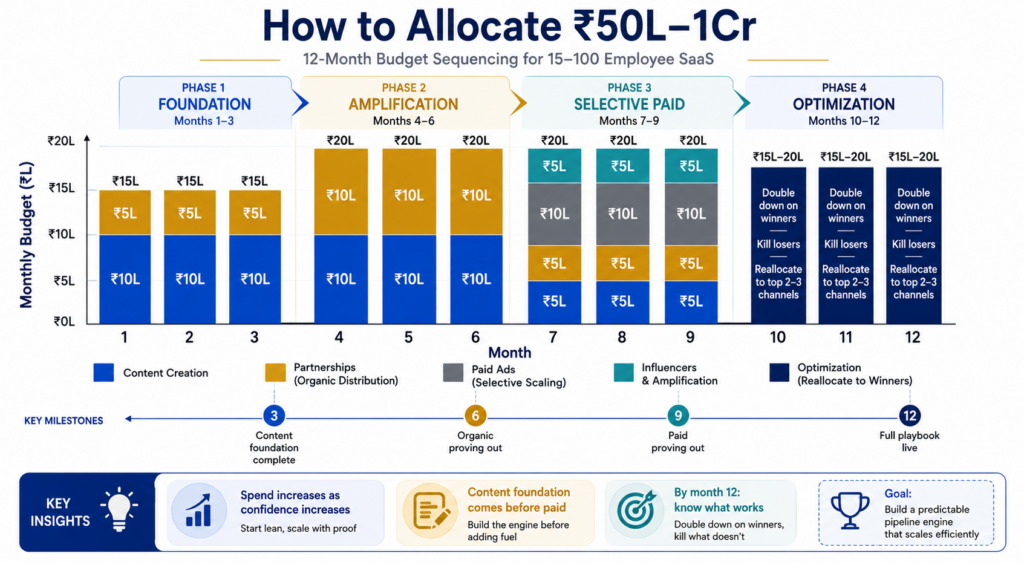
Here’s the sequence that works:
Months 1-3: Foundation (Spend ₹15L)
- Content creation: ₹10L
- 4-8 blog posts/month
- 2-3 founder LinkedIn posts/week
- 1 newsletter/week
- Content partnerships: ₹5L
- 1-2 small community sponsorships
- Test partnerships before committing
Why first: You need owned media. You can’t run paid before you have something to send traffic to. You can’t do outbound without a strong website to share.
Months 4-6: Organic Amplification (Spend ₹20L)
- Content creation (continued): ₹10L
- Continue 4-8 posts/month
- Double down on what’s working
- Content partnerships (scale): ₹10L
- Add 2-3 more partnerships
- Total: 3-4 active partnerships
- Each driving 10-15 leads/month
Why second: By month 4, your content should be getting some traction. Double down on organic before spending on paid.
Months 6-9: Selective Paid (Spend ₹15L–20L)
- Paid search (keywords): ₹10L–15L
- High-intent keywords only
- Aim for ₹50K–150K CAC
- Influencer partnerships: ₹5L–10L
- 2-3 partnerships with actual authority figures
- Content (continued): ₹5L
- Reduce content spend as paid takes over
- Keep 2-3 posts/month going
Why third: By month 6, organic is working and partnerships are generating leads. Now the test is paid on high-intent keywords. But only with proven creative.
Months 9-12: Optimization (Spend ₹15L–20L)
- Double down on what works: ₹20L
- If organic search is generating SQLs, hire a second content person
- If partnerships are converting, add more partnerships
- If paid search is profitable, scale spend
- Kill what’s not working:
- Stop founder LinkedIn if engagement is low
- Stop partnerships with low ROI
- Stop paid channels with CAC > ₹150K
By Month 12: You should have:
- 3000+ organic monthly visitors
- 30-50 inbound conversations/month
- 5-10 closed customers/month
- CAC of ₹50K–150K
- Proof that demand gen works
Benchmarks for This Stage (15–100 Employees)
What “good” looks like:
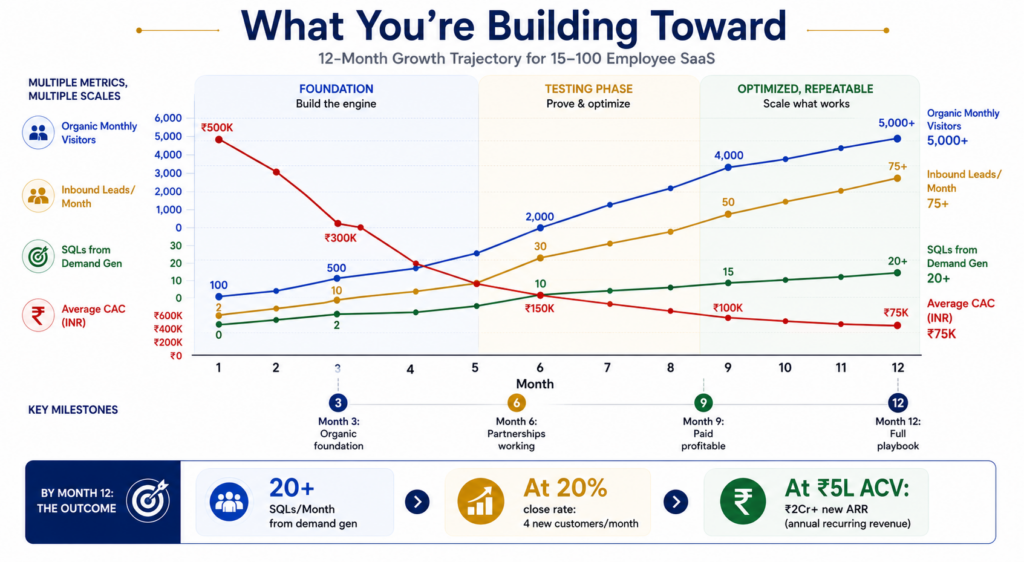
What you’re aiming for by month 12:
- 2000+ organic monthly visitors
- 30–50 inbound conversations/month
- 10–20 SQLs/month
- ₹50K–150K CAC
- 15–20% close rate (SQL to customer)
That’s 10–20 customers/month from demand gen alone.
At ₹2–10L ACV (depending on your product), that’s ₹2Cr–2Cr ARR from demand gen.
ROI on your ₹50L–1Cr annual spend: 2–4x. That’s good. That’s healthy. That’s what you’re building toward.
The Real Advantage You Have (And Most Don't Use It)
At 15–100 people, you have something bigger companies don’t: speed and specificity.
Enterprise demand gen campaigns take 3-6 months to launch. You can test and iterate monthly.
Enterprise has broad messaging. You can be specific: “CRM for construction startups” vs “CRM.”
Enterprise has approval layers. You have a founder who can make decisions.
Use this.
Test. Measure. Kill what doesn’t work. Double down on what does.
Most startups your size wait for perfect. They spend months planning. They build a massive content calendar. They commission a brand study.
By the time they launch, they’ve spent ₹20L and have nothing to show.
Instead: Launch in 2 weeks. Measure in 4 weeks. Iterate by week 6.
Your competitive advantage isn’t budget. It’s speed.
Common Mistakes (And How to Avoid Them)
Mistake 1: Treating all channels equally
You try SEO, paid ads, partnerships, influencers and content all at once. You spread ₹50L across 5 channels. Each channel gets ₹10L. None of it works.
How to avoid it:
- Pick 2-3 channels. Fully commit to those.
- Run others at low cost (organic founder content).
- Once you find winners, scale winners.
Mistake 2: Hiring an agency
You’re 30 people. You hire an agency for ₹40L/year. The agency delivers mediocre results. You’ve burned your budget on overhead.
How to avoid it:
- Do it in-house with one contractor.
- Use that ₹40L to buy better services (software, tools, partnerships).
- Hire an agency only when you’re over 100 people and have revenue to support it.
Mistake 3: Building for perfect instead of launching
You spend months building the perfect website. The perfect landing page. The perfect content strategy.
By the time you launch, the market has moved.
How to avoid it:
- Launch your website/landing page at 70% done.
- Get real customers first. Perfect later.
- Publish content as you write it, not in batches.
Mistake 4: Running paid without organic foundation
You skip content. You jump to paid ads. You send traffic to a weak website with no social proof.
Conversion rate is 0.5%. CAC is ₹500K+. You burn the budget fast.
How to avoid it:
- Build organic first (3-4 months).
- Get proof of concept (10-20 leads/month).
- Then layer on paid for scale.
Your Next 90 Days
Month 1:
- Define your ICP (industry, company size, pain point)
- Write 4-6 blog posts targeting your top keywords
- Start founder + team LinkedIn presence (3-5 posts/week)
- Identify 2-3 community partnerships to test
Month 2:
- Launch partnerships (2-3 active)
- Publish 4-8 new blog posts
- Measure: How many organic visitors? How many leads? How many SQLs?
- Adjust based on data
Month 3:
- Double down on what’s working
- Kill what’s not
- Launch first paid ads campaign (₹5L budget) on high-intent keywords
- Aim for 20-30 total inbound conversations
By Month 4, you should know:
- Which channels work for you
- What your CAC is
- What your realistic pipeline is
Then scale what works. Ignore everything else.
If you’re in this growth stage and your demand gen isn’t working, let’s talk. We’ll spend 60 minutes mapping out your ideal demand gen strategy for the next 12 months, with realistic budgets and channels that work for your stage.