Every B2B marketing team debates this.
You’re sitting in a planning meeting. Budget is limited. You have two options:
Option 1: Double down on LinkedIn ads. Immediate reach. You can target by title, company, or industry. Results in 2-4 weeks.
Option 2: Build content. Slow burn. It takes 3-6 months to see traction. But it compounds.
Which do you choose?
The real answer is not “either/or.” It’s “it depends.”
But most teams get the dependency wrong. And spend 70% of the budget on the wrong channel.
Here’s how to think about it.
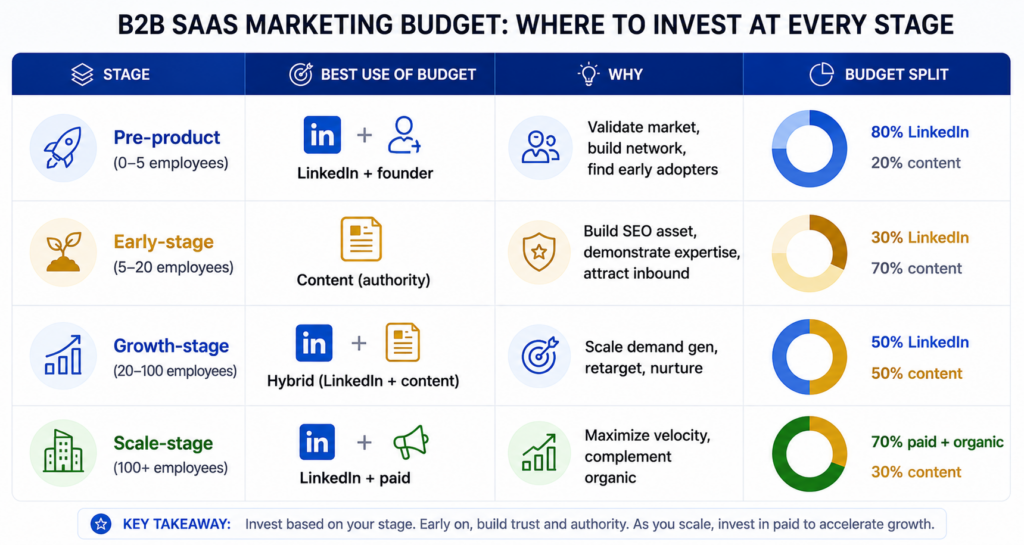
Quick Decision Framework (Table)
Why This Is the Wrong Question (Framed Right)
Before we answer “LinkedIn or content?” you need to answer two different questions:
Question 1: What stage are you at?
- Pre-product founders (validate the market)
- Early-stage scaling (build authority)
- Growth-stage optimizing (scale demand)
- Scale-stage maximizing (velocity)
The right channel is different at each stage.
Question 2: What are you actually trying to build?
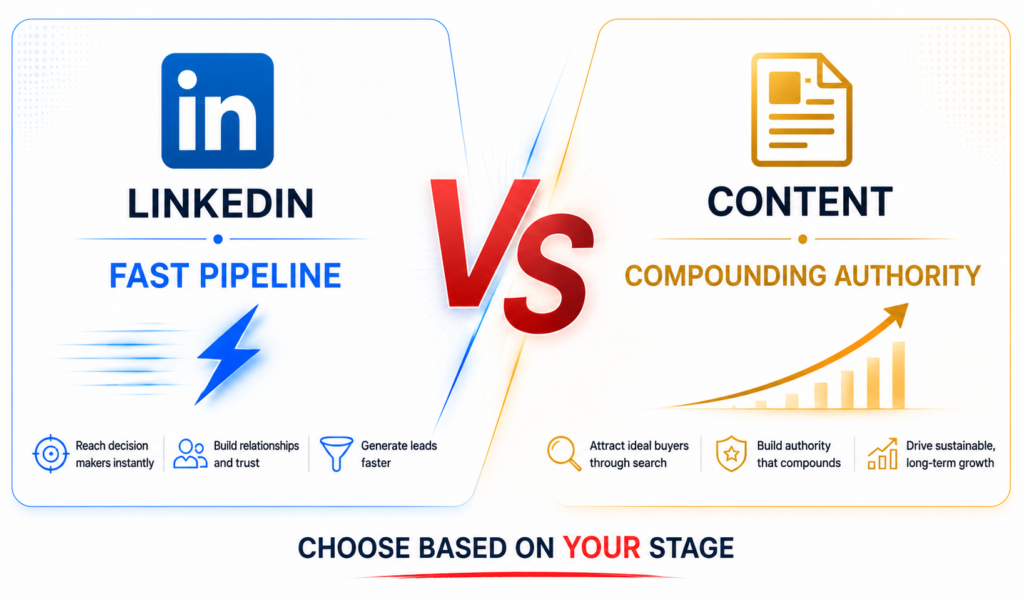
- Option A: Quick pipeline (LinkedIn does this)
- Option B: Compounding authority (content does this)
- Option C: Both (need both channels)
Most teams confuse these questions.
They want compounding authority. But they spend a budget like they want a quick pipeline.
Result: Neither works well.
So the question isn’t LinkedIn vs content.
The question is, “What are you actually building?”
If you want quick pipeline → LinkedIn. If you want compounding authority → Content. If you want both → Split budget by stage.
What LinkedIn Actually Does Well for B2B Pipeline
LinkedIn ads work. They work because they do one thing exceptionally well:
Precision targeting + immediate reach = fast pipeline.
LinkedIn’s superpower:
You can target:
- By job title (VP of Sales, CMO, etc.)
- By company size (exactly the size you want)
- By industry (your vertical)
- By seniority (manager, director, C-level)
- By buying signals (engagement, company growth, hiring)
No other channel gives you this level of precision.
Result: Your message reaches exactly who you want, immediately.
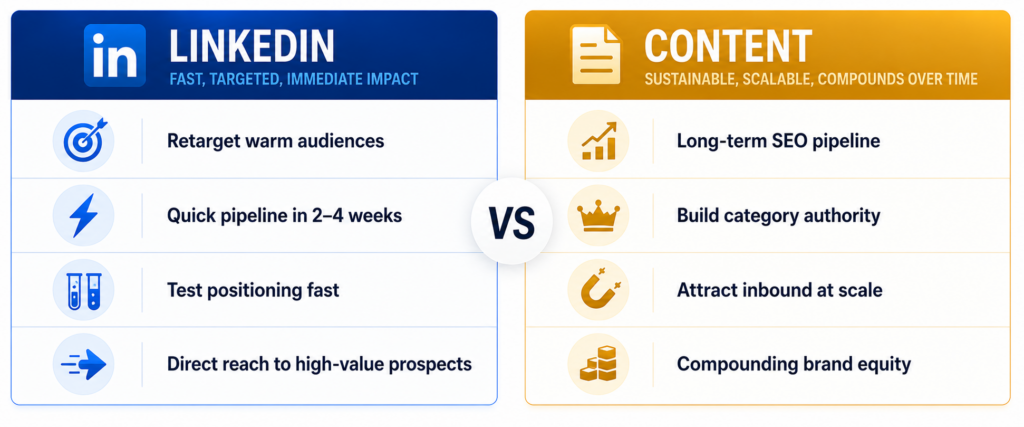
This is what LinkedIn is good for:
Retargeting warm audiences
- If someone visited your site, engaged with content, or attended your webinar, retarget them on LinkedIn.
- They’re already interested. LinkedIn just accelerates the conversion.
Quick pipeline when you have limited time
- You need ₹50L in the pipeline by Q4.
- You have 6 weeks.
- LinkedIn can deliver that.
- (Content can’t deliver in 6 weeks; it takes 3-6 months to compound.)
Testing new positioning
- You want to test messaging to your ICP.
- LinkedIn ads get data in 2-4 weeks.
- You can see: Does this positioning resonate? Are these the right people?
- Use LinkedIn to validate. Use content to scale what works.
Direct outreach at scale
- You want to reach 100 specific companies or founders.
- LinkedIn lets you target them precisely.
- One message to 100 high-value prospects > one blog post to 10,000 random visitors.
What LinkedIn is NOT good for:
- Building authority (people don’t remember you from ads)
- Long-term compounding (ads stop working when budget stops)
- Brand awareness (it’s noisy)
- SEO benefits (no link juice, no long-term ranking power)
What Content Actually Does Well for B2B Pipeline
Content is different. It doesn’t work fast. But it compounds.
Content’s superpower:
You publish a blog post. It ranks in Google for 12-24 months. Every day, 50 people search for that topic. Every day, some of those 50 people become leads.
Month 1: 50 leads from a blog post. Month 6: 300 leads from a blog post (it’s ranked higher now). Month 12: 600 leads from blog posts.
That’s compounding.
This is what content is good for:
Long-term SEO pipeline
- You want consistent, predictable leads 6-12 months from now.
- Content builds that.
- Every blog post is an asset that keeps working.
Building authority in your category
- You want to be known as “the expert” in your space.
- One ad doesn’t do that.
- But 20 blog posts about your specialty? That does.
- Buyers remember you because you’ve proven expertise through content.
Attracting inbound at scale
- You don’t want to hunt. You want to attract.
- Content marketing is inbound magnetism.
- When prospects search “how to solve X problem,” your blog post shows up.
- They come to you, already educated, already warm.
Extending sales cycle (building trust)
- B2B sales cycles are 3-6 months.
- Content sustains interest during the cycle.
- Prospects read your blog, consume your content and get educated.
- By the time they talk to sales, they trust you and understand your solution.
Compounding brand equity
- Every blog post adds to your credibility.
- After 50 posts, you’re THE authority.
- This attracts better prospects, better partnerships and better press.
What content is NOT good for:
- Fast pipeline (takes 3-6 months to compound)
- Hyper-specific targeting (you can’t target “companies with 5-10 employees in Bangalore using Salesforce”)
- Urgent demand (if you need pipeline in 60 days, content won’t deliver)
- Testing messaging fast (takes too long to see data)
The Stage-Based Decision Framework
Here’s how to think about it:
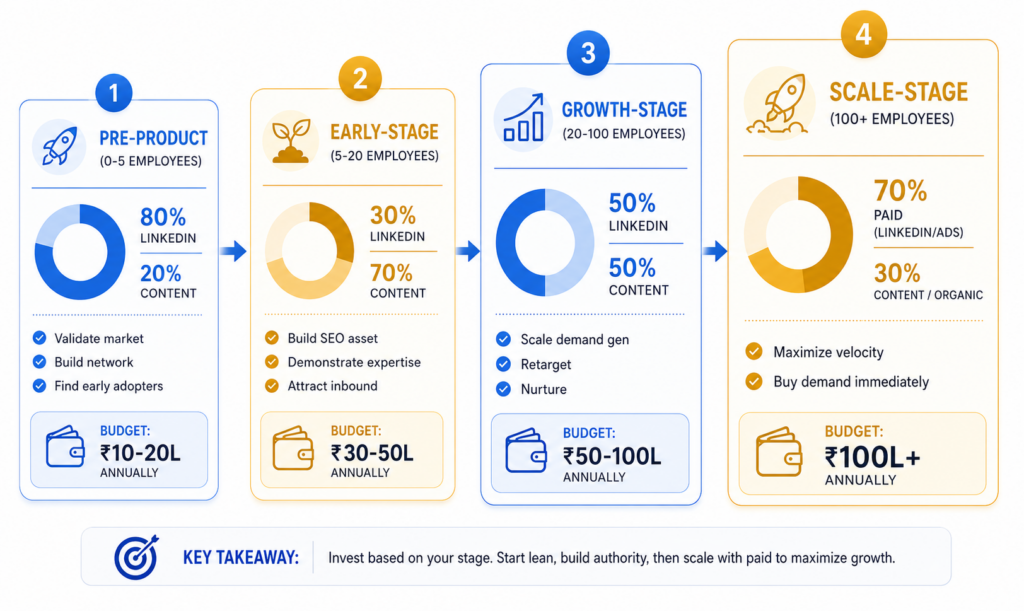
Stage 1: Pre-product (Validating the market)
Budget: ₹10-20L annually
Split: 80% LinkedIn / 20% Content
Why: You’re not ready for content yet. You haven’t proven product-market fit. You need to validate if people actually want this.
LinkedIn lets you reach prospects fast, get feedback and learn.
Content is wasted at this stage (not enough proof points to make authority stick).
What to do:
- Run LinkedIn ads to your ICP
- Get feedback on positioning
- Once you have customers, start building content
Stage 2: Early-stage scaling (Building authority)
Budget: ₹30-50L annually
Split: 30% LinkedIn / 70% Content
Why: You have customers. You have proof. Now build authority that compounds.
LinkedIn is still useful (for retargeting and testing), but content is where the real leverage is.
Content builds:
- SEO pipeline (organic traffic)
- Authority (people know you as the expert)
- Sales enablement (your content educates prospects)
What to do:
- Publish 2-4 blog posts/month
- Use LinkedIn for retargeting blog readers
- Build thought leadership (founder on LinkedIn, in media, on podcasts)
Stage 3: Growth-stage optimizing (Scaling demand gen)
Budget: ₹50-100L annually
Split: 50% LinkedIn / 50% Content
Why: You need BOTH at this stage.
LinkedIn accelerates pipeline (retargeting, paid reach). Content provides the base (SEO, authority, inbound).
You’re not choosing anymore. You’re optimizing both.
What to do:
- Maintain 4-6 blog posts/month (keep content engine running)
- Scale LinkedIn retargeting (larger audience, more budget)
- Build paid demand gen (Google search ads alongside LinkedIn)
- Develop thought leadership at scale (executive team on LinkedIn, media, speaking)
Stage 4: Scale-stage maximizing (Velocity)
Budget: ₹100L+ annually
Split: 70% Paid (LinkedIn + Google) / 30% Content/Organic
Why: You’re past building authority. You’re maximizing velocity.
Paid channels (LinkedIn + Google ads) drive 70% of demand. Organic (content + inbound) is a bonus on top.
You’re not waiting for content to compound. You’re buying demand immediately.
What to do:
- Maintain content operation (4-6 posts/month, SEO, organic)
- Double down on paid (LinkedIn + Google search + retargeting)
- Hire demand generation manager to optimize paid
- Let content run in the background (it’s compounding, not urgent)
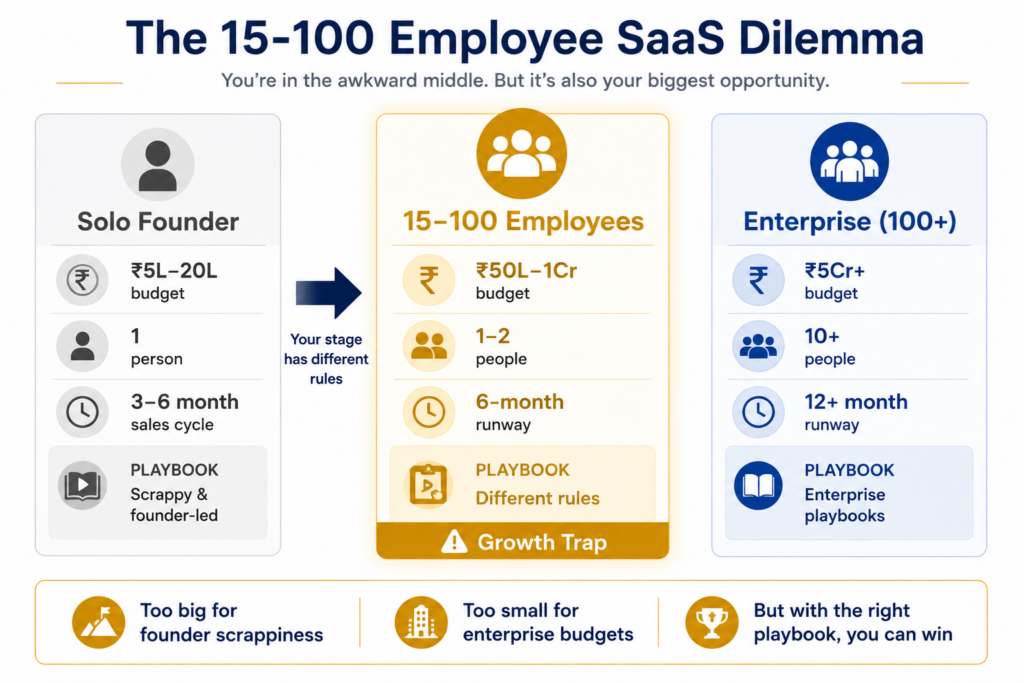
The Hybrid Approach That Works for Most 15–100 Person SaaS
If you’re a 30-person SaaS founder with a ₹30-50L marketing budget, here’s what works:
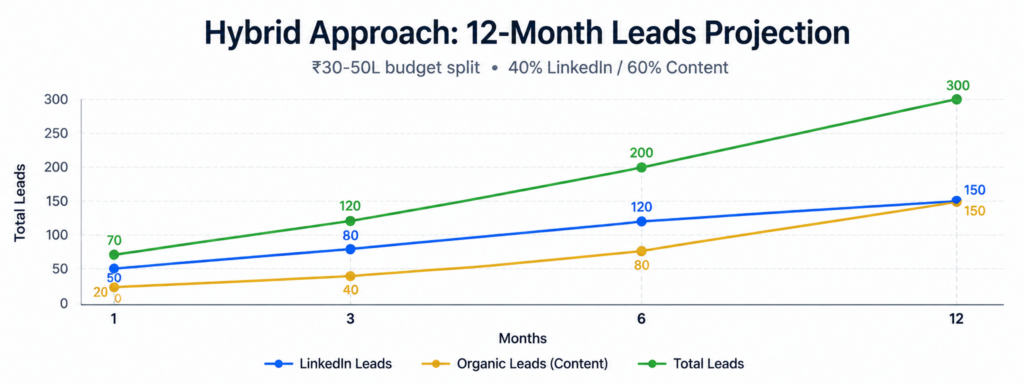
The split: 40% LinkedIn / 60% Content
Reason: You’re between Stage 2 and Stage 3.
You need content to build compounding authority. You need LinkedIn to accelerate the process.
The breakdown:
Content budget (₹18-30L):
- 1 full-time content marketer or agency: ₹10-15L
- Tools (SEMRush, Canva, WordPress): ₹2-3L
- Design/graphics: ₹3-5L
- Freelance writers: ₹2-5L
- Result: 4-6 blog posts/month + LinkedIn content
LinkedIn budget (₹12-20L):
- LinkedIn ads: ₹8-12L (retargeting + testing)
- Tools (LinkedIn automation, analytics): ₹1-2L
- Founder thought leadership investment (time): ₹3-6L
- Result: Retargeting warm audiences + founder visibility
Execution:
Months 1-3: Build initial content (12 posts), test LinkedIn messaging. Months 4-6: Double down on what works in both channels and optimize. Months 7-12: Scale what’s working; keep both engines running
Expected outcomes:
- Month 1: 50 LinkedIn leads, 20 organic leads → 70 total
- Month 3: 80 LinkedIn leads, 40 organic leads → 120 total
- Month 6: 120 LinkedIn leads, 80 organic leads → 200 total
- Month 12: 150 LinkedIn leads, 150 organic leads → 300 total (2x growth)
The POV: Where the Real Leverage Is
Here’s our point of view:
LinkedIn is a distribution channel. It’s good for:
- Reaching high-intent prospects fast
- Retargeting warm audiences
- Testing positioning quickly
But LinkedIn alone doesn’t build authority.
Content is the authority builder. It’s good for:
- Building SEO pipeline (long-term, compounding)
- Demonstrating expertise (proof through depth)
- Attracting inbound (people come to you)
The winning teams use both:
- Content builds the authority asset
- LinkedIn amplifies it (retargeting, distribution)
Don’t choose one. Build both. Sequence them by stage.
If you’re early, LinkedIn validates the market. If you’re growing, content compounds the authority. If you’re scaling, both work together.
The mistake: Spending 70% on LinkedIn ads, 30% on content.
That’s backwards. At the growth stage, flip it.
Not sure where your pipeline budget should go? We can build a stage-specific strategy tailored to your company.