You’re writing better content than ever.
Your blog posts are detailed. They’re well-researched. They answer real questions that your buyers have.
But something’s changed.
Your traffic isn’t increasing the way it used to. And more importantly, you’re not appearing in ChatGPT answers. You’re not being cited by Perplexity. Google’s AI Overviews rarely mention your brand.
Why?
Because the rules of content have changed.
For the last decade, content strategy meant writing effective content, optimizing for keywords, getting backlinks, and ranking higher in Google. That playbook still works for traditional search.
AI engines don’t reward effort. They reward structure. Authority. Extractability.
They reward content designed to be cited.
Here’s how to build that.
Quick Framework (Table)
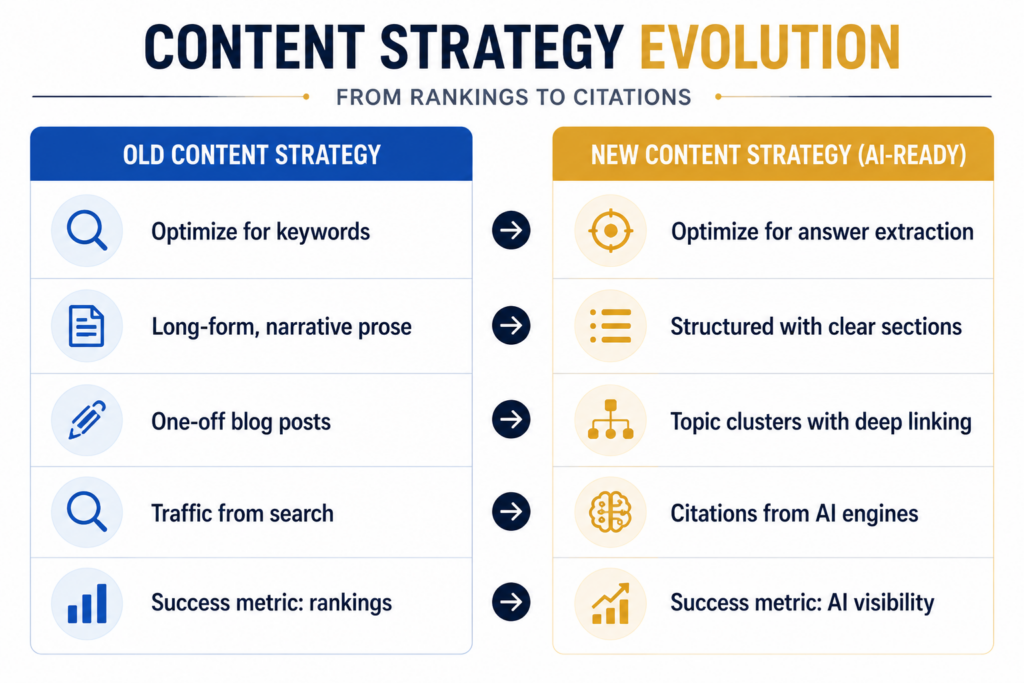
Why Traditional Content Strategy Fails in AI Search
For the last 10 years, B2B content marketing worked like this:
Step 1: Find a high-volume keyword (e.g., “B2B demand generation”)
Step 2: Write a long-form blog post (2,000+ words) around that keyword
Step 3: Optimize for on-page SEO (H2s, internal links, backlinks)
Step 4: Get backlinks from authority sites
Step 5: Rank in Google and get organic traffic
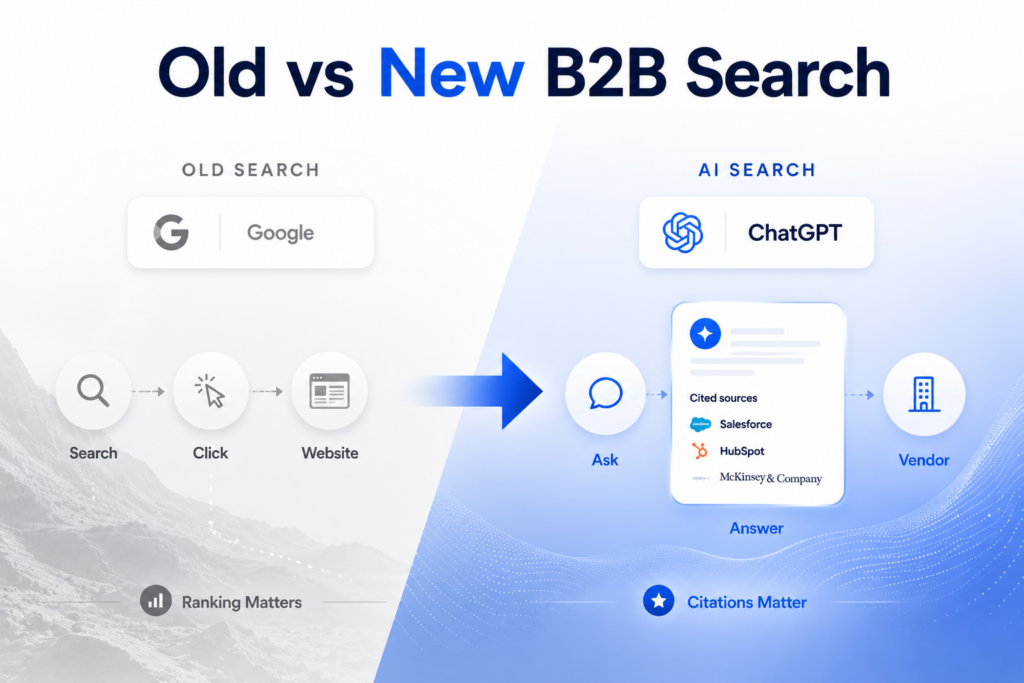
This system worked because Google was indexing web pages and ranking them based on relevance, authority, and user signals.
But AI search engines work differently.
AI doesn’t rank pages. It extracts answers.
When someone asks ChatGPT or Perplexity a question, the AI engine:
- Searches the web for relevant content
- Reads multiple sources simultaneously
- Extracts information from each source
- Synthesizes an answer
- Cites the source(s) it pulled from
This means:
Your content isn’t competing to rank #1 in search results.
Your content is competing to be extracted and cited in AI-generated answers.
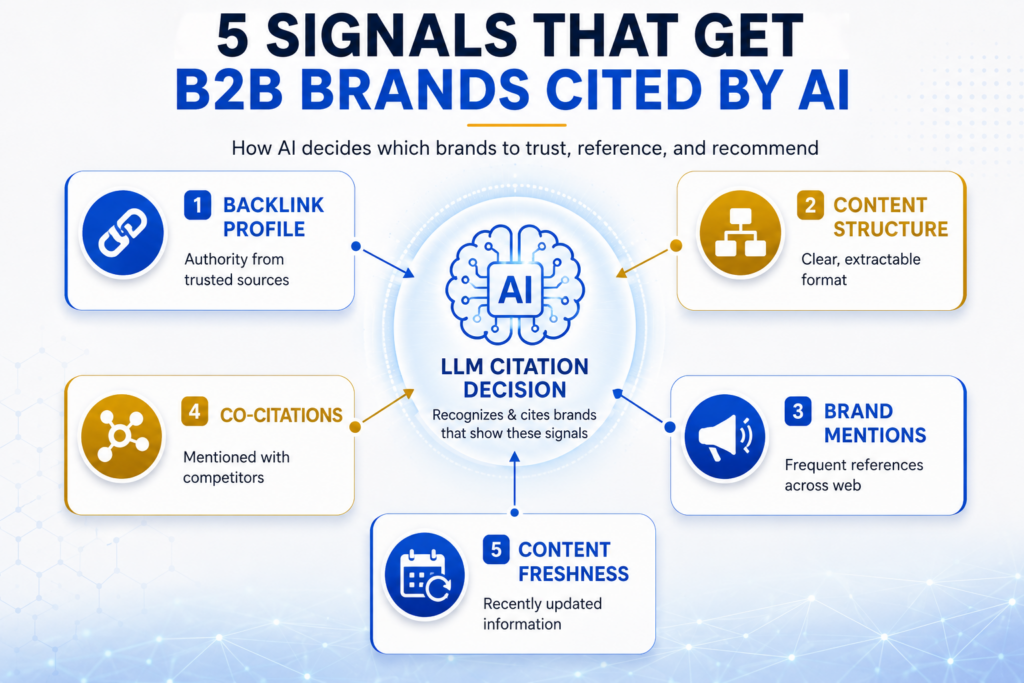
And extraction isn’t about what ranks well in Google. It’s about:
- Structure (can the AI easily parse your content?)
- Authority (does this source sound authoritative on this topic?)
- Clarity (are the answers explicit and clear, or buried in prose?)
- Freshness (is this current information, or outdated?)
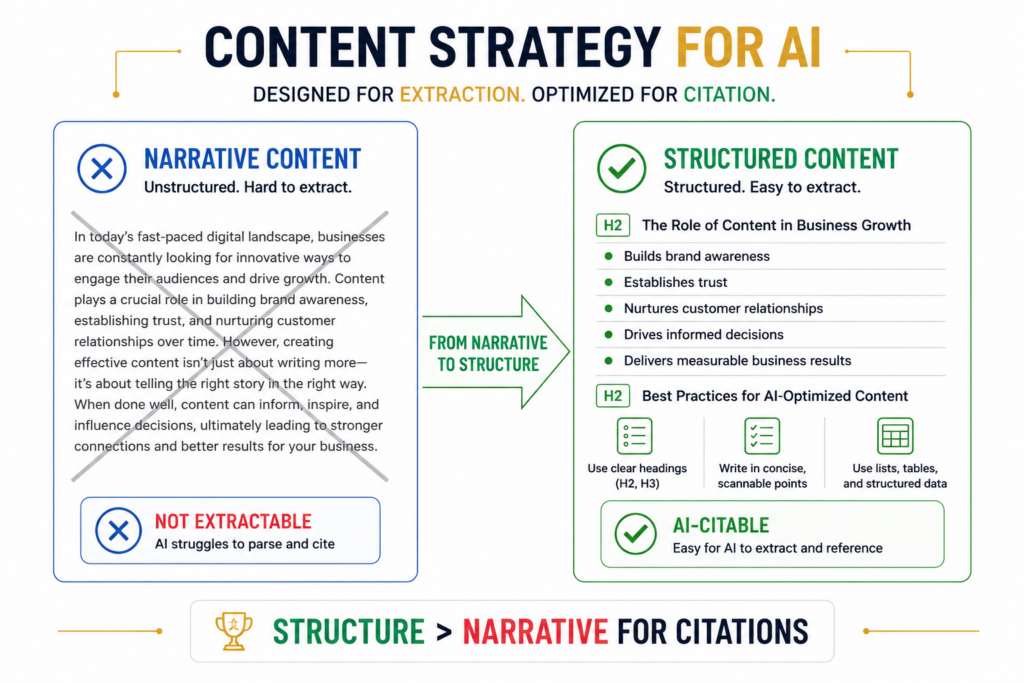
Most B2B content is optimized for Google. Most B2B content is narrative; it buries key findings in paragraphs and requires reading to extract value.
AI engines hate that.
They want structured, explicit, extractable answers.
That’s why your blog posts aren’t getting cited. They’re optimized for ranking, not for extraction.
The 4 Properties of AI-Citable Content
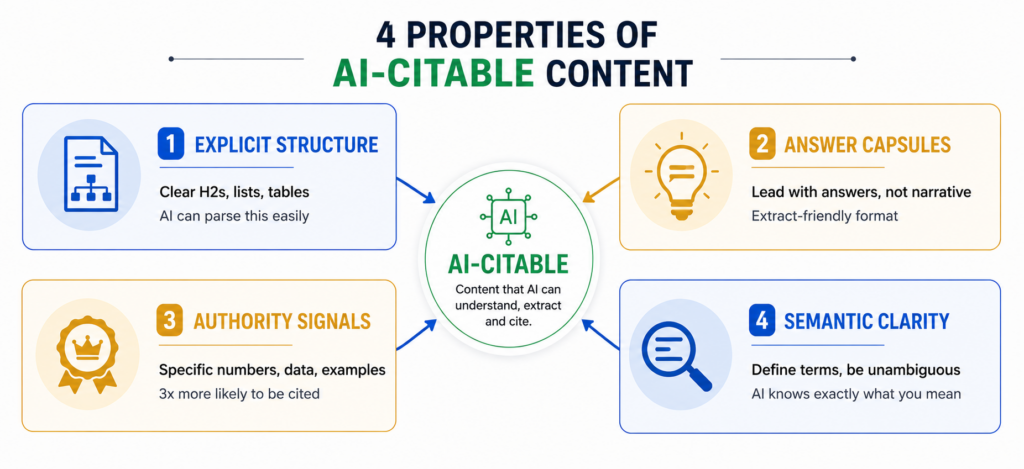
If you want ChatGPT, Perplexity, and Google AI Overviews to cite you, your content needs 4 things:
Property 1: Explicit Structure
AI can’t parse narrative. It can parse structure.
❌ Bad: “B2B demand generation is complex. There are many approaches. Some companies focus on content, others on paid ads. Both approaches can be effective, depending on your current stage.
✅ Good:
There are 3 core approaches to B2B demand generation:
- Content Marketing (for long-term authority)
- Paid Advertising (for short-term pipeline)
- Outbound Sales (for high-touch pipeline)
The right choice depends on your company stage.
The second version is extractable. The AI engine can:
- Identify the list structure
- Extract each item
- Present it clearly in an answer
Property 2: Answer Capsules
Don’t hide your answers in paragraphs. Lead with them.
❌ Bad: “The question of which B2B marketing channel is most effective has been debated for years. There are pros and cons to each approach. LinkedIn is good for certain stages, while content is good for others…”
✅ Good: “LinkedIn drives a faster pipeline when you have warm audiences to retarget. Content compounds over time and builds long-term authority. At the growth stage (20-100 employees), use both: 50% LinkedIn and 50% content.”
The second version is a clear, extractable answer. An AI engine can pull this information directly into a response.
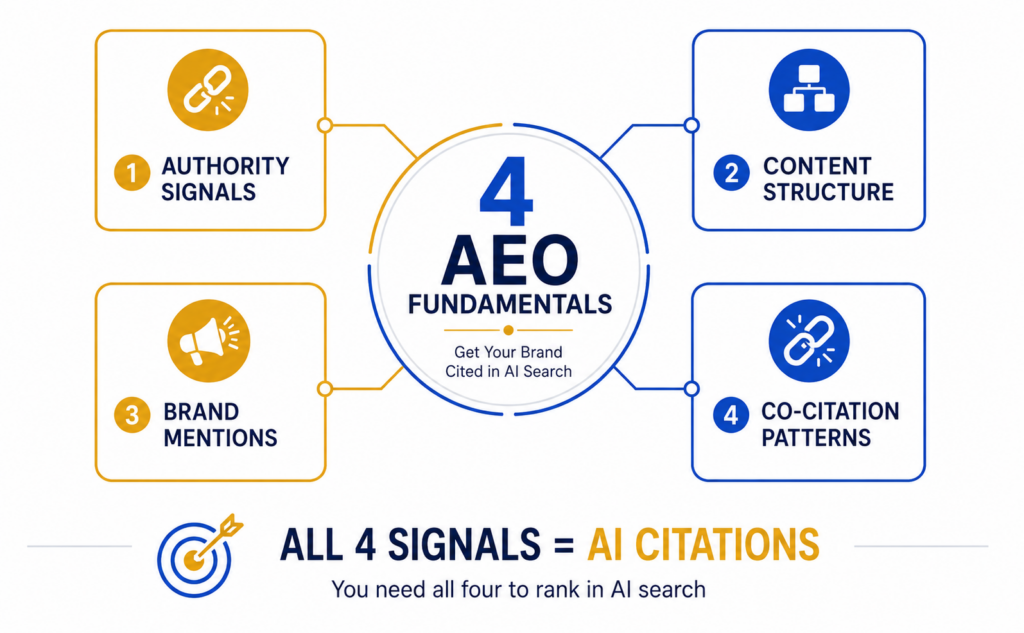
Property 3: Authority Signals
AI engines evaluate source authority. If your content has these signals, you’re more likely to be cited:
- Specific numbers and data (not vague claims)
- Real examples (case studies, client results)
- Primary research (surveys, original data you collected)
- Author credentials (who wrote this? What’s their background?)
- Publication history (does this brand publish regularly on this topic?)
One data point: a study we cited in our research found that sources with specific metrics (e.g., “we grew 350% SQL in 6 months”) are cited 3x more often than generic claims (e.g., “we grew a lot”).
Property 4: Semantic Clarity
Use clear, unambiguous language. Define your terms upfront.
❌ Bad: “Pipeline varies depending on your approach.”
✅ Good: “Pipeline (the total value of open sales opportunities) varies by channel. Inbound pipeline averages $2-5M per year for a 30-person SaaS company. Outbound pipeline averages $1-3M depending on team size.”
The second version is semantically clear. The AI engine knows exactly what you mean by “pipeline” and can extract specific benchmarks.
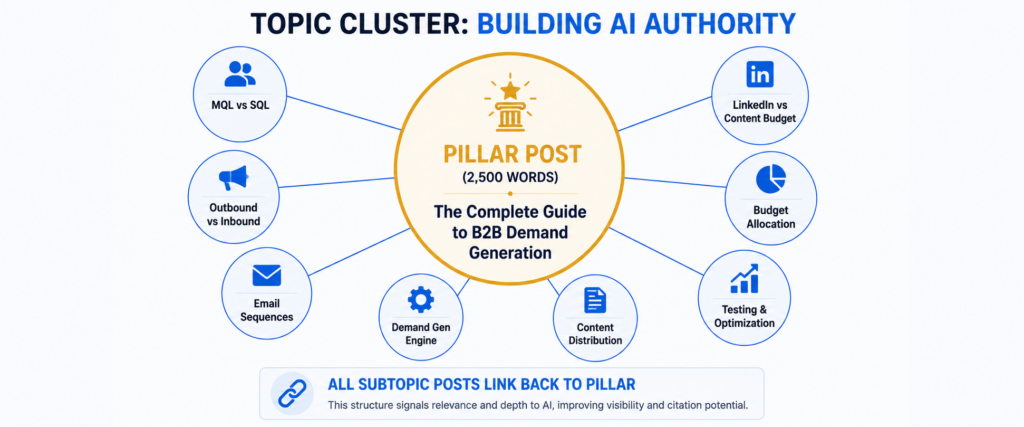
Building Your Topic Cluster for AI Authority
AI doesn’t cite one post in isolation. It cites clusters of related posts that together prove authority.
If you publish just one blog post about “B2B demand generation,” AI is unlikely to cite it. If you publish 10 posts about different aspects of B2B demand generation, you build topical authority and you’re much more likely to be cited across multiple topics.
How to build a topic cluster for AI authority:
Step 1: Identify your pillar topic
Choose a broad topic you want to own: “B2B Demand Generation” or “AI Search Visibility” or “Fractional CMO”
Step 2: Define 8-12 subtopics
Under “B2B Demand Generation,” your subtopics might be:
- MQL vs SQL (what’s the right metric?)
- LinkedIn vs Content (budget split by stage)
- Outbound vs Inbound (when each works)
- Email sequences (turning leads into pipeline)
- Demand gen engine (building from scratch)
- Budget allocation (at different revenue stages)
Each subtopic gets its own post.
Step 3: Link them all back to a pillar post
Create ONE comprehensive pillar post that covers the whole topic at 2,000+ words. Link every subtopic post back to this pillar post. The pillar post should link out to all the subtopic posts.
This creates a web of topical authority. When an AI engine searches for information about “B2B demand generation,” it finds not just one post, but a whole cluster of authoritative content on related topics. That’s when citations increase.
Step 4: Update cyclically
AI engines favor fresh content. If you published “B2B Demand Gen 101” in 2024, update it in 2026 with new examples, new benchmarks, and new case studies. Republish it with a new date. The AI engine will recognize it as fresh and more relevant.
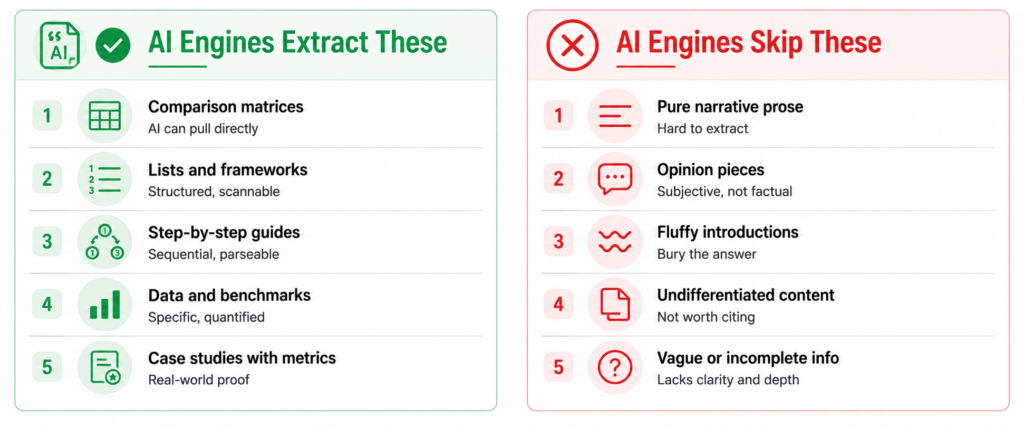
Content Formats That Get Extracted vs Ignored
Not all content formats are equally extractable by AI.
Formats that get EXTRACTED (and cited):
- Comparison matrices: “10 Demand Gen Platforms Compared”
- AI can pull these directly
- High citation rate
- Lists and frameworks: “The 5-Step Demand Gen Engine”
- Structured, scannable
- Very extractable
- Step-by-step guides: “How to Build a Demand Gen Engine in 90 Days”
- Sequential, easy to parse
- High extractability
- Data and benchmarks: “B2B Demand Gen Budgets by Company Size”
- Specific, quantified
- AI loves this
- Case studies with metrics: “$10M Pipeline Generated Using This Method”
- Real-world proof
- Highly citable
Formats that get IGNORED (low extraction):
- Pure narrative prose: Long paragraphs with no structure
- Hard to extract
- Low citation rate
- Opinion pieces: “What I Think About Demand Gen”
- Subjective, not factual
- AI engines skip this
- Fluffy introductions: “The History of Marketing” (5 paragraphs before you answer the actual question)
- AI engines jump past this
- They want the answer upfront
- Undifferentiated content: “Demand Gen 101” (same as 1,000 other sites)
- No unique data or insight
- Not worth citing
The Editorial Calendar Structure for AI Visibility
Structure your editorial calendar to maximize AI citations.
Month 1: Publish pillar post
Create one comprehensive post on your pillar topic. 2,500+ words. Covers the full landscape.
Example: “The Complete Guide to B2B Demand Generation” (all approaches, all stages, all budgets)
Months 2-3: Publish 4 subtopic posts
Each post dives deeper into one aspect of the pillar topic.
Example:
- Post 2: “LinkedIn vs Content Budget” (comparison)
- Post 3: “Building a Demand Gen Engine from Scratch” (how-to)
- Post 4: “Outbound vs Inbound by Stage” (decision matrix)
- Post 5: “B2B Email as Pipeline Nurture” (channel guide)
Every post links back to the pillar.
Months 4-6: Add specialized content
Posts that go even deeper on specific subtopics. Usually shorter (1,200-1,600 words).
Example:
- Post 6: “5 Mistakes in B2B Email Sequences”
- Post 7: “LinkedIn Retargeting for Warm Audiences”
- Post 8: “Demand Gen Budget Allocation at ₹5Cr ARR”
Every post links to the pillar AND to relevant subtopic posts.
Timeline: This creates a mesh of topical authority over 6 months. By month 6, you have 8-10 posts that all link back to a pillar topic. AI engines recognize these posts as a source of authoritative, deep expertise. Citation rate increases.
How to Measure Citation Performance (Not Just Traffic)
Most marketers measure content success by traffic: how many people visited the blog post?
For AI-optimized content, that’s the wrong metric.
You need to measure citation rate instead.
How to measure citation rate:
Method 1: Manual tracking
Ask yourself regularly: “Am I being cited in ChatGPT/Perplexity/Google AI?”
- Open ChatGPT
- Ask a question related to your content
- Do they cite your site?
- Record whether you appear
Do this 2x per week for 10 weeks. Track which pieces get cited.
Method 2: Automated tools
Tools like Semrush, Ahrefs, and Moz are rolling out “AI citation tracking.” Check if they track:
- How often your site is cited in AI overviews
- Which pages get cited most
- Citation growth over time
What to track:
For each piece of AI-citable content, track:
- Citation frequency: How often does this appear in AI answers?
- Citation growth: Is this increasing month-over-month?
- Citation across topics: Are you cited across multiple AI-generated answers, or just one?
Why citation rate matters more than traffic:
One citation in a ChatGPT answer might be worth 100x more than organic traffic because
- It establishes credibility (ChatGPT vetted you as a source)
- It reaches people already interested (they asked the question)
- It creates brand authority (people start to know you as “the source” on this topic)
Putting It All Together: Your AI Content Strategy
Here’s what an AI-optimized content strategy looks like:
Month 1:
- Audit your existing content for AI-citeability
- Restructure top posts (add H2s, answer capsules, lists)
- Publish pillar post (2,500 words, comprehensive)
Months 2-3:
- Write 4 subtopic posts (1,600-2,000 words each)
- All link back to pillar
- Use explicit structure (lists, comparison tables)
- Include specific benchmarks/data
Months 4-6:
- Write 4 specialized subtopic posts (1,200-1,600 words)
- Establish topic cluster
- Begin tracking citation rate
- Update pillar posts with new examples/benchmarks
Months 7-12:
- Publish new subtopic variations
- Update pillar posts every 3 months
- Build case studies showing results
- Track citation growth
Expected result: By months 6-8, you should see the citation rate increase. By month 12, you’re a recognized source in your category.
Ready to restructure your content strategy for AI visibility?
Let’s audit your existing content and build a citation-focused strategy.