Most founders get this wrong at the 30-person mark. Not because they don't think about it, but because they compare salary to retainer and stop there. The real cost of the wrong decision is 6 months of lost pipeline and a severance check. Here's how to make the right call.
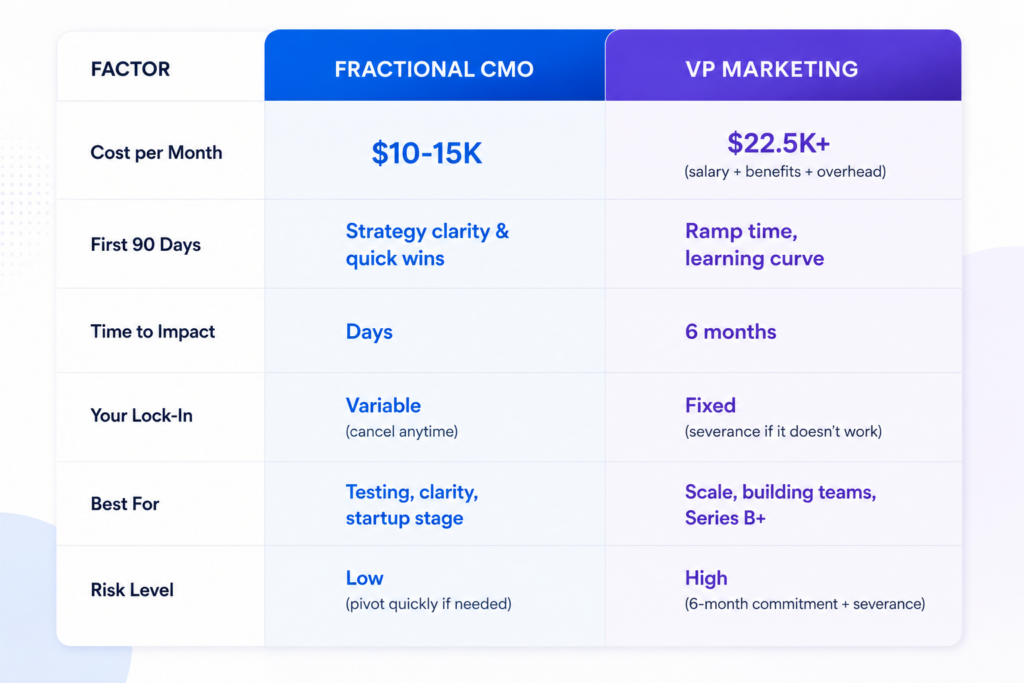
Quick Comparison Table
What a Fractional CMO Actually Does
A Fractional CMO is a part-time, executive-level strategic leader who owns your marketing without the full-time salary. They typically work 10–20 hours per week (or are project-based) and handle:
- Revenue-focused strategy & goal-setting
- Go-to-market planning for new products or segments
- Audit & optimization of existing marketing operations
- Leadership of the internal marketing team (if you have one)
- Direct accountability to the CEO for pipeline and revenue impact
The fractional model works because you get 15+ years of experience without paying for 40 hours/week. They’re experienced working across 20+ companies; they bring playbooks, not theory. You pay only for strategic input, not junior execution (execution happens in-house or via agencies). Ramp time is measured in days, not months.
A Fractional CMO typically:
- Spends the first 2-3 days auditing your current marketing state
- Identifies 3-5 high-impact opportunities in week 1
- Presents a 90-day plan by the end of week 2
- Begins implementation and oversight in week 3
Example engagement: A founder with a $2M revenue B2B SaaS company hires a Fractional CMO to diagnose why their 15-person team is generating leads but not pipeline, build a new demand gen strategy focused on SQL instead of MQL, coach the VP Sales on lead quality standards, oversee implementation of a CRM and marketing automation stack, and review results monthly and adjust strategy.
Cost: $8K–$15K/month. Value: Could add $50K–$200K in monthly pipeline.
“See how we rebuilt the pipeline for a B2B SaaS company.”
The fractional model is perfect if you:
- Have a clear product-market fit but marketing strategy is fuzzy
- Have a marketing team but they lack senior direction
- Need expertise but can’t justify a $180K+ salary
- Are moving fast and need decisions made in days, not months
What a VP Marketing Does (And Costs)
A VP Marketing is a full-time, W-2 employee who reports directly to the CEO and typically manages:
- 100% of marketing operations and strategy
- A team of 2–5 marketing managers, specialists, coordinators
- Budget management for paid, content, events, tools
- Direct revenue accountability
- Day-to-day execution and team management
The full-time model requires a base salary of $120K–$200K+ (plus benefits, taxes, equity add 30–40%). Ramp time is 3–6 months to understand the business, team, and market. You’ll have hiring costs of $15K–$30K in recruitment. And you’ll likely need to hire junior staff to support them.
Total all-in cost: $180K–$350K+ per year.
A full-time VP Marketing typically:
- Takes 30-60 days to fully understand the business, market, and team structure
- Takes another 30-60 days to build relationships with sales, product, finance
- Presents a comprehensive 1-year strategy around month 4
- Begins execution in month 5-6
Example: A Series B SaaS company hires a VP Marketing to build a marketing team from scratch; own the full-funnel strategy across paid, organic, content, and events; report directly to the CEO on pipeline sourcing; and build scalable systems for demand generation.
Cost: $180K salary + $60K benefits + $30K recruiting = $270K+ year 1, plus ongoing team costs of $50K-$150K for junior hires.
The full-time model makes sense if you:
- Are Series B+ with $5M+ annual revenue
- Have complex, multi-channel marketing operations
- Need someone to hire, train, and manage a team
- Can wait 6 months for impact without panic
- Have stable revenue where salary is a known, predictable cost
The 30-Person Inflection Point: Where Most Founders Mess Up
There’s a critical moment in every B2B company’s growth: the 30-person mark.
At 30 people, your company is
Too big for the founder to do marketing. You can’t run campaigns, write copy, manage ads, and run sales meetings. You need someone reporting to you owning this.
Too small to afford a full-time VP. A $180K+ salary is 5–10% of revenue. At $2M revenue, that’s 9% of your entire revenue going to one person’s salary. That’s a massive bet.
Too early-stage for a full agency. Agencies charge $8K–$20K/month and move at their own pace. When you need decisions made in 24 hours, agencies aren’t fast enough.
Too desperate for results to wait 6 months. You need a pipeline today. Not in 6 months. Not after ramp time. Now.
This is where most companies make the expensive mistake: they hire a full-time VP Marketing (or Head of Growth) because it feels like the “right” move at this stage. Then things go wrong:
- Ramp time eats Q1 and Q2 with zero impact (and no one notices until month 4)
- Salary is locked in while you’re still figuring out product-market fit
- If they don’t work out (30% of C-level hires don’t), you’re stuck with severance + 6-month hiring cycle
- Your revenue trajectory stalls while you pay them to learn your business
By contrast, hiring a Fractional CMO at the 30-person mark:
- Gets you senior expertise in days, not months
- Keeps your cost variable (you can pause if needed)
- Lets you test if the strategy works before hiring a full team
- Gives you optionality if the hire doesn’t work
Red Flags You Need a Fractional CMO NOW
You should hire a Fractional CMO if:
✓ You have product-market fit but marketing feels chaotic
✓ You’re generating leads but sales says they’re low quality
✓ You don’t know which channels drive real pipeline
✓ Your team executes tactics but lacks strategy
✓ You need experienced leadership but can’t justify $200K/year salary
✓ You’re between Series A and B and need clarity before scaling
✓ You have a full-time marketer but they need senior guidance
✓ You’re 2–3 years into growth but marketing isn’t moving the needle on revenue
✓ Your investors are asking why pipeline isn’t keeping pace with headcount and you don’t have a clean answer
Red Flags You Need a Full-Time VP Marketing
You should hire a full-time VP if:
✓ You’re Series B+ with $5M+ revenue and proven unit economics
✓ You have a complex marketing operation (multiple teams, channels, regions)
✓ You need someone to build and scale a full marketing department
✓ You have the budget for 6-month ramp time without panic
✓ Your revenue is growing so fast you need dedicated full-time leadership
✓ You have multiple product lines and need someone to own the entire portfolio
✓ Your marketing budget is $500K+/year (justifies full team)
✓ You can commit to this person for 2+ years (not a short-term hire)
How to Evaluate Fit: Questions to Ask
Before hiring either, ask yourself:
- Revenue clarity: Do you know which marketing channels contribute to the pipeline? If no, you need a strategy first (Fractional). If yes, you might be ready for execution scale (Full-time).
- Team readiness: Do you have a marketing team in place? If no, a Fractional CMO teaches your team while doing strategy. If yes, a VP can manage and scale.
- Timeline urgency: Do you need results in 30–60 days? Fractional wins. Can you wait 6 months? Full-time VP might work.
- Budget flexibility: Can you commit $180K+/year locked in? If no, Fractional. If yes, Full-time.
- Scope clarity: Do you know exactly what you need marketing to do? If no, hire a Fractional first to diagnose. If yes, a VP can execute.
- Growth stage: Are you pre-Series A or Series A? Fractional. Are you Series B+? Full-time.
- Decision speed: Do you need 24-hour turnaround on strategy questions? Fractional. Can your decisions wait for weekly/monthly reviews? Full-time.
The Hybrid Approach (The Smart Play)
Many companies do this and win big:
Years 1–2: Start with a Fractional CMO ($10K–$15K/month)
Why?
- Build a repeatable, revenue-focused marketing system
- Diagnose what’s working and what’s not
- Coach your first full-time marketer (if you have one)
- Give the CEO confidence in the marketing strategy
- Validate the strategy works before hiring a full team
During this phase, a Fractional CMO also helps you:
- Hire your first full-time marketer or growth manager
- Build out the marketing tech stack
- Establish lead quality standards with sales
- Create a scalable demand generation engine
Year 2–3: Hire a Full-Time VP Marketing ($180K–$250K all-in)
By now:
- You know what good strategy looks like (from the Fractional)
- You have a foundation to scale (systems, processes, team)
- You can test if a full-time hire will work in the role
- Your revenue is high enough to justify the salary
- You have clarity on scope (not guessing)
The VP Marketing’s job then becomes: scale what the Fractional built, manage a growing team, own more complex operations.
Why this works:
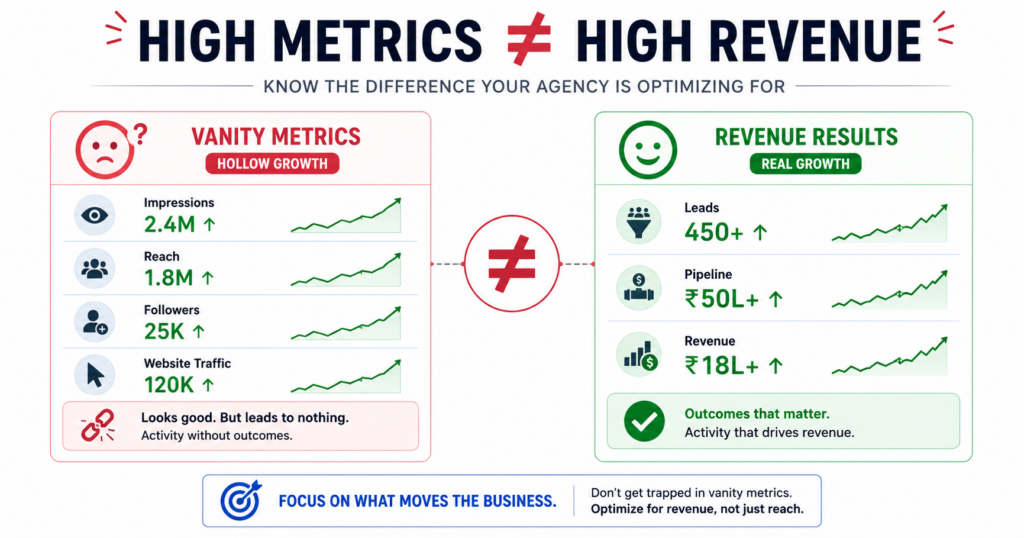
You get strategy clarity before spending $200K+ on a full-time hire. You avoid the 6-month ramp time problem at a critical growth stage. You can test if the strategy works before building a full team around it. It’s cheaper than hiring the wrong VP and paying severance. You build a marketing org that’s actually revenue-focused (not vanity-metric-focused).
Closing: Which One Should You Hire?
The bottom line: A Fractional CMO is insurance for the 30-person inflection point. You get senior-level marketing strategy and leadership without the salary lock-in. If it works, you’ve built a foundation to hire a VP. If it doesn’t, you’ve learned what doesn’t work without a 6-month severance commitment.
The worst thing you can do? Hire a full-time VP without clarity on strategy. The second worst? Stay without any experienced marketing leadership and hope tactics work.
Most B2B companies between 15–100 people should start with a Fractional CMO. Test the strategy. Prove the model. Then scale with a full-time leader if you need to.
If you’re at 30+ people and marketing isn’t producing pipeline, this is exactly the problem we’re built to solve at Amplio Luma.
If you’re at the 30-person mark and marketing isn’t producing pipeline, this is exactly the problem Amplio Luma is built for. Let’s spend 30 minutes on your situation no pitch, just diagnosis.