B2B email is broken.
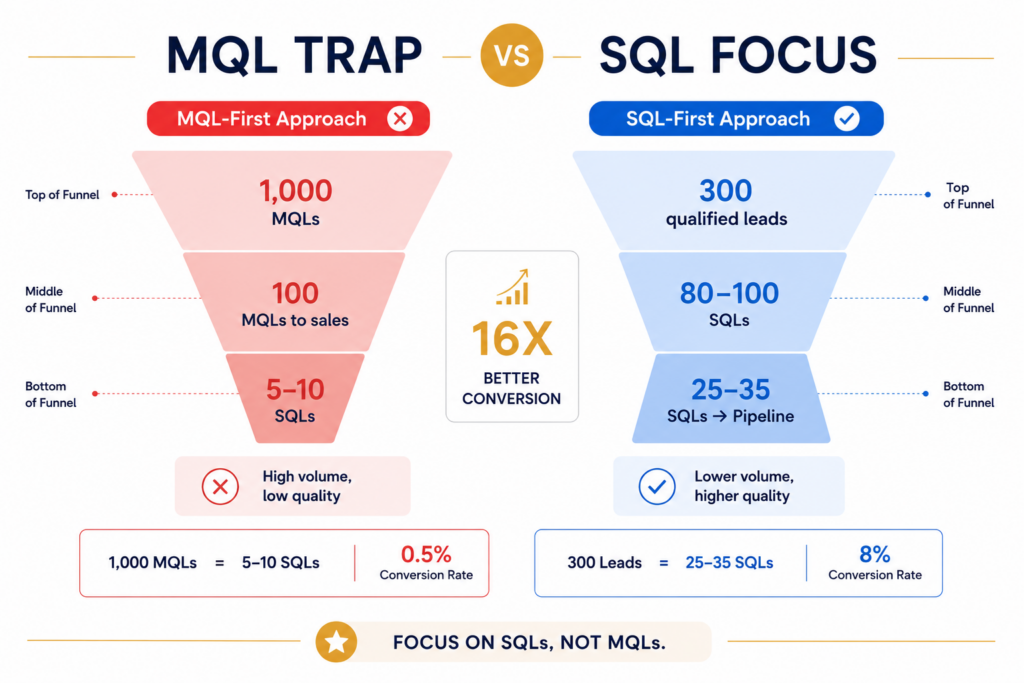
Companies send emails to “stay top of mind” but don’t measure if prospects actually move forward.
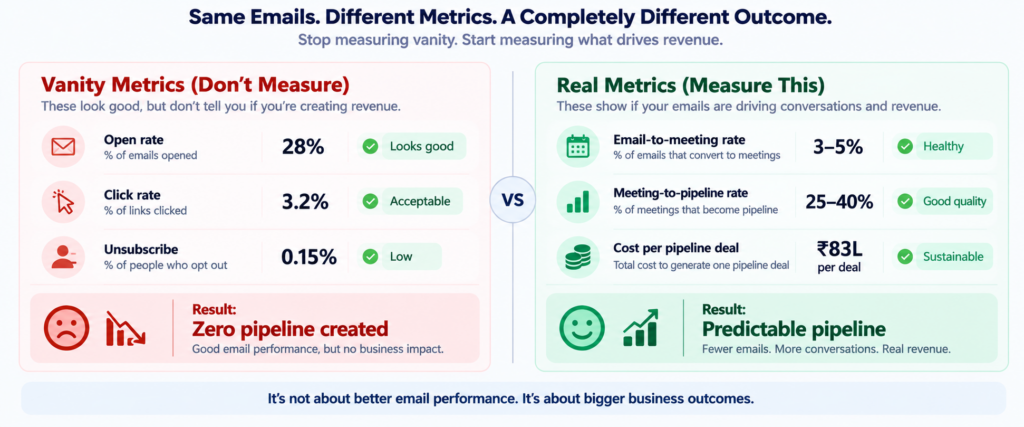
They track open rates (28%, looks good) but not pipeline created (zero, not good).
They optimize for volume (100 emails/day) instead of conversion (3-5 qualified leads).
Here’s the reality: Most B2B email is noise because it’s not built for pipeline progression.
The email that works isn’t the one that gets opened. It’s the one that moves a prospect closer to a conversation.
This is the exact 5-email sequence we use with clients to convert interest into pipeline and the metrics that actually matter.
Why Most B2B Email Fails to Build Pipeline
First, let’s diagnose the problem.
Most B2B companies optimize email for the wrong thing.
They optimize for open rate (28% is the benchmark). They optimize for click rate (the benchmark is 3-5%). They optimize for unsubscribe rate (keeping it below 0.2%).
None of these metrics connect to the pipeline.
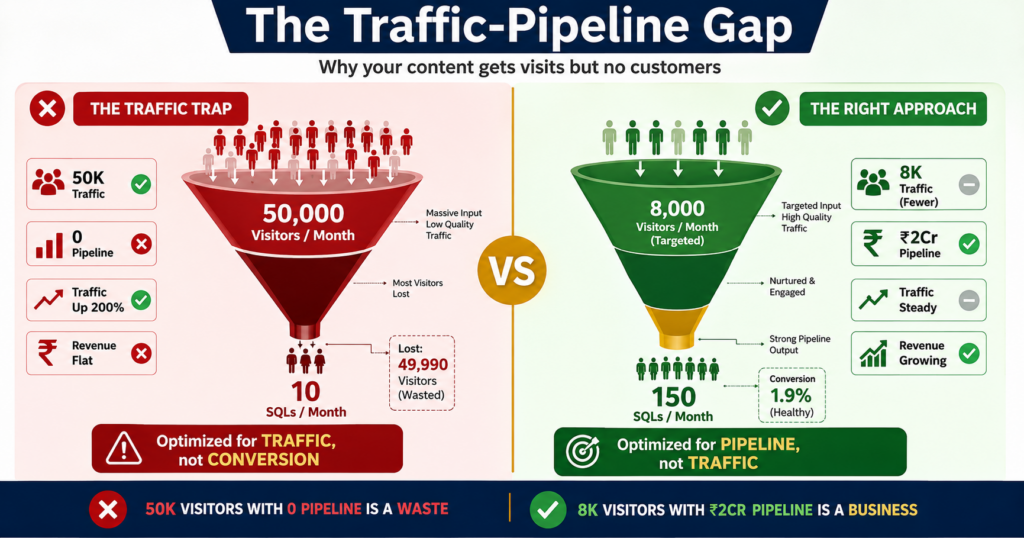
An email can have a 40% open rate and zero pipeline impact. The person opened it. They didn’t care.
An email can have a 5% click rate and still not move someone to a sales conversation. They clicked. They didn’t engage.
Why does this happen?
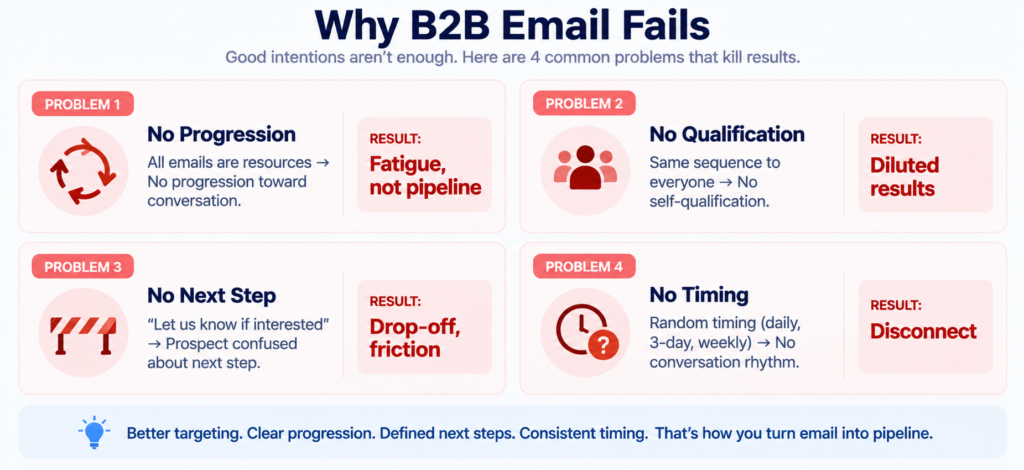
Email sequences aren’t designed for progression
- Email 1: Here’s a resource
- Email 2: Here’s another resource
- Email 3: One more resource
- Email 4: Still resources
- Email 5: Please call us
- Result: Fatigue, not pipeline
No qualification in the sequence
- You send the same sequence to everyone
- Both the right fit and the wrong fit get the same emails
- Results get diluted
No mechanism for the next step
- Email ends with “Let us know if interested.”
- The prospect has to figure out what’s next
- Friction = drop-off
Timing is random
- Emails come daily, every 3 days, every week
- No pattern the prospect recognizes
- No rhythm to the conversation
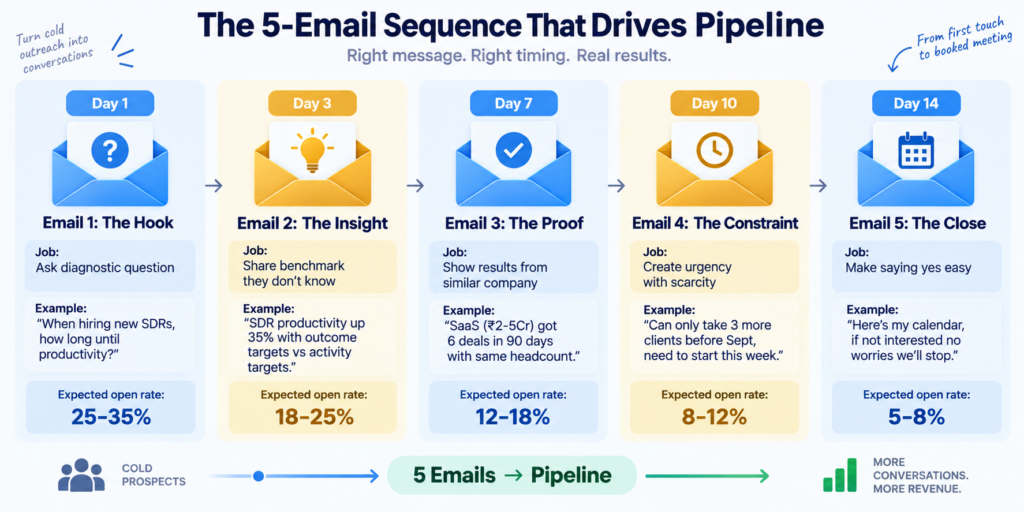
The 5-Email Sequence That Builds Pipeline
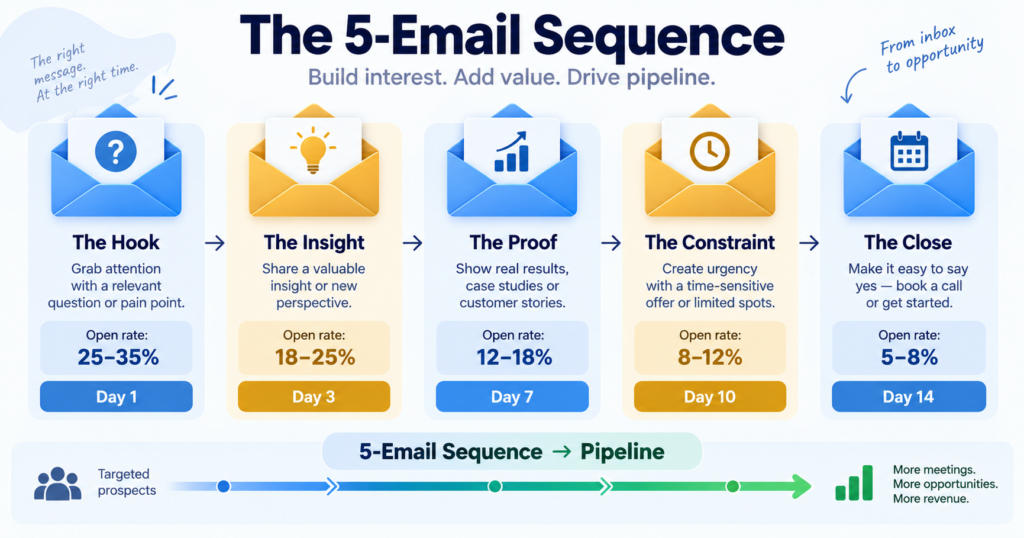
Here’s the exact structure we use. Each email has a job.
Email 1: The Hook (Day 1)
Goal: Establish relevance + ask a diagnostic question
Opening: “Quick question for you…”
Content: One specific problem your ICP faces. Not a pitch. Not a resource dump. A problem statement.
CTA: A yes/no question that requires them to think. “Does this sound familiar?” or “Is this on your roadmap this year?”
Why it works: You’re not pitching. You’re asking them to self-qualify. The response (even if it’s a silent open) tells you if they care.
Example: “Quick question: when you’re hiring new SDRs, how long does it typically take before they’re fully productive? Most companies take 3-4 months to ramp up.
Open rate expectation: 25-35% (it’s personalized, not broadcast)
Email 2: The Insight (Day 3)
Goal: Provide one specific insight that proves you understand their world.
Opening: “A quick insight based on what we’re seeing…”
Content: One trend or benchmark that matters to your ICP. A data point they don’t know yet. Something that makes them think, “Huh, I didn’t know that.”
CTA: A teaching CTA, not a selling CTA. “If you want to see the full breakdown, here’s the link” or “Here’s the tool we use to measure this topic.”
Why it works: You’re now moving from “someone asking questions” to “someone who knows my world.” Trust builds.
Example: “We’re seeing SDR productivity increase 35% when companies shift from activity targets (calls, emails) to outcome targets (conversations, pipeline). The math is wild: same effort, 3.5x outcome.
Open rate expectation: 18-25% (second email in sequence, some fatigue)
Email 3: The Proof (Day 7)
Goal: Show specific results with someone like them
Opening: “Here’s what we’re seeing in practice…”
Content: One case study. Short. Specific numbers. Same problem they have. Specific solution.
CTA: A credibility CTA. “If you want to see the full story, here’s a 2-min read.”
Why it works: Proof beats pitch. When they see someone like them got results, they stop asking if it’s possible and start asking if they can do it.
Example: “A SaaS company (₹2-5 Cr ARR like you) shifted their SDR team to pipeline targets instead of activity targets. Result: 6 closed deals in 90 days (vs. 2 typical), same headcount. Here’s how…”
Open rate expectation: 12-18% (third email, more fatigue, only engaged to stick around)
Email 4: The Constraint (Day 10)
Goal: Create urgency without being pushy
Opening: “Quick clarification…”
Content: Why now matters. Not “we’re raising prices” (cheap urgency). But “this works because X, and we can only take on 3 more clients this quarter before we’re full.”
CTA: A decision CTA. “Does this make sense for you, or should we just pass?”
Why it works: You’re giving them an out. “Should we just pass?” feels respectful. But it forces them to make a decision instead of staying in “thinking about it” forever.
Example: “We typically see results in 90 days because of the way we structure intake and sequencing. We can only take on 3 more clients before September, so if you are keen to explore this option, we’d need to start the conversation this week. Does that window work for you?”
Open rate expectation: 8-12% (fourth email, only the most interested are still reading)
Email 5: The Close (Day 14)
Goal: Make it easy to say yes
Opening: “Last one from us…”
Content: The entire conversation so far, but summarized in 3 sentences. Then a direct ask.
CTA: A calendar link. Not “let me know if you’re interested.” An actual meeting link.
Why it works: By email 5, if they’re still reading, they’re ready. You just made it easy.
Example: “Your challenge is that SDR ramp time is taking 3-4 months.” Our approach: shift to pipeline targets, measure daily, and adjust weekly. Results: 6 closed deals in 90 days with the same headcount. If this approach sounds worth exploring, here’s my calendar for a 20-minute call: [link]. If not, no problem, we’ll leave it here.
Open rate expectation: 5-8% (final email, only the most serious are still reading)
The Metrics That Actually Matter
Forget open rate. Here’s what to measure:
Email-to-Meeting Rate
Of all the emails you send in the sequence, how many result in a calendar booking?
- Emails sent: 500
- Meetings booked: 15-25
- Email-to-meeting rate: 3-5%
This metric tells you if the sequence moves people to conversation.
Meeting-to-Pipeline Rate
Of the meetings you book from email, how many become qualified opportunities?
- Meetings: 15
- Pipeline deals: 4-6
- Meeting-to-pipeline rate: 25-40%
This tells you if the meetings are actually qualified.
Cost Per Pipeline Deal from Email
- Annual email tool cost: ₹5L
- Emails sent per year: 5,000
- Pipeline deals created: 60
- Cost per pipeline deal: ₹83,000 per deal
Key insight: Email is often your cheapest channel per pipeline deal created.
5 Mistakes That Tank Email Pipeline Performance
Mistake 1: Same sequence for everyone
You send the same five emails to everyone who visits your landing page.
But your ICP has different pain points. A founder cares about different things than a VP of Sales.
Fix: Segment your list. Different sequences for different buyer personas.
Mistake 2: Sequence is too fast.
You send 5 emails over 5 days. It feels spammy.
Fix: Spread emails across 2 weeks. This matches the sales cycle (they’re thinking, not deciding).
Mistake 3: No unsubscribe path
People hate the sequence. But the only option is “unsubscribe.”
Fix: Add an “I’m not interested” option that removes them from this sequence (but keeps them on your general list).
Mistake 4: No qualification gate
You send the sequence to everyone, even if they’re clearly not a fit.
Fix: Qualify before the sequence. If they click “not interested” in email 1, don’t send emails 2-5.
Mistake 5: You measure the wrong thing.
You track open rate (30%) and declare success. Meanwhile, zero pipeline was created.
Fix: Measure the email-to-meeting rate and the meeting-to-pipeline rate. That’s success.
How to Implement This Sequence in 3 Days
Day 1: Write the 5 emails.
Take the templates above. Customize with your data. That’s 2-3 hours.
Day 2: Set up in your email tool
HubSpot, Marketo, and Klaviyo all have workflow/automation tools.
- Email 1 triggers on day 1
- Email 2 triggers on day 3 (if no click on email 1)
- Email 3 triggers on day 7 (if no click on email 2)
- Email 4 triggers on day 10
- Email 5 triggers on day 14
That’s 1 hour.
Day 3: Test + launch
Send the sequence to yourself. Check formatting, links, and CTAs. Launch.
Real Benchmarks: What to Expect in the India/GCC Market
B2B email open rates vary by region and subject line quality:
- India: 22-28% typical, 35%+ strong subject line
- GCC: 24-30% typical, 38%+ strong subject line
- Global average: 20-25%
But remember: Open rate ≠ pipeline. Instead, measure your email-to-meeting rates (3-5% is healthy).
Building a pipeline from email is simple once you know the sequence.
Let’s build your sequence together.