SEO got you traffic. AEO gets you cited. The buyers reading AI-generated answers never click through, so if your brand isn’t the answer, you don’t exist.
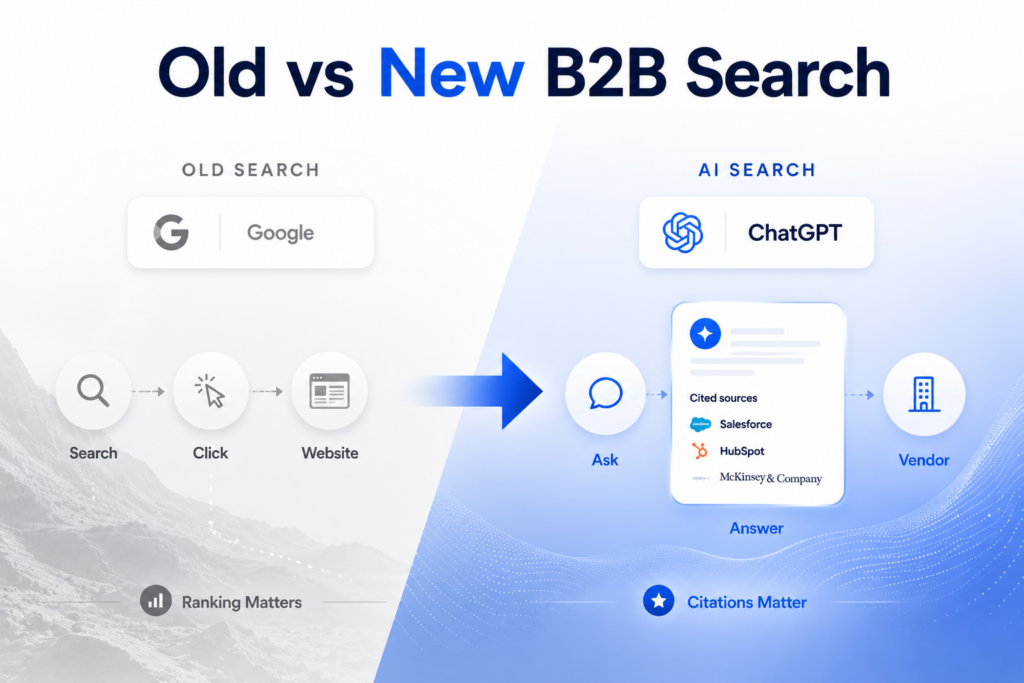
For 20 years, B2B marketers obsessed over Google rankings. The top 3 results got 70% of clicks. You ranked for “best CRM for mid-market”; you won the click.
That world is ending.
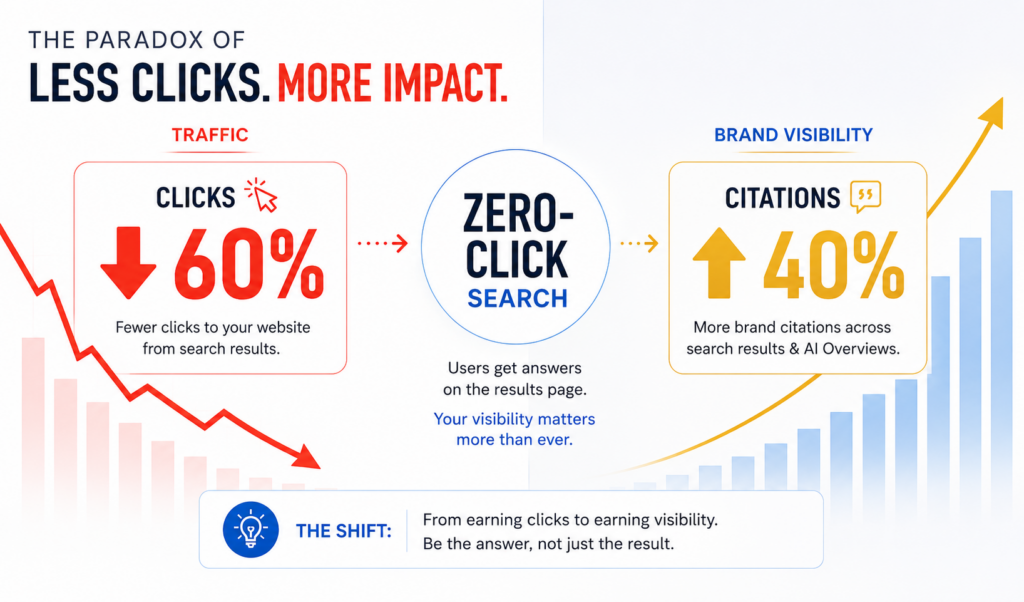
Now 60%+ of B2B tech queries show AI Overviews. Buyers ask ChatGPT, “What’s the best CRM for mid-market companies?” They read an AI answer that cites Salesforce, HubSpot, and Pipedrive. They never visit Google. They never click your website. They never even know you exist.
The new game isn’t ranking. It’s a citation. And it’s not taught in any traditional SEO playbook.
AEO (Answer Engine Optimization) is the framework for that new game.
Quick Definition Table
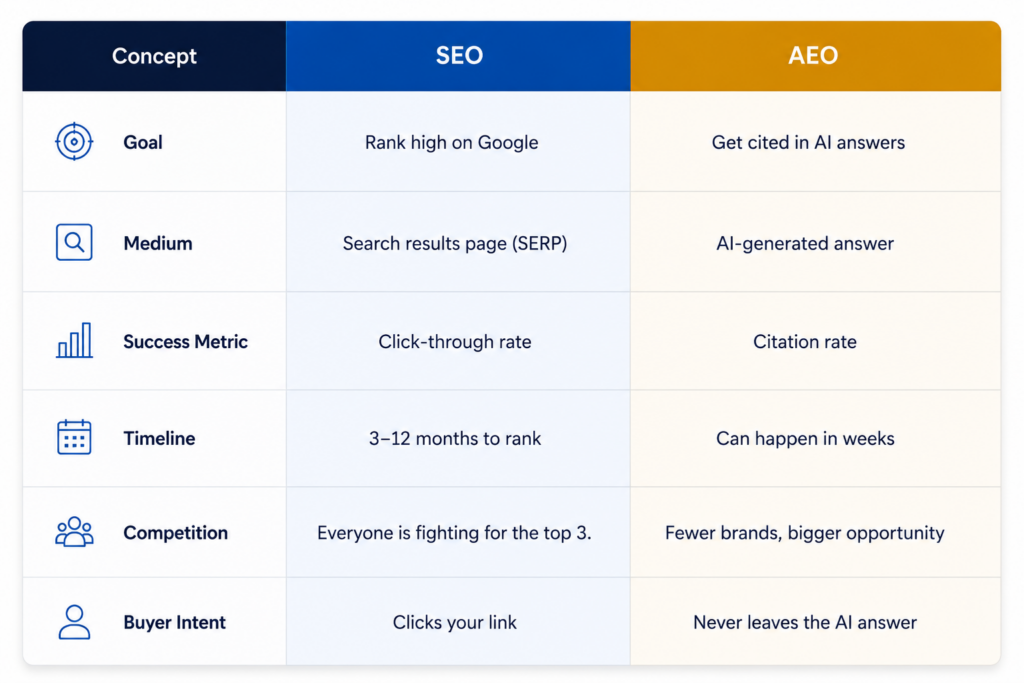
What AEO Means (And What It Doesn't)
AEO stands for Answer Engine Optimization. It’s the practice of structuring your content and building your authority so that AI language models cite your brand when answering user questions.
That’s it. That’s the core idea.
What AEO is:
- Getting cited in ChatGPT, Perplexity, Google AI Overviews, Claude, and other answer engines
- Being recognized as an authoritative source by AI systems
- Appearing in the synthesized answers that buyers read (not in a list of links)
- A strategy for the post-Google era of search
What AEO is NOT:
- A replacement for SEO (SEO still matters, but it’s not enough)
- About tricking AI or “gaming the algorithm”
- Only for big brands (small brands can own this right now)
- Complicated (it’s built on fundamental principles)
The mental shift required:
For 20 years, we optimized for “Will this page rank?” Now we optimize for “Will AI cite this page?”
Those are two different questions. And they require two different strategies.
Traditional SEO asks: “How do I beat other websites for this keyword?”
AEO asks, “How do I become so authoritative that AI systems recognize me as the answer?”
How AEO Differs from Traditional SEO
SEO and AEO both care about authority and content quality. But they optimize for different things.
Traditional SEO (Still Important):
- Goal: Rank on Google’s search results page
- Metric: Position #1-3 gets most clicks
- Strategy: Backlinks, on-page keywords, technical SEO
- Timeline: 3-12 months to see results
- Competition: Very high (everyone fighting for top 3)
- Buyer behavior: Clicks your link, reads your page
AEO (The New Frontier):
- Goal: Get cited in AI-generated answers
- Metric: Citation frequency in ChatGPT, Perplexity, Google AI
- Strategy: Content structure, schema markup, brand authority, mentions
- Timeline: 2-8 weeks to see first citations
- Competition: Low (most brands haven’t started)
- Buyer behavior: Reads AI answer citing you, trusts your brand
The overlap: Both require authority. Both require good content. Both require people to know you exist.
The difference: SEO optimizes for ranking and clicks. AEO optimizes for citation and trust.
You can rank #1 on Google and still not be cited by AI. (You have good SEO but poor AEO.)
You can have lower rankings but be cited constantly by AI. (You have good AEO but ignore SEO.)
The smart move: Do both. Use SEO to get traffic. Use AEO to get cited.
The B2B Buying Journey in the AI Era
Three years ago, the B2B buying journey looked like this:
- Problem recognised
- Google search
- Visit 5-10 websites
- Read reviews on G2, Capterra
- Request demo
- Talk to sales
Now it looks like this:
- Problem recognised
- Ask ChatGPT / Perplexity
- Read AI answer (mentions 2-3 brands)
- Trust those brands
- Request demo
- Talk to sales
The critical shift: Step 3.
In the old model, you had time to convince. The buyer visited your website, read your content, compared you to competitors and made a decision.
In the new model, buyers have already made their decision. The AI cited Brands X, Y, and Z. Those are the trusted options. Everything else is invisible.
If that AI answer doesn’t cite your brand, you lost the deal in step 2.
See why most B2B brands are invisible in AI search
The implication for B2B marketers:
You can’t wait for Google rankings anymore. AI answers are faster and more trusted. Your buyers prefer them.
So your marketing strategy must shift from “How do we rank on Google?” to “How do we get cited by AI?”
That’s AEO.
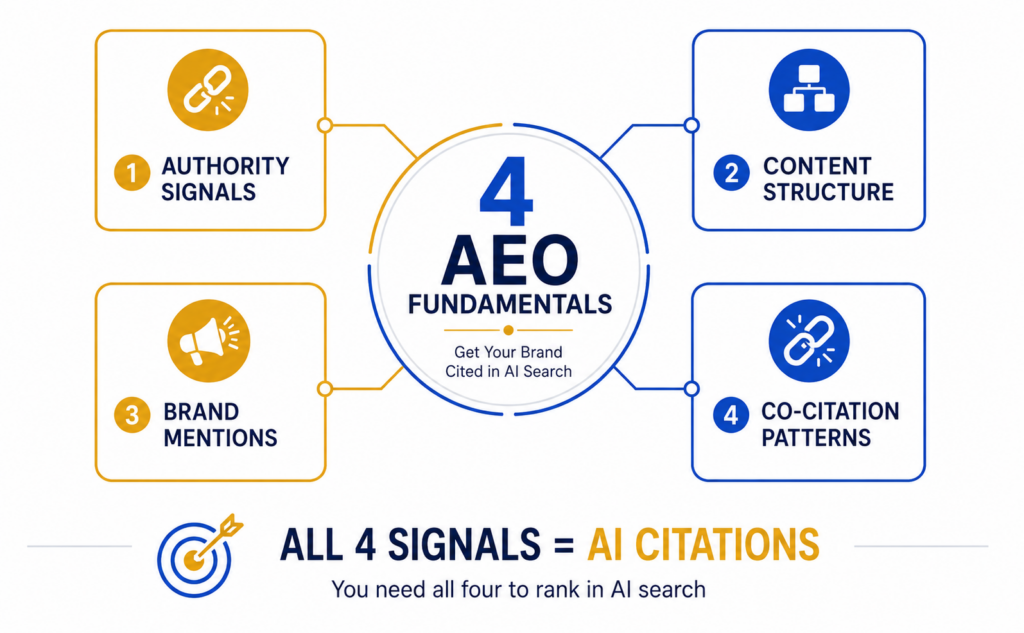
4 AEO Fundamentals Every Brand Needs
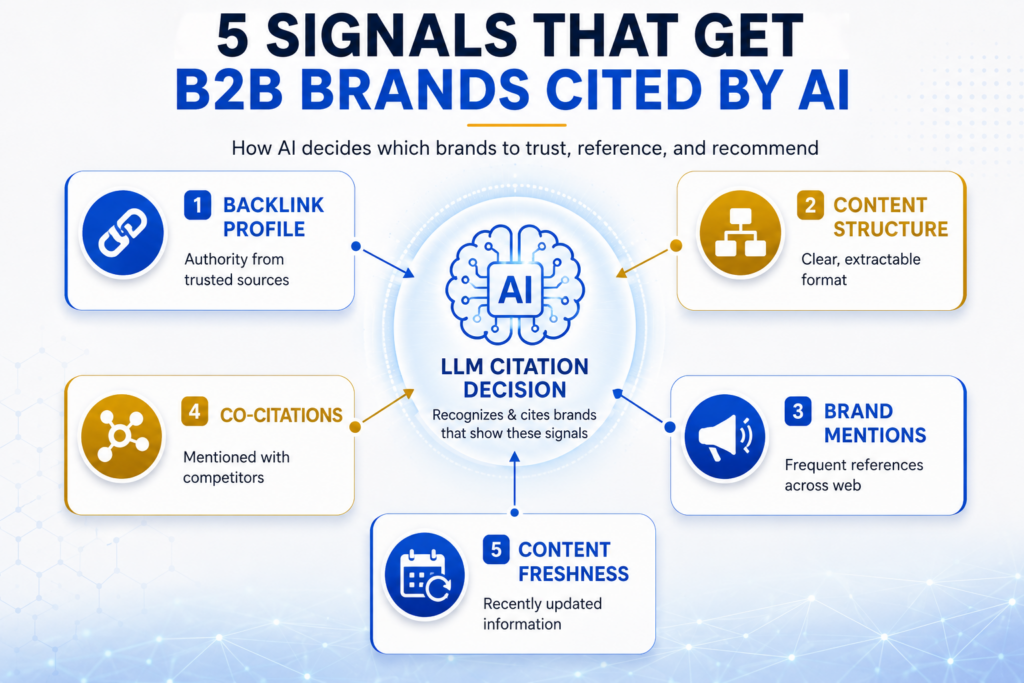
If you want to get cited by AI, you need four things. Not one, not two. All four.
Fundamental 1: Authority Signals
AI systems assess whether you’re a credible source by looking at:
- Backlinks from authoritative domains (not just quantity, but quality)
- How many websites mention your brand
- Your domain authority (typically 30+ is a baseline)
- Whether industry publications cite you
Action: Get mentioned in 10+ industry publications, analyst reports, and partner sites. One mention from TechCrunch > 100 mentions from blogs.
Fundamental 2: Content Structure (AI Extraction)
AI can only cite you if it can extract clear information from your site. It needs:
- Clear H2 and H3 headers (not walls of text)
- Bullet points and lists (easy to parse)
- Tables and data (AI loves structured information)
- Schema markup (tells AI what you are)
Action: Audit your 10 most important pages. Add schema markup. Restructure content with H2s and bullets. You don’t need to rewrite; just reorganize.
Fundamental 3: Brand Mention Frequency
How often is your brand mentioned across the web? AI tracks these instances.
If your brand gets mentioned 100 times in industry contexts, you have higher authority than a competitor that gets mentioned 5 times. Period.
Action: Get mentioned in:
- Industry publications (aim for 20+ publications)
- Review sites (G2, Capterra, similar)
- Partner ecosystem (integrations, partnerships)
- Speaking engagements and event recaps
- Analyst reports
Fundamental 4: Co-Citation Patterns
When people discuss your category, are you mentioned alongside the leaders?
If someone writes “best CRM for mid-market,” do they mention your brand alongside Salesforce, HubSpot, Pipedrive? Or do they mention Salesforce, HubSpot, Pipedrive, and 10 others (but not you)?
Co-citation shows you’re in the same tier as competitors.
Action: Get reviewed on comparison sites where you appear next to competitors. Get mentioned in “top 5” and “best of” roundup articles. Be cited by industry influencers alongside category leaders.
How to Start Without Rebuilding Everything
AEO doesn’t require a complete website overhaul. You can start with quick wins.
Week 1-2: Content Structure
- Audit your top 5 pages
- Add clear H2 headers (if missing)
- Add bullets and lists (where you have paragraphs)
- Add schema markup to homepage and key product pages
Time: 8-10 hours. Impact: Immediate (AI can now extract your information).
Week 3-4: Schema Markup
- Install schema markup on all key pages
- Add Company schema to homepage
- Add Product schema to product pages
- Add Article schema to blog posts
Use Google’s Structured Data Testing Tool to verify. Time: 4-6 hours. Impact: AI now understands what you are.
Month 2: Authority Building
- Get mentioned in 5 industry publications
- Get listed on 3 review sites (G2, Capterra, similar)
- Publish a new blog post or asset that targets your category (e.g., “Best X for Y”)
Time: 20-30 hours (mostly outreach). Impact: Brand mention frequency increases.
Month 3: Content Optimization
- Update your 10 most important pages with fresh data
- Ensure each page targets your category clearly
- Add internal links between related pages
- Make sure each page answers a specific user question
Time: 15-20 hours. Impact: AI can extract better answers from your site.
What NOT to do:
Don’t wait for perfection. Don’t rebuild everything. Don’t hire an agency. Start with these four fundamentals, measure citations after 30 days, then adjust.
The brands winning at AEO right now started 60 days ago. You can catch up fast.
Why This Matters (And When to Prioritise It)
AEO matters because the buying journey changed and you didn’t get a memo.
Your competitors are already getting cited. Salesforce, HubSpot, Stripe, and Slack are cited constantly because they have authority, structure, and mentions. Smaller brands that move fast are also getting cited.
The brands still waiting for Google rankings? They’re losing deals.
When to prioritize AEO:
Immediately if:
- You’re in B2B SaaS, marketing, or tech (fast AI adoption)
- Your average deal is $50K+ (AEO gives you a 2-month advantage over competitors)
- You’re 15-100 people (smaller, faster to execute)
- You’re between Series A and B (proving pipeline before investors ask)
Not immediately if:
- You’re in traditional industries where AI search adoption is still low
- Your deals are small (<$10K)
- You already dominate Google rankings and customers come to you
But even then, AEO will matter in 12 months. Better to start now.
The Closing: Your Next Step
SEO got you traffic. AEO gets you cited. And cited brands earn trust.
In the AI era, being the answer matters more than ranking high. Your buyers are reading AI answers, not visiting Google. They’re trusting the brands cited in those answers. They’re never clicking through to your website.
If you’re not in those answers, you’re invisible.
The good news: The time is early. Most brands haven’t started optimizing for AEO. The window to own your category is open right now.
Start with the 4 fundamentals. Pick one. Execute this month. Measure citations after 30 days. Adjust.
The brands that move first will own AI search visibility in their category for years.
Find out where your brand stands in AI search: free snapshot →