
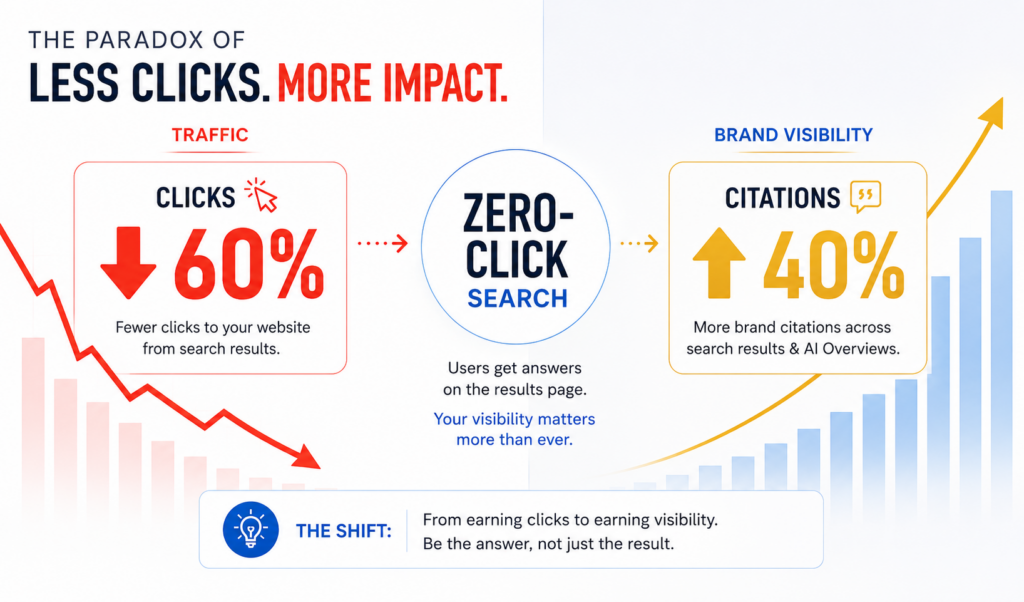
Your search traffic just dropped 30%.
You check Google Analytics. Organic sessions are down. Click-through rate is down. But wait, your brand is showing up MORE in Google search results.
What’s happening?
Zero-click search.
A buyer searches, “What’s the best CRM for sales teams?” Google answers the question directly in an AI Overview. The buyer reads the answer. Gets their information. Clicks away.
They never visit your website.
But they saw your name cited as the source.
This is the new reality. And it changes everything about how B2B lead generation works.
The game isn’t “rank and get clicked” anymore. It’s “get cited and get remembered.”
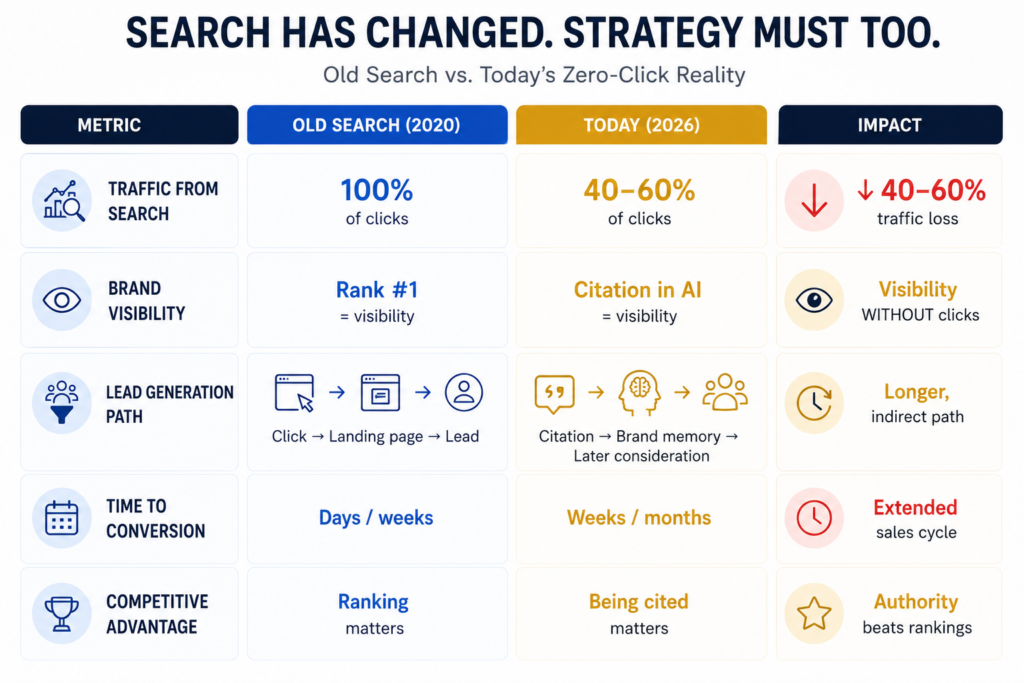
Quick Problem Summary (Table)
What Zero-Click Search Actually Means
Zero-click search happens when
- A buyer searches a question
- “How do you implement AI in sales?”
- “What’s the cost of a fractional CMO?”
- “Best practices for B2B lead scoring?”
2. Google shows an AI Overview answer
- AI synthesizes information from multiple sources
- Shows the answer right in search results
- Cites the sources it used
3. The buyer reads the answer and leaves
- No click to your website
- No visit to your landing page
- No lead captured
- But your brand was mentioned
The trend: 60%+ of search queries now trigger AI Overviews. Of those, 40-50% result in zero clicks (the buyer got what they needed).
The consequence: Search traffic is dropping. But brand visibility (through AI citations) is staying the same.
You’re being seen more and visited less.
How AI Overviews Are Reshaping B2B Buying
The B2B buying journey is changing because AI Overviews are changing when and how buyers get information.
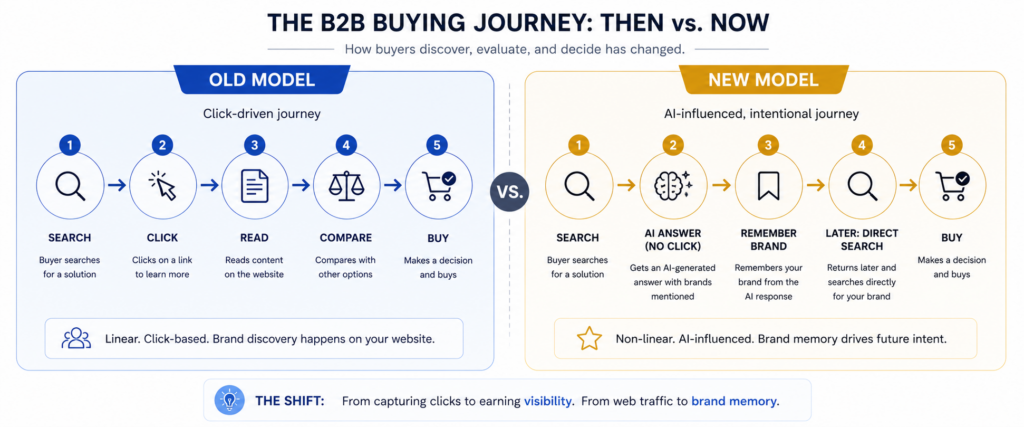
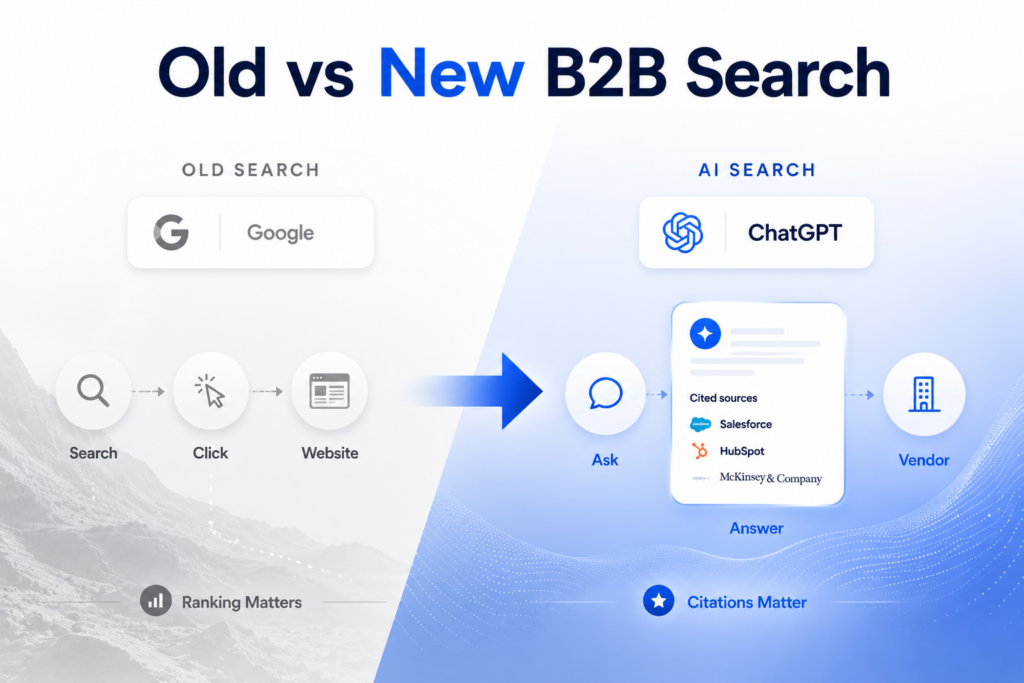
Old buying journey:
Awareness: Search → Click → Read
Consideration: Multiple searches → Multiple clicks → Compare options
Decision: Final search → Read reviews → Buy
New buying journey:
Awareness: Search → Get AI answer (no click)
Consideration: Search again → See different sources cited → Remember brands
Decision: Go directly to known brands OR search with brand name
What this ranking means:
In the old model, ranking #1 meant you got the click. You got the visitor. You could start the nurture sequence.
In the new model, being cited in AI Overviews means you get brand memory. The buyer remembers you. But they don’t visit. Not yet.
Then, when they’re ready to buy (weeks or months later), they remember which brands were cited. They search “[Your company] pricing” or “[Your company] cost.” They visit your site directly.
Result:
Your search traffic drops (fewer clicks). But your brand awareness increases (more citations). And your direct traffic increases (buyers searching for you by name).
The game isn’t broken. It’s just different.
The 3 Ways B2B Brands Lose in a Zero-Click World
If you’re not prepared, zero-click search will devastate your lead generation.
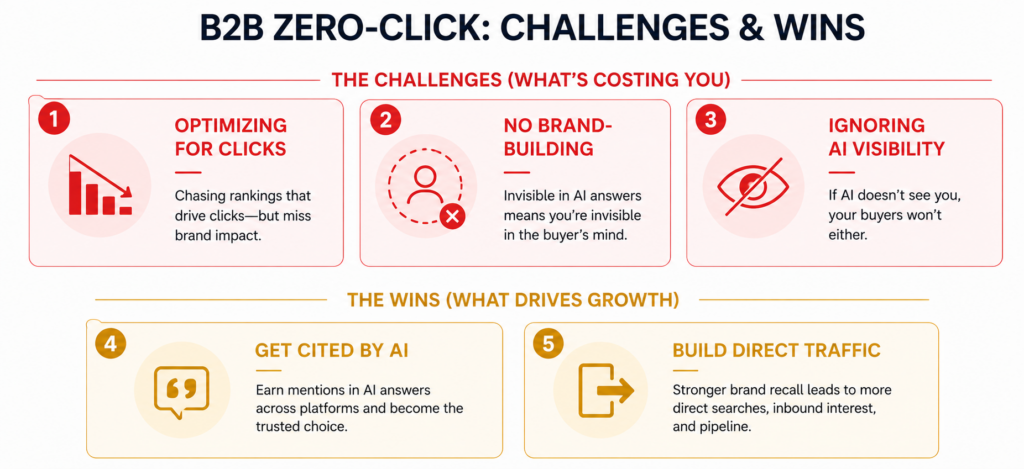
Way 1: Optimizing for clicks instead of citations
You’re still writing blog posts to rank for keywords. You’re still optimizing for click-through rate.
But the game changed. You should be optimizing for:
- Being cited by AI Overviews
- Brand memorability
- Direct traffic (people searching your name)
If you keep chasing clicks, you’ll get fewer and fewer as zero-click search grows.
Way 2: No brand-building alongside demand gen
You’ve relied on search traffic to drive leads. Zero-click search means you also need to build brand awareness.
Brands that only do demand gen (search, ads, content) are losing out.
Brands that do demand gen AND brand-building (thought leadership, PR, community) are winning.
If you’ve skipped brand-building, zero-click search exposes that.
Way 3: Ignoring AI visibility
You’re not optimized for AI extraction. Your content isn’t structured for LLMs. You’re not getting cited by ChatGPT or Perplexity.
While your competitors get cited (and remembered), you’re invisible.
Result: You lose the brand memory game. When buyers are ready to buy, they don’t remember you.
The 2 Ways B2B Brands Win in a Zero-Click World
If you’re prepared, you can turn zero-click search into an opportunity.
Way 1: Be cited by AI (get brand memory)
Strategy: Optimize for LLM citations (not just search rankings)
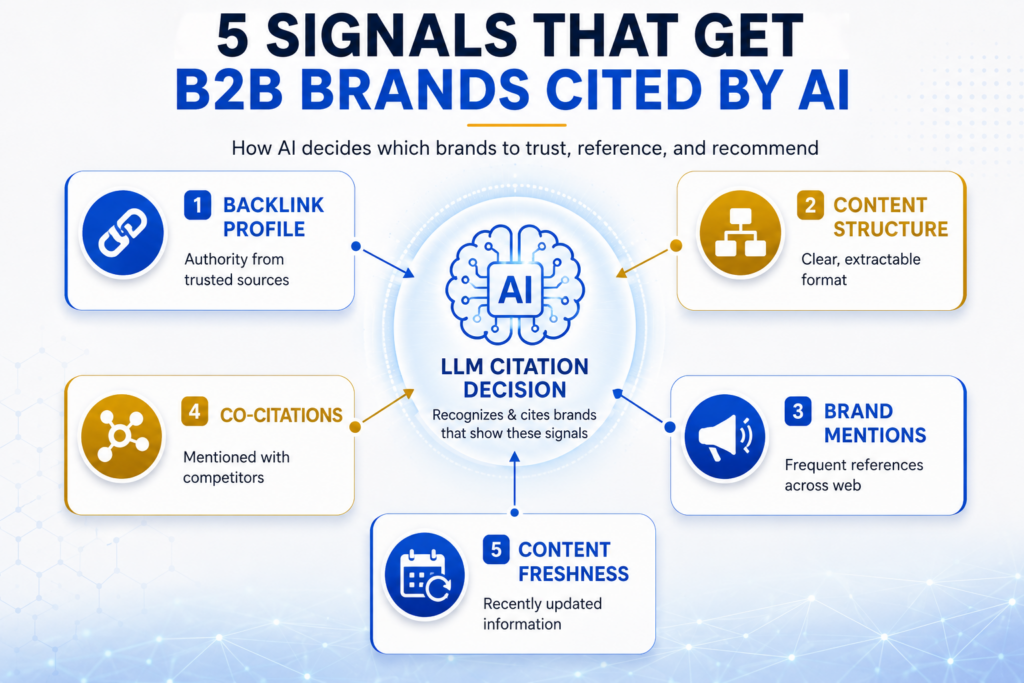
- Structure your content for AI extraction (clear H2s, bullets, schema)
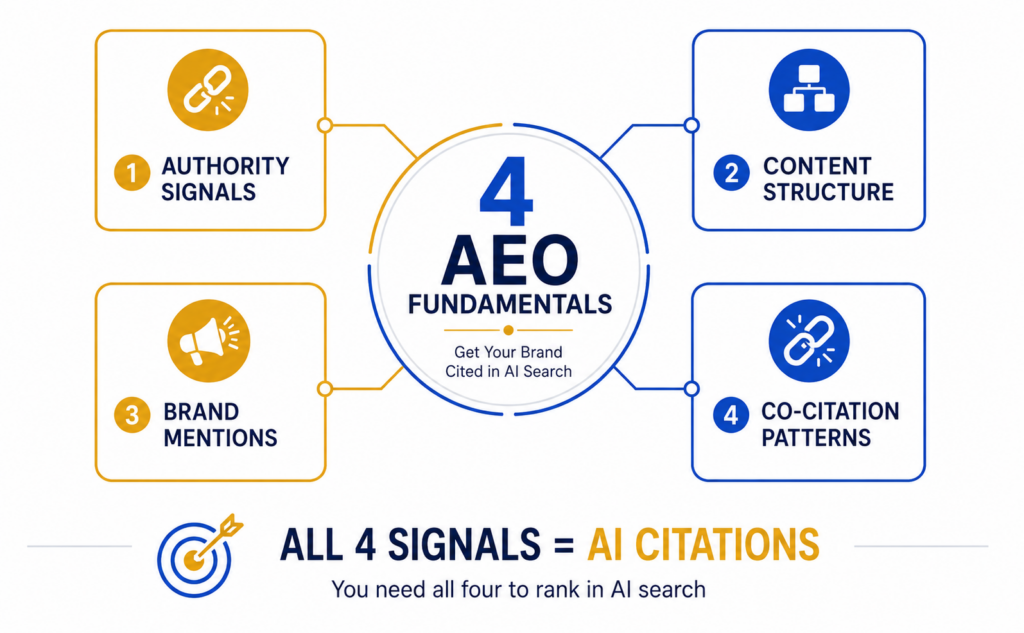
- Build authority signals (backlinks, mentions, co-citations)
- Get cited in AI Overviews for your category
When a buyer sees your brand cited in an AI Overview (even without clicking), they remember you. They associate you with authority on that topic.
Weeks later, when they’re ready to buy, they search for you by name.
Execution (this week):
- Audit 3 key content pieces (is the structure AI-friendly?)
- Optimize for authority signals (who can mention you this month?)
- Get cited in 1 AI context (pitch a research report, contribute to industry guide)
Way 2: Build direct traffic (be the brand people search for)
Strategy: Be so well-known that people search “[Your company] pricing” instead of “pricing for [category].”
When direct traffic is high, you don’t depend on search clicks. You depend on brand memory.
Execution (this week):
- Build a brand positioning statement (what do you own in buyers’ minds?)
- Run founder thought leadership (LinkedIn, podcasts, media)
- Create “company name search” content (FAQs, pricing pages, comparison pages)
What to Do With Your Lead Gen Strategy Now
Here’s what changes, starting this week:
Change 1: Shift from “rank for keywords” to “get cited by AI”
Old strategy: Publish blog about “CRM software” → Rank #1 → Get clicks → Convert leads
New strategy: Publish content about “CRM software” → Get cited in AI Overviews → Build brand memory → Later, direct traffic + conversion
Action this week:
- Audit your top 5 blog posts
- Check if they’re cited in AI Overviews (ask ChatGPT/Perplexity your category question)
- If not cited: Improve structure + authority signals
- If cited: Protect the citation (keep content fresh, maintain authority)
Change 2: Add brand-building to your demand gen
You can’t rely on search clicks anymore. You need brand memory.
Old strategy: 100% of budget to demand gen (content, ads, conversion)
New strategy: 70% demand gen + 30% brand-building (thought leadership, PR, community, word of mouth)
Action this week:
- Identify 3 brand-building channels (founder LinkedIn, Industry podcast, Media outreach?)
- Plan 1 brand-building initiative for next quarter
- Allocate 10-20% of content budget to thought leadership
Change 3: Measure success differently
You can’t just measure search traffic anymore. You need to measure:
- Brand citations (are you cited in AI Overviews?)
- Direct traffic (people searching your name)
- Brand awareness (how many prospects know you?)
- Sales cycle impact (does brand awareness shorten cycles?)
Action this week:
- Set up Google Analytics filters for direct traffic
- Monitor your brand in AI Overviews weekly
- Add “brand awareness” metrics to your dashboard
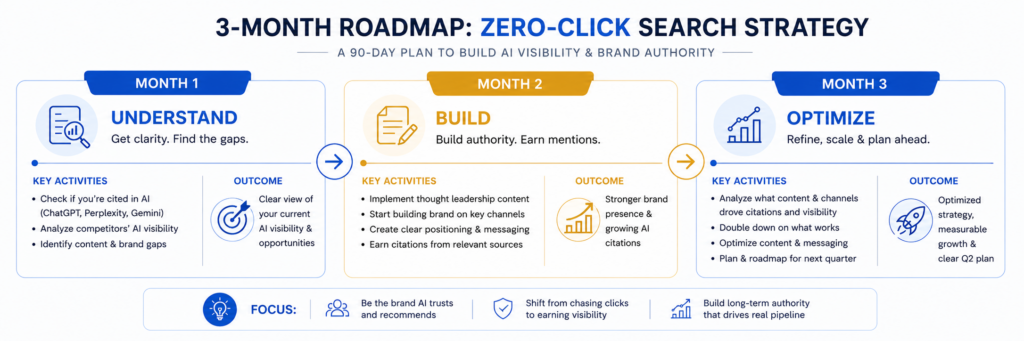
The 3-Month Roadmap
Month 1: Understand your zero-click opportunity
Week 1:
- Check if you’re cited in AI for your top 5 keywords
- Identify which competitors ARE cited
- Understand why they win (content structure, authority)
Week 2-3:
- Improve your top 10 content pieces for AI extraction
- Build 2-3 authority signals (backlinks, mentions)
Week 4:
- Measure: Are you cited more?
- Adjust strategy based on early data
Month 2: Build brand alongside demand gen
Week 1:
- Implement thought leadership content (founder, team)
- Start 1 brand-building channel (podcast, LinkedIn series)
Week 2-3:
- Create content that builds brand (positioning, opinion pieces)
- Get Amish/founder on podcast or in media
Week 4:
- Measure: Direct traffic increasing? Brand mentions growing?
Month 3: Optimize the new model
Week 1:
- Analyze: Which strategies worked? (Citations? Brand-building?)
- Double down on what works
Week 2-3:
- Refine: Improve execution on winning strategies
- Kill: Stop doing what doesn’t work
Week 4:
- Plan next quarter based on learnings
Not sure if your brand is winning or losing in zero-click search?
Get your free AI Visibility Snapshot; we’ll show you where you’re cited, where you’re missing, and what to fix.
This hit different lol. I literally checked my analytics last week and thought something broke — traffic down but somehow more brand mentions showing up when I search stuff. Didn’t realize this was an actual trend and not just me.
The “rank and get clicked” vs “get cited and get remembered” line is gonna stick with me tbh. Makes total sense why my direct traffic has been creeping up even though clicks from search are flat.
Gonna go audit my content for AI citations now, thanks for this.