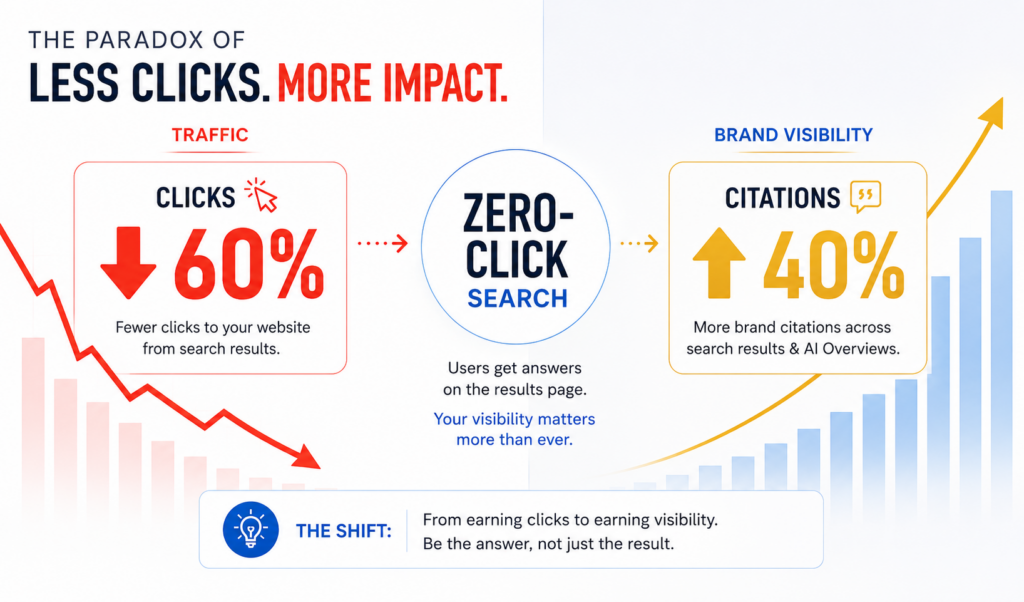
AI Overviews now dominate 60%+ of B2B tech queries. If you’re running marketing at a B2B SaaS company between 15 and 200 people, this is the problem you haven’t fully diagnosed yet: if you’re not cited, you don’t exist in the new buying journey.
Your buyers have changed how they research. They no longer start with a Google search and click through 5 websites. They open ChatGPT or Perplexity, ask a question, and read the AI-generated answer. Done.
That answer? It cites 2-3 “authoritative” brands. Maybe Salesforce. Maybe HubSpot. Maybe a few smaller players. But probably not you.
Unless you’re one of those cited brands, your prospects are reading answers that mention your competitors. They never learn you exist. They never click to your website. They never see your value prop.
This is the new competitive dynamic: visibility in AI search results, not Google rankings.
And most B2B brands are invisible.
Here’s What AI Visibility Looks Like in Practice
Before we diagnose the problem, let’s see what success looks like.
A B2B founder searches “best outbound sales tools for SaaS” in Perplexity. The AI answer reads:
“Top outbound sales platforms for SaaS teams include Apollo.io (unlimited email sequences, lead database), Outreach (workflow automation, deal management), and Salesloft (comprehensive revenue intelligence). Each has different strengths depending on team size and automation needs.”
In this one answer, three brands just owned that buying moment. Apollo.io, Outreach, and Salesloft are now the category leaders in this buyer’s mind. Every other outbound sales vendor, no matter how good, didn’t exist in this conversation.
That’s what AI visibility looks like. And it’s what most brands don’t have.
Why This Matters for India/UAE SaaS Companies
If you’re building a B2B SaaS company in India or the UAE/GCC region, the opportunity is even larger.
In Western markets (US, UK, EU), the AI search game is crowded. Established brands with massive backlink profiles (Salesforce, HubSpot, Pipedrive) already dominate citations. The competitive landscape is entrenched.
But in India and the GCC, the landscape is different. AI search adoption is growing fast, but the competitive consolidation hasn’t happened yet. There’s a citation gap fewer brands are fighting for those mentions, and the criteria for “authority” are different. A strong Indian or UAE-based SaaS brand with good content, backlinks, and mentions can own its category in AI search before the global players notice.
If you’re building in these markets and you move on AI visibility now, you can lock in category leadership before competitors catch on. That’s a significant advantage.
How AI Search Results Are Built
AI Overviews (Google’s term) and answer engines (ChatGPT, Perplexity) work differently than traditional search. Here’s what you need to know:
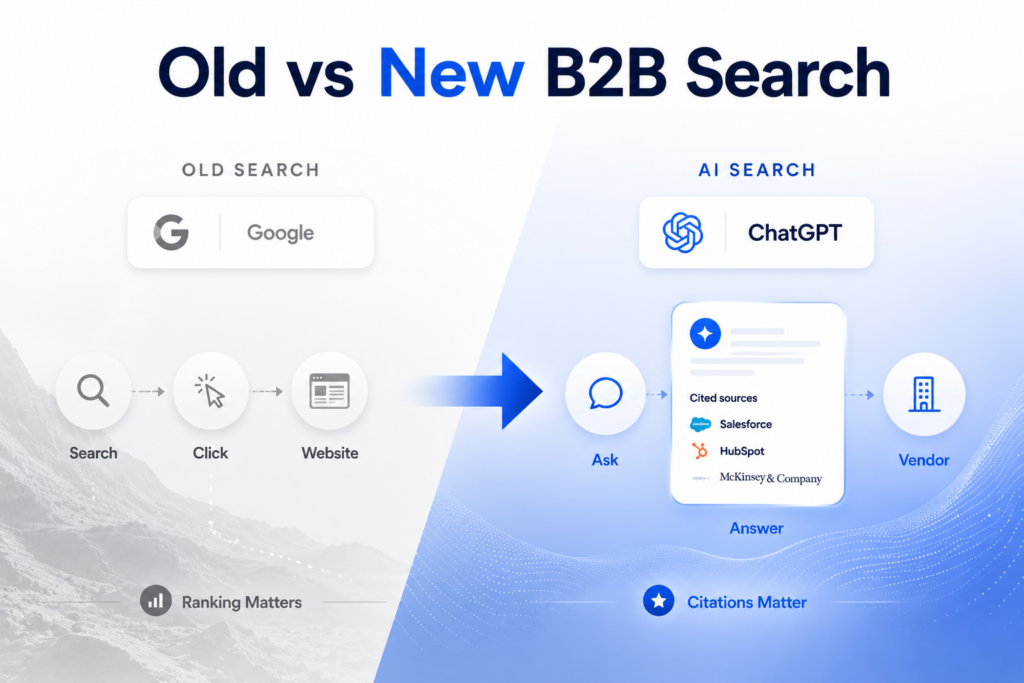
Traditional Google Search:
- User searches keyword
- Google returns ranked list of websites
- User clicks a result
- User reads the page
In this model, ranking is king. The top 3 results get 70% of clicks.
AI Search (ChatGPT, Perplexity, Google AI Overviews):
- User searches or asks a question
- AI scans 100+ sources
- AI synthesizes one answer
- AI cites 2-5 “authoritative” sources in the answer
- User reads the answer, maybe clicks citations
In this model, citation is king. Being mentioned is more valuable than ranking.
How does AI decide who to cite?
The LLM (Large Language Model) looks for:
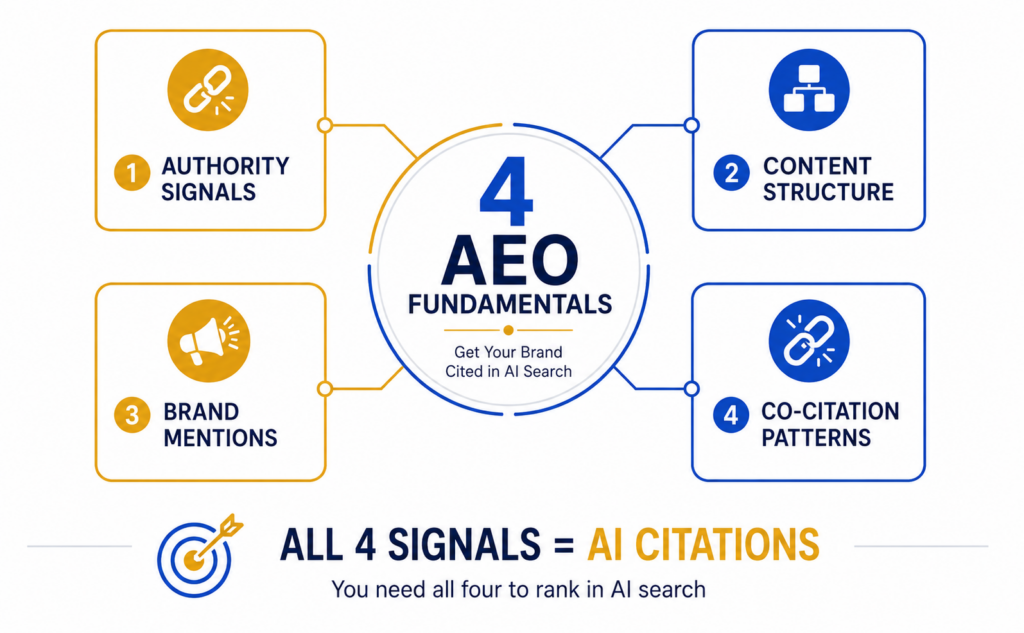
- Authority signals: Backlinks, domain authority, expertise
- Content structure: Clear headings, bullets, schema markup
- Frequency: How often your brand is mentioned across the web
- Context: Is it mentioned in the right context?
- Recency: Is it fresh, updated, current?
- Cross-referencing: Are you cited by other authoritative sources?
The AI doesn’t read your website once and rank it. It scans the entire web, identifies which brands are mentioned most often as authorities on a topic, and synthesizes those into an answer.
Example: A founder searches “What’s the best SaaS CRM for mid-market companies?”
ChatGPT’s answer might be:
For mid-market SaaS companies, top CRM platforms include Salesforce (enterprise-grade, highly scalable), HubSpot (mid-market friendly, good for startups), and Pipedrive (sales-focused, flexible). Each has different pricing models and feature sets.
Notice: Only 3 brands are mentioned. Thousands of other CRM platforms don’t exist in this answer. Why? Because Salesforce, HubSpot, and Pipedrive have:
- Massive backlink profiles
- Content at scale
- Frequently mentioned across industry sites
- Schema markup identifying them as CRM platforms
- High domain authority
Your CRM platform? Probably mentioned nowhere in that answer. Even if it’s objectively better for mid-market. Even if it’s cheaper. Even if it has better features.
It doesn’t matter. You’re not cited. You don’t exist to this buyer.
Why Most B2B Brands Are Invisible
Here’s the brutal truth: Most B2B brands are invisible in AI search because they meet none of the citation criteria.
The 5 visibility gaps:
- Low authority signals: You probably have a total of 50-200 backlinks. Salesforce has 50,000+. Your domain authority is likely 30-40. Theirs is 70+. To AI search engines, you’re not yet a recognized authority, and that’s fixable.
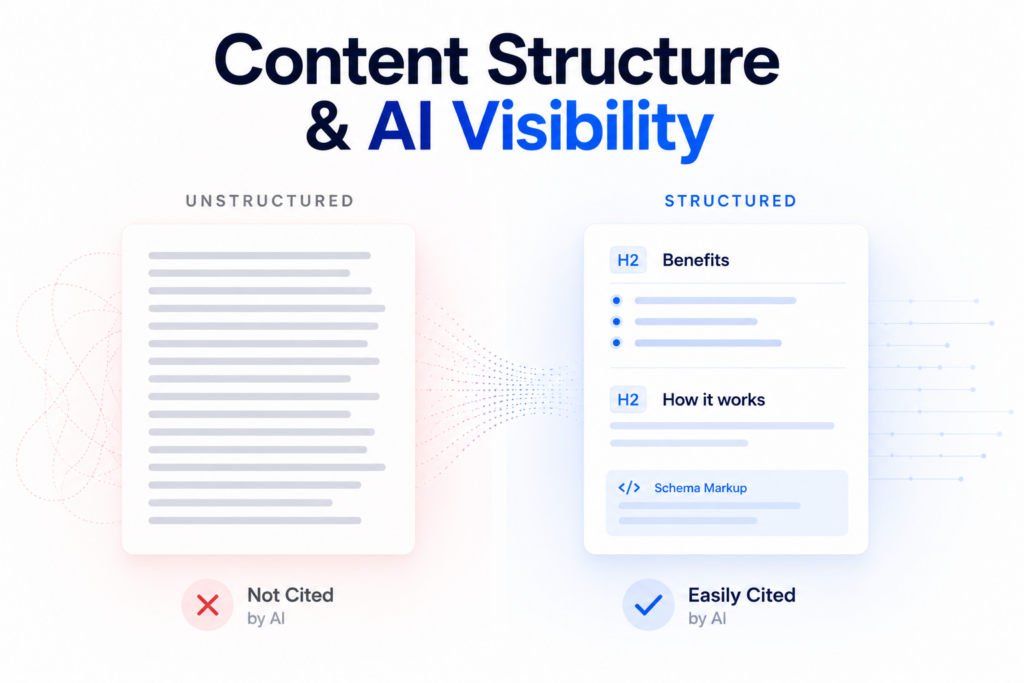
- Poor content structure: Your blog posts are probably written for humans (narrative, long paragraphs). AI can’t extract structured information from walls of text. It extracts from clear H2s, bullet points, tables, schema markup. Your content is invisible to extractors.
- Low mention frequency: Your brand is mentioned on maybe 10-20 websites. Industry leaders are mentioned on 1,000+. AI weights the brands mentioned most often as most authoritative.
- Weak co-citation patterns: When people mention CRM platforms, they mention Salesforce, HubSpot, Pipedrive together. When your brand is mentioned, it’s usually alone, out of context. That signals weak authority.
- Missing from aggregator sites & schema markup: You’re probably not mentioned on G2, Capterra, industry rankings, or review sites. Industry leaders are mentioned on 50+ third-party sites. Plus, you probably lack schema.org markup identifying you as what you are.
Combined, these five factors make you invisible. The AI never even considers citing you because it doesn’t have enough signals that you’re authoritative.
The 5 Citation Signals AI Engines Use to Cite Brands
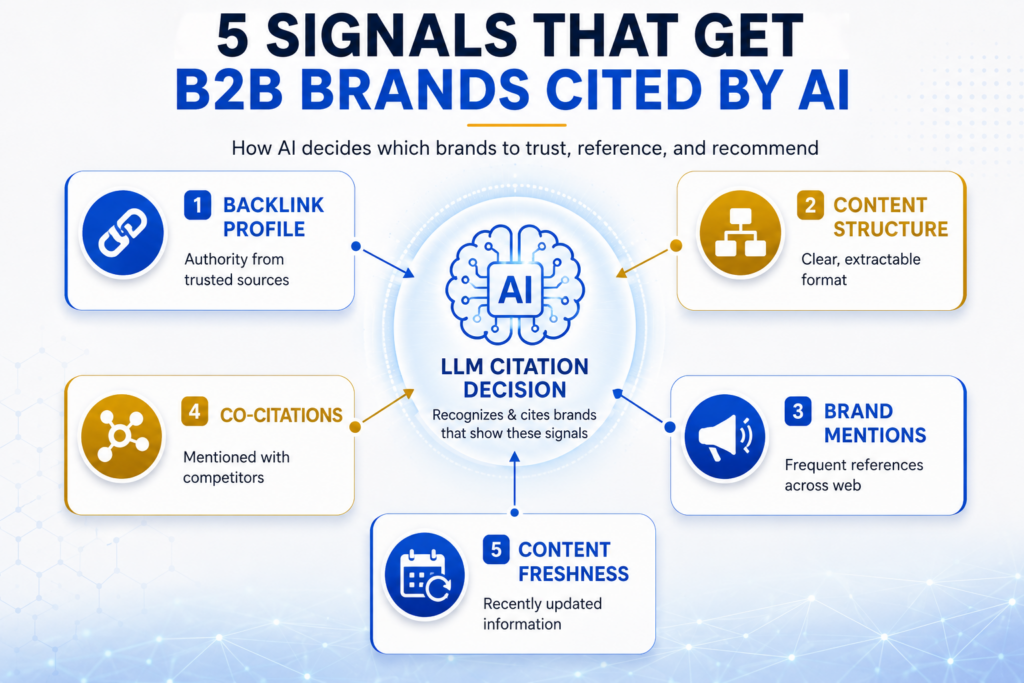
If invisibility comes from those 5 gaps, then visibility comes from fixing them. Here are the 5 citation signals you need to master:
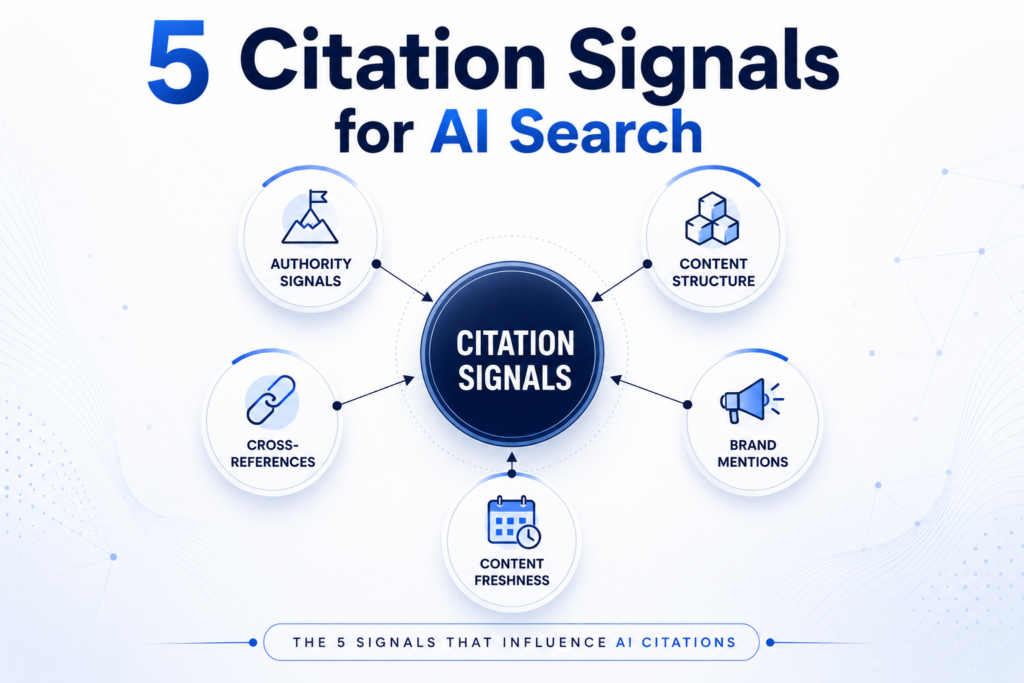
Signal 1: Backlink Profile
- Do other authoritative websites link to you?
- Quality > Quantity (1 link from HubSpot > 100 links from spam sites)
- What anchor text do they use? (Does it match your brand or category?)
Signal 2: Content Structure & Schema Markup
- Can AI easily extract structured information from your pages?
- Do you use H2s, H3s, bullet points, tables?
- Do you have schema markup (Company, Product, breadcrumb list)?
Signal 3: Brand Mention Frequency Across the Web
- How many websites mention your brand (in any context)?
- Are these mentions in relevant, authoritative contexts?
- Do mentions spike when you have news?
Signal 4: Co-Citation Patterns
- When people discuss your category (e.g., CRMs), is your brand mentioned alongside competitors?
- Or are you mentioned in isolation?
- Strong players = frequently mentioned together with other leaders
Signal 5: Content Freshness & Recency
- When was your last piece of content published?
- Are you actively updating old content?
- Do you respond to industry changes with new content?
These 5 signals work together. You need progress on all of them, not just one.
What an AI Visibility Audit Surfaces
So how do you know if you’re invisible? An AI Visibility Audit checks:
- Citation baseline: How often are you cited in ChatGPT, Perplexity, Google AI Overviews for your target keywords?
For example: Search “best SaaS CRM for mid-market” in ChatGPT 10 times. How many times does your brand appear? 0? 2? 8? That’s your citation rate.
- Competitor comparison: How does your citation rate compare to competitors?
If competitors are cited in 8/10 responses and you’re cited 0/10, you have a visibility problem.
- Content structure audit: Does your content have the structure AI can extract?
Check: Do your pages have clear H2s? Bullets? Tables? Schema markup? Or are they walls of text?
- Backlink profile: What’s your domain authority? How many high-quality backlinks do you have?
Tools like Ahrefs or SEMrush show this. Benchmark against competitors.
- Mention analysis: How often is your brand mentioned across the web?
Use tools like Mention.com or Brandwatch to track. Compare to competitors.
- Content freshness: When was your last blog post? Last update to key pages? Are you staying current?
- Schema markup: Do you have schema markup on your site? Is it complete?
Check via Schema.org validator. Most sites are missing it entirely.
An AI Visibility Audit reveals exactly where the gaps are. Then you can fix them.
Quick Wins vs Structural Fixes
Not all fixes are equal. Some take 2 weeks. Others take 6 months. Here’s how to prioritize:
Quick Wins (2-4 weeks):
✓ Add schema markup to your homepage, product pages, about page
✓ Restructure your blog posts with clear H2s, bullets, tables
✓ Update 5 old blog posts with fresh data, new insights, current year
✓ Create a “comparison” page comparing you to 2-3 competitors
✓ Get listed on 3-5 relevant review sites (G2, Capterra, similar)
✓ Publish a new piece of content that directly answers your target question
Impact: Might get you cited in 1-2 additional AI queries per week.
Structural Fixes (3-6 months):
✓ Build a strategic backlink strategy (target 20-30 high-quality backlinks from relevant sites)
✓ Publish 12+ pieces of new content (1 per week) optimized for AI extraction
✓ Get mentioned in 20+ industry publications, analyst reports, partner sites
✓ Build out comprehensive schema markup across your entire site
✓ Establish a content refresh calendar (update every post every 6 months)
✓ Partner with complementary brands for co-authored content, co-marketing
Impact: Should increase citation rate by 50-200% over 6 months.
Start with quick wins. Get some quick citations. Prove the model. Then move to structural fixes.
Most brands spend 0 dollars on AI visibility. If you spend $5K on quick wins (hiring someone to do schema, restructuring content, and updating pages) and get 1-2 additional citations per week, that could be 50-100+ additional qualified leads per year.
ROI is usually 10:1 or better.
What to Do This Week
You don’t need a 90-day plan. Start with this week’s audit. It takes 45 minutes and tells you exactly where the gaps are.
This week: Three things you can do before Friday
- Search your top 3 target keywords in ChatGPT and Perplexity. Record whether your brand appears in the answers. That’s your citation baseline. If you’re cited 0/3 times, you have a visibility gap. If you’re cited 2-3 times, you’re doing better than most.
- Run your homepage and top 3 product pages through Schema.org validator. Note what’s missing. Most sites have zero schema markup. Five minutes per page, and you’ll know exactly what to add.
- Count how many of your last 10 blog posts have clear H2s and bullet structures vs walls of text. You’re probably 30-40% structured, 60-70% narrative. That’s typical. But it’s also why you’re invisible.
That audit search keywords, run schema validator, and count structure takes 45 minutes and tells you exactly where to start.
Then pick one quick win and execute it this month.
The question isn’t whether AI search will matter. It’s already here. 60%+ of B2B tech queries show AI Overviews. ChatGPT and Perplexity are replacing Google for a growing segment of buyers.
The real question is: Will your brand be cited in those answers?
If you’ve just realized you’re invisible in AI search, you’re not alone. But the brands that move now, that add schema markup, restructure content, earn backlinks, and publish fresh content will own AI search visibility in their category.
The brands that wait? They’ll be wondering why their pipeline dried up.
Start with this week’s audit. Spend 45 minutes. Then commit to one quick win.
Your visibility in the new search era depends on it.
Get your AI visibility. Snapshot free 48-hr audit →