Most agencies pitch reach, rankings, and impressions. The right agency pitches a pipeline.
See how we rebuilt pipeline for another B2B company
You call an agency. They send a proposal. It’s full of:
- “We’ve helped clients reach 500K+ people.”
- “Average ranking improvement: 8 positions”
- “Typical impression growth: 250%”
You read it and feel impressed. Then you hire them. Six months later, you have 500K impressions and zero new customers. The agency says, “Give it more time.” You’re six figures in and have nothing to show for it.
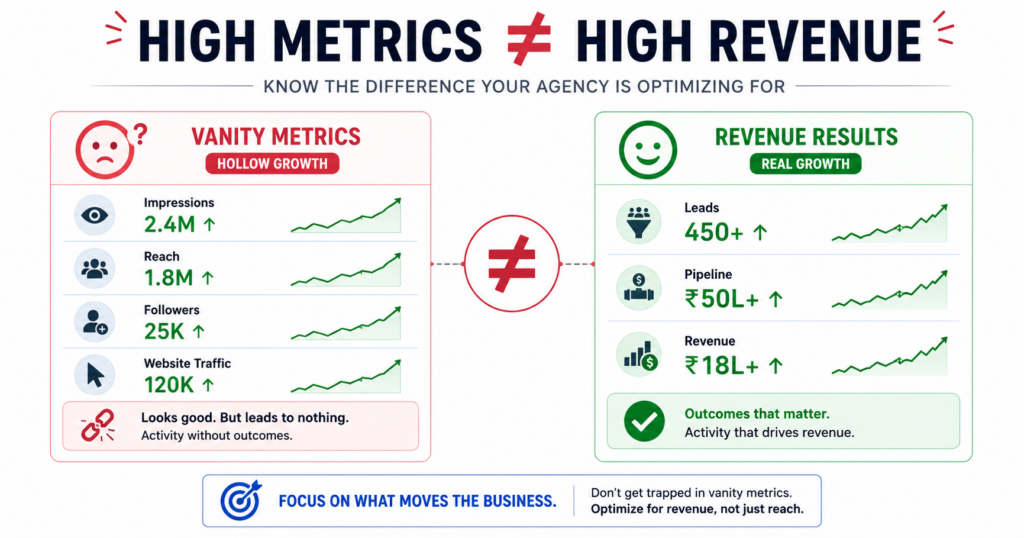
This happens because most agencies are optimized for metrics that look good in a presentation, not metrics that move your business.
The right agency is optimized for pipeline. For SQLs. For closed deals. For revenue.
Here’s how to tell them apart before you sign a contract.
Quick Comparison Table
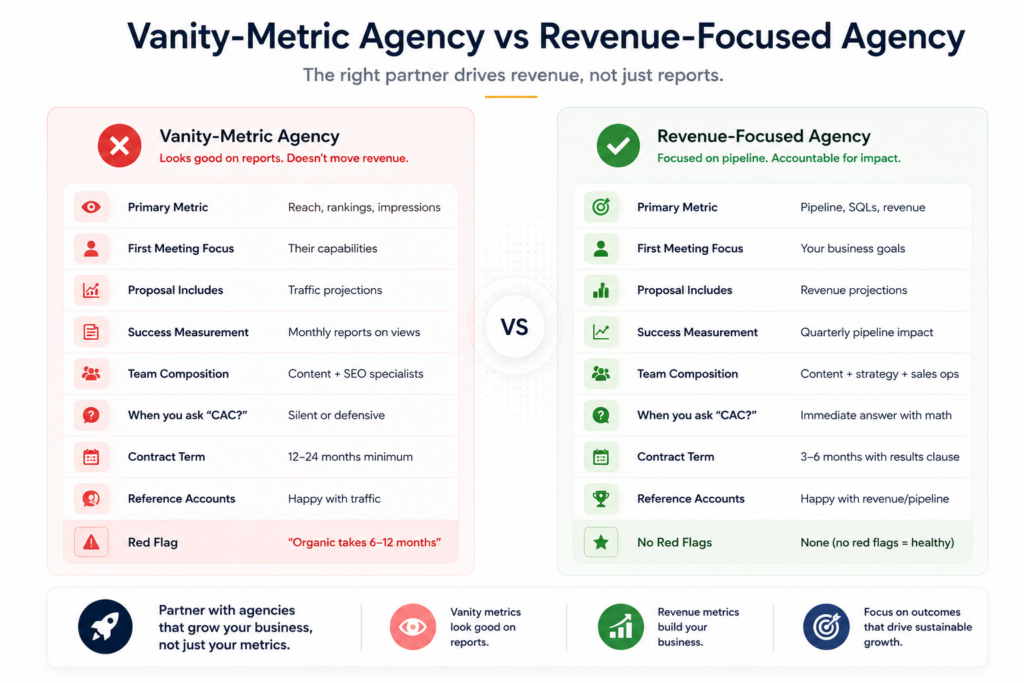
Why Most Agency Pitches Are Vanity-Led
Agencies optimize for metrics that are easy to measure and easy to explain.
Reach is easy to measure. “You had 1000 visitors. Now you have 5000. That’s a 400% increase.”
Rankings are easy to measure. “You ranked 15th. Now you rank 3rd.”
Impressions are easy to measure. “Your content got 100K impressions.”
None of those metrics correlates with revenue. But they’re easy to put in a spreadsheet and show a client.
Revenue is hard to measure. It requires:
- Sales data integration (CRM access)
- Sales cycle tracking (6+ months)
- Attribution modeling (messy, multiple touchpoints)
- Understanding customer economics (CAC, LTV, churn)
It’s harder. It’s messier. So agencies avoid it.
The vanity-metric trap for agencies:
If an agency optimizes for reach, they can take on 50 clients. Fifty different websites, fifty different content calendars, fifty different dashboards. The client is happy with the metrics. The agency makes money.
If an agency optimizes for revenue, they can take on 3-5 clients. They need to understand your business deeply. They need access to your sales data. They need to care if you close deals.
One model scales. One model doesn’t. Agencies choose the model that scales.
But that model doesn’t work for you.
You don’t care about reach. You care about customers. You don’t care about impressions. You care about revenue.
So you have to hire differently.
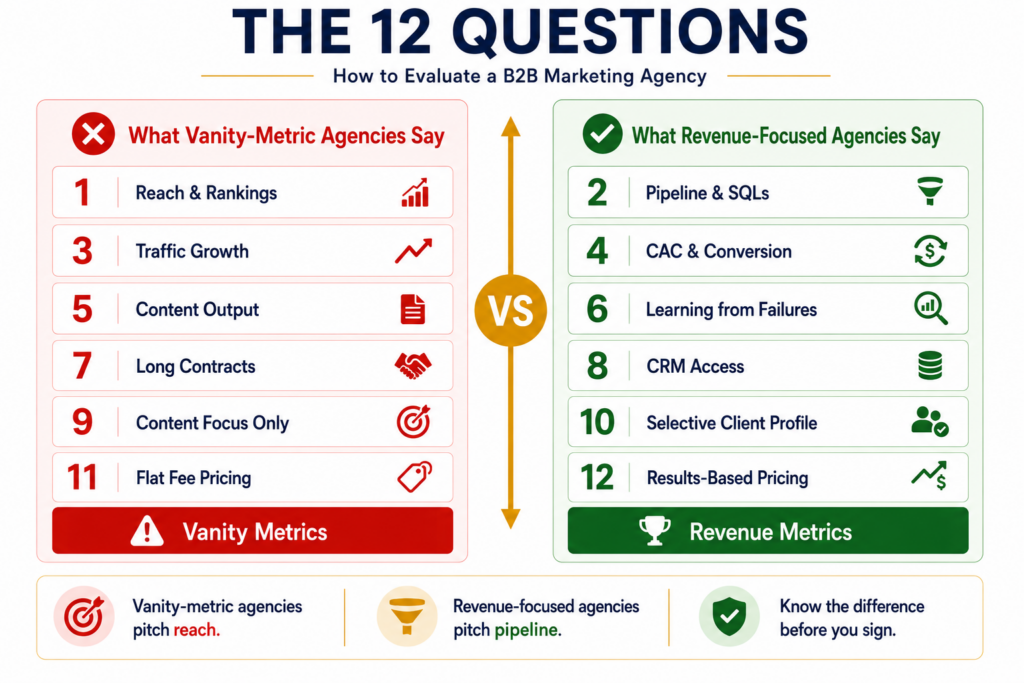
The 12 Questions to Ask Any Agency
Before you sign, ask these 12 questions. Their answers reveal everything.
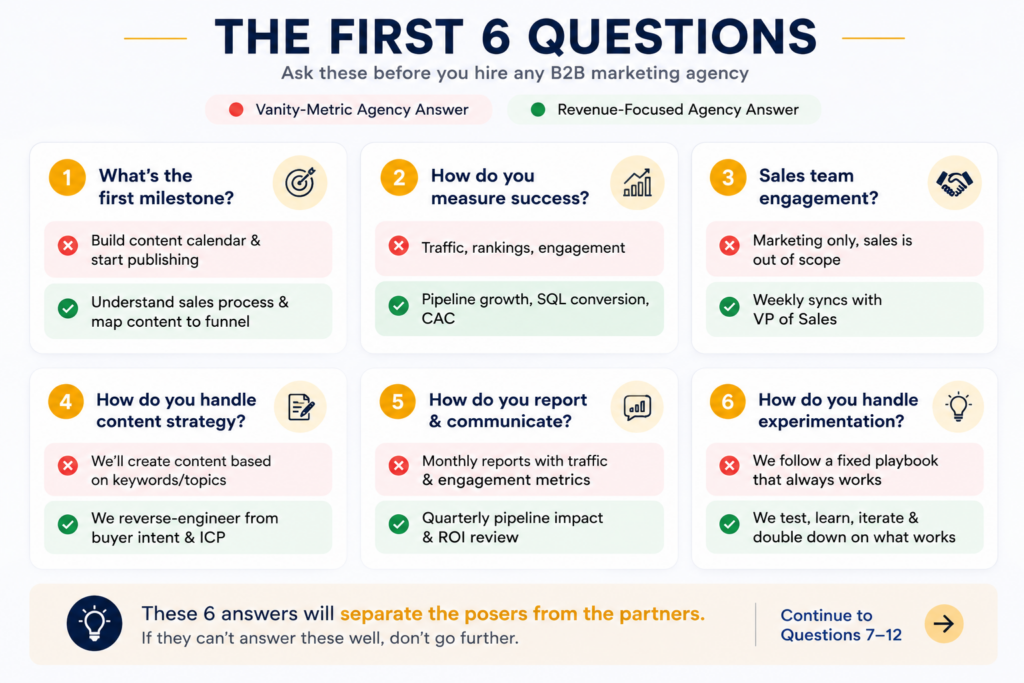
Question 1: “What’s the first milestone in your 90-day plan?”
Vanity metric answer: “Audit your site, build a content calendar, start publishing posts.”
Revenue-focused answer: “Understand your sales process, identify where deals drop, map content to each stage of the buyer journey.”
What you’re looking for: Do they care about your sales process or just content output?
Question 2: “How do you measure success?”
Vanity metric answer: “Monthly traffic growth, ranking improvements, engagement metrics.”
Revenue-focused answer: “Pipeline growth, SQL conversion rate, CAC compared to your LTV.”
What you’re looking for: Are they measuring revenue impact or just activity?
Question 3: “What’s your engagement rate with my sales team?”
Vanity metric answer: “We work with marketing only. Sales is their domain.”
Revenue-focused answer: “We talk to sales weekly. They tell us what’s working. We adjust content based on their feedback.”
What you’re looking for: Are they siloed or integrated?
Question 4: “How do you know if a piece of content worked?”
Vanity metric answer: “Views, engagement, shares.”
Revenue-focused answer: “Did it move someone down the buying journey? Did it generate a lead? Did that lead become an SQL?”
What you’re looking for: Are they tracking business impact or just metrics?
Question 5: “What’s your typical client CAC before and after?”
Vanity metric answer: “We don’t track that. Our focus is content.”
Revenue-focused answer: “[Specific numbers] We usually see CAC improve 20-40% in the first 6 months.”
What you’re looking for: Do they have this data? Can they predict impact?
Question 6: “Tell me about a client who didn’t work out. What happened?”
Vanity metric answer: “They wanted results too fast.” or “They didn’t listen to our recommendations.”
Revenue-focused answer: “We realized they didn’t have sales infrastructure. We worked with them to build that first, then content.”
What you’re looking for: Do they blame the client or take ownership?
Question 7: “What’s your contract termination clause?”
Vanity metric answer: “12-month minimum. Non-refundable.”
Revenue-focused answer: “3-6 month initial period. If we’re not delivering pipeline impact by month 4, we part ways.”
What you’re looking for: Are they confident in their results?
Question 8: “How much access do you need to our CRM and sales data?”
Vanity metric answer: “Not much. We focus on the marketing funnel top.”
Revenue-focused answer: “Full CRM access. We need to see where deals drop off and align content to those gaps.”
What you’re looking for: Are they willing to get hands-on with your business?
Question 9: “What happens in months 4-6?”
Vanity metric answer: “We continue content production and optimization.”
Revenue-focused answer: “By month 4, we pivot. We know what content works. We either scale it or shift to new angles based on lead quality data.”
What you’re looking for: Do they have a plan to iterate?
Question 10: “What’s your ideal client profile?”
Vanity metric answer: “B2B SaaS, any size.”
Revenue-focused answer: “B2B SaaS, $2-10M ARR, with a sales team ready to move opportunities through the pipeline. We’re not a fit if you don’t have sales ops.”
What you’re looking for: Are they selective or desperate for clients?
Question 11: “If I hire you, what do YOU need to commit to be successful?”
Vanity metric answer: “Just let us do our thing. Check in monthly.”
Revenue-focused answer: “Weekly sales syncs with your VP of Sales. Access to closed deal data. Willingness to test content and shift based on results. 90-minute kick-off with your entire go-to-market team.”
What you’re looking for: Are they asking for partnership or just a vendor relationship?
Question 12: “What happens after 12 months? Do we keep paying?”
Vanity metric answer: “Ongoing maintenance. Content production continues. Usually ₹30L+/year.”
Revenue-focused answer: “By month 12, content is working. Most of our budget shifts to running ads on proven content. The business becomes self-sustaining. You might pay ₹15-20L instead of ₹30L.”
What you’re looking for: Are they building a machine or creating ongoing dependency?
Red Flags in Proposals
When you get a proposal, watch for these red flags:
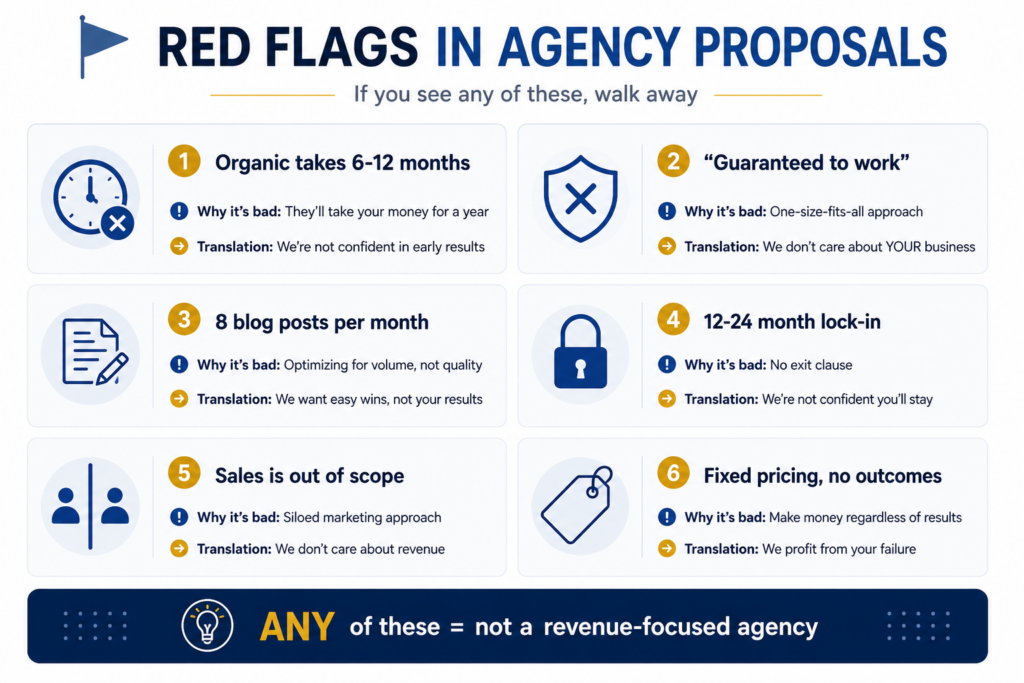
Red Flag 1: “Organic results take 6-12 months”
Translation: “We’ll take your money for a year without delivering results. By then, you’ll be locked in and accept anything.”
Revenue-focused agencies deliver signals in 30-60 days (not revenue, but direction signals).
Red Flag 2: “We’ll implement [tactic] that’s guaranteed to work”
Translation: “We have a playbook. We don’t care if it fits your business.”
Ask, “How do you know this will work for us specifically?”
If they can’t answer, walk.
Red Flag 3: “We’ll create 8 blog posts per month”
Translation: “We’re optimizing for volume, not quality.”
Ask, “How do you know 8 posts is the right number for our business?”
Red Flag 4: “Our contract is 12-24 months with no exit clause”
Translation: “We’re not confident you’ll get results, so we’re locking you in.”
Revenue-focused agencies are happy with 3-6 month terms because they’re confident.
Red Flag 5: “We’ll work with your marketing team. Sales is out of scope.”
Translation: “We don’t care about your business results. We care about our output.”
The best agencies integrate with sales from day one.
Red Flag 6: “Our pricing is [flat fee]. We don’t adjust based on results.”
Translation: “We make money regardless of your success.”
Revenue-focused agencies tie some compensation to results.
Green Flags That Signal Revenue Focus
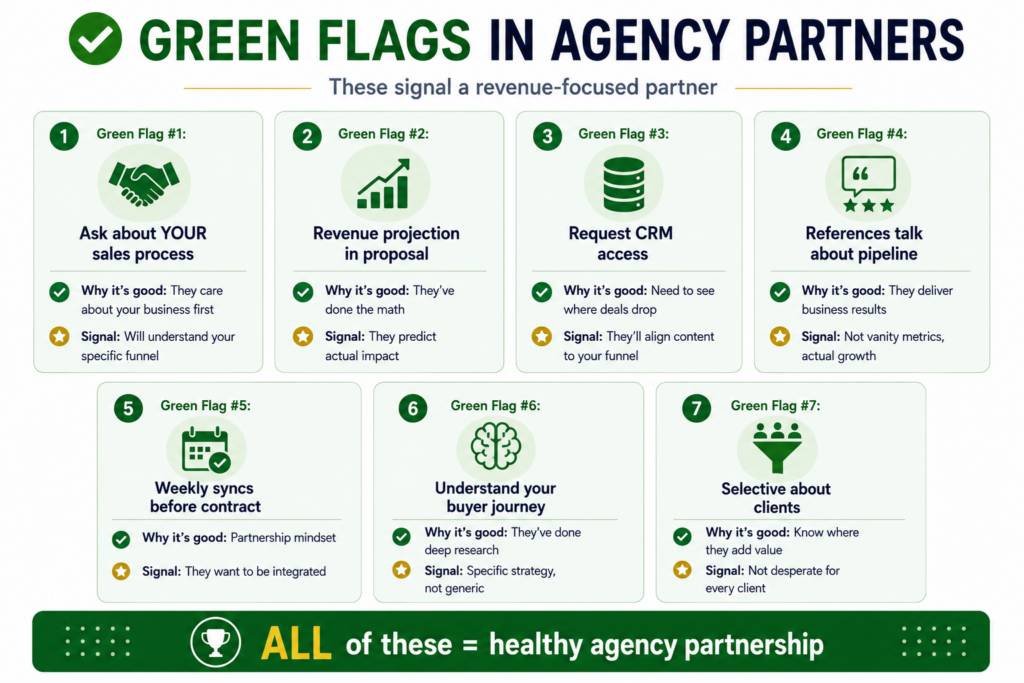
Green Flag 1: They ask about your sales process before pitching
They want to understand your business first. That’s how you know they’re thinking about revenue.
Green Flag 2: Their proposal includes a revenue projection
“Based on industry benchmarks, at your stage, we’d expect X SQLs/month, which converts to Y new customers.”
They’ve done the math. They’re not guessing.
Green Flag 3: They ask for CRM access immediately
They need to see where deals drop off. That’s how they know what content to create.
Green Flag 4: References who talk about pipeline, not impressions
When you call their references, they say, “They moved us from 10 SQLs/month to 30.” Not: “Our traffic tripled.”
Green Flag 5: They have a weekly sync scheduled before contract signature
Vendors don’t need weekly syncs. Partners do.
See our case studies for proof
Green Flag 6: They can articulate your customer’s buying journey
In the first call. Before you’ve hired them.
If they understand your buyer journey better than you do, they’ve done their homework.
Green Flag 7: They’re selective about clients
They tell you: “We’re only a fit if [specific condition is met].”
That means they’ve thought about where they add value. They’re not taking every client.
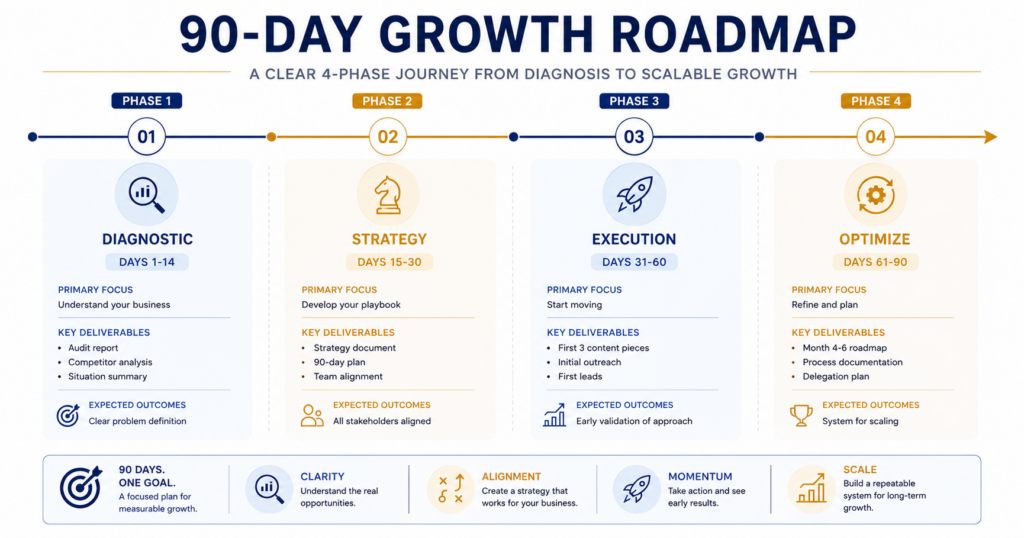
What a Good First 90 Days Looks Like
Month 1:
- Audit your sales process and content gaps
- Kick-off with your entire go-to-market team
- Define success metrics (SQLs, CAC, pipeline target)
- Create 2-3 initial pieces of content
Month 2:
- Launch first content assets
- Start tracking where leads go in your funnel
- Weekly syncs with sales
- Measure: 1-5 SQLs from content (early signal)
Month 3:
- Analyze what’s working
- Adjust content strategy based on data
- Plan months 4-6 (what to scale, what to kill)
- Measurement: 5-10 SQLs/month, CAC trending down
By the end of Month 3, you should have:
- ✓ Proof that content can drive your funnel
- ✓ Data on which topics work
- ✓ A plan for months 4-12
- ✓ Confidence that the partnership is working
If you don’t have those by month 3, end the contract.
How Amplio Luma Answers These 12 Questions
Our answers to the 12 questions above:
Question 1: “What’s the first milestone in your 90-day plan?”
Amplio’s answer: “We spend Week 1 understanding your sales process, your CAC, your deal size, and where deals typically stall. Then we design content strategy around moving people through that specific funnel. The first milestone is not ‘publishing posts.’ It’s ‘proving this approach works with your first 10 SQLs.'”
Question 2: “How do you measure success?”
Amplio’s answer: “SQLs delivered, CAC compared to your LTV, time-to-close improvement. We don’t celebrate traffic. We celebrate closed deals. You’ll see a quarterly dashboard showing pipeline impact, not monthly traffic reports.”
Question 3: “What’s your engagement with my sales team?”
Amplio’s answer: “Weekly. Your VP of Sales is in every strategy meeting. They tell us what’s working and what’s not. Half our content ideas come from sales feedback. If sales isn’t happy, we’re not done.”
Question 4: “How do you know if a piece of content worked?”
Amplio’s answer: “Did it move someone from Stage 1 to Stage 2 in your buying journey? Did it generate a lead that became an SQL? We track every piece of content to business outcome. We don’t celebrate views. We celebrate closed deals.”
Question 5: “What’s your typical client CAC before and after?”
Amplio’s answer: “Our typical client goes from ₹150K-₹300K CAC to ₹50K-₹100K CAC within 6 months. That’s a 40-60% improvement. See our case studies for proof.”
Question 6: “Tell me about a client who didn’t work out.”
Amplio’s answer: “We’ve had clients without proper sales infrastructure. We didn’t force-fit our playbook. We worked with them to build a CRM, hire an SDR, and define their ICP first. Only then did demand gen make sense. That’s the right answer, even if it’s not the most profitable for us.”
Question 7: “What’s your contract termination clause?”
Amplio’s answer: “A 3-month initial period. Month 4, we do a pulse check. If the pipeline isn’t improving, we part ways. We’re confident you’ll see results by month 4, so we’re comfortable with short terms.”
Question 8: “How much access do you need to our CRM and sales data?”
Amplio’s answer: “Full access. We need to see your sales process, your pipeline, your closed deals, and your churn. Without that, we’re guessing. With it, we’re strategizing.”
Question 9: “What happens in months 4-6?”
Amplio’s answer: “By month 4, we know which content angles work for your audience. We shift from exploration to scaling. Some content gets promoted with paid ads. Some gets distributed through partnerships. We pivot aggressively based on data.”
Question 10: “What’s your ideal client profile?”
Amplio’s answer: “B2B SaaS, ₹2Cr-20Cr ARR, with a sales team ready to move SQLs. We’re not a fit for companies without sales infrastructure or those expecting content alone to drive deals.”
Question 11: “If I hire you, what do YOU need?”
Amplio’s answer: “Weekly syncs with your VP of Sales and CMO. CRM access. Willingness to act on our recommendations (even if they’re uncomfortable). A 90-minute kick-off where we understand your entire go-to-market. If you give us those four things, we’ll deliver results.”
Question 12: “What happens after 12 months?”
Amplio’s answer: “By month 12, your content is working. The business is self-sustaining. You might have 50+ SQLs/month from demand gen. You’ll likely spend more on paid ads to amplify proven content and less on content production. Your spend might stay at ₹20L-30L/year, but now it’s generating measurable revenue.”
Want to see how Amplio Luma answers these 12 questions?