Before you hire a fractional CMO, you want to know one thing:
“What will you actually do?”
Not the generic consultant answer: “We’ll audit your marketing, develop a strategy, and execute.” Everyone says that.
You want the real answer. The specific activities. The week-by-week breakdown. The deliverables you’ll actually see.
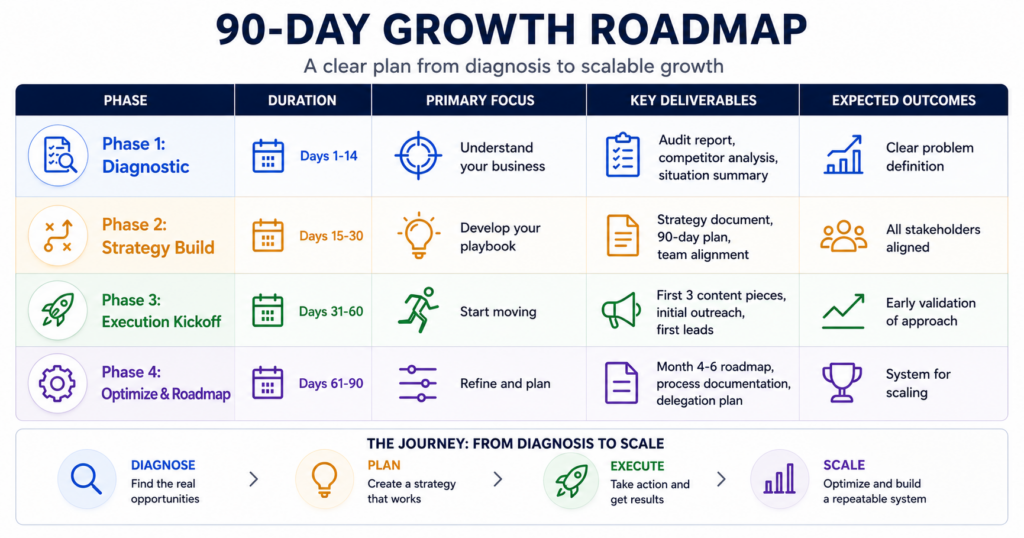
Here’s what the first 90 days of a Fractional CMO engagement at Amplio Luma actually looks like.
This is the playbook we follow. With every client. Week by week. No surprises.
Quick Problem Summary (Table)
Why the First 90 Days Make or Break the Engagement
Most fractional CMO relationships fail in the first 90 days.
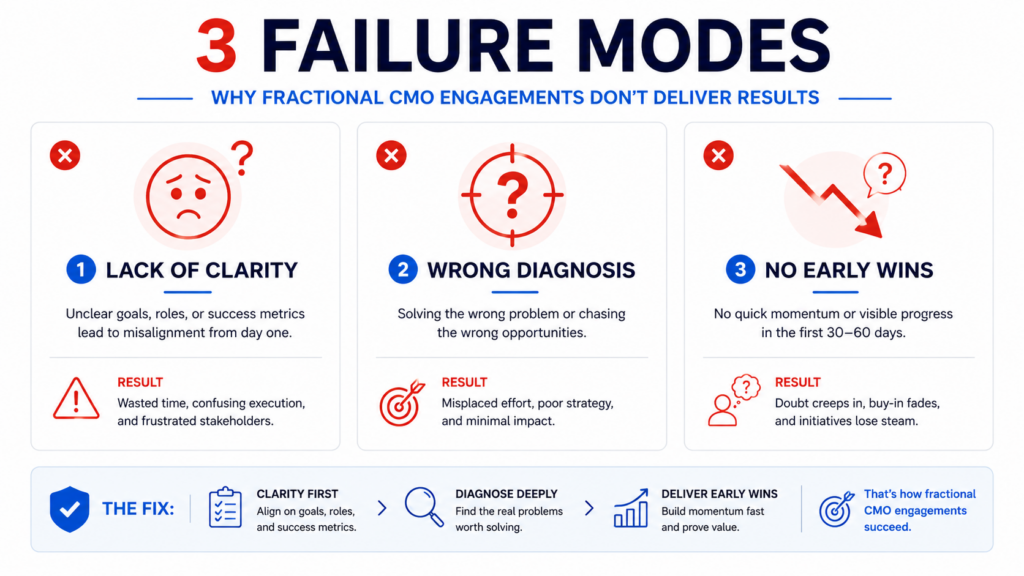
Not because the strategy is wrong. But because one of three things happens:
Failure mode 1: Lack of clarity
You hire a fractional CMO. They start working. But you don’t know what they’re doing. They send a Slack message about “building a content pillar.” You’re confused. You don’t hear from them for a week. You start doubting the hire.
By day 60, you’re frustrated. By day 90, you’ve ended the engagement.
Failure mode 2: Wrong problem diagnosis
They jump into execution without understanding your business. They create a strategy based on assumptions. You realize by week 4 that they missed something critical. Now you’re 3 weeks behind.
Failure mode 3: No early wins
You need to see that this is working. By day 45, you want proof. If there’s no sign of progress, no early lead, and no validation, you lose confidence.
The first 90 days prevent all three.
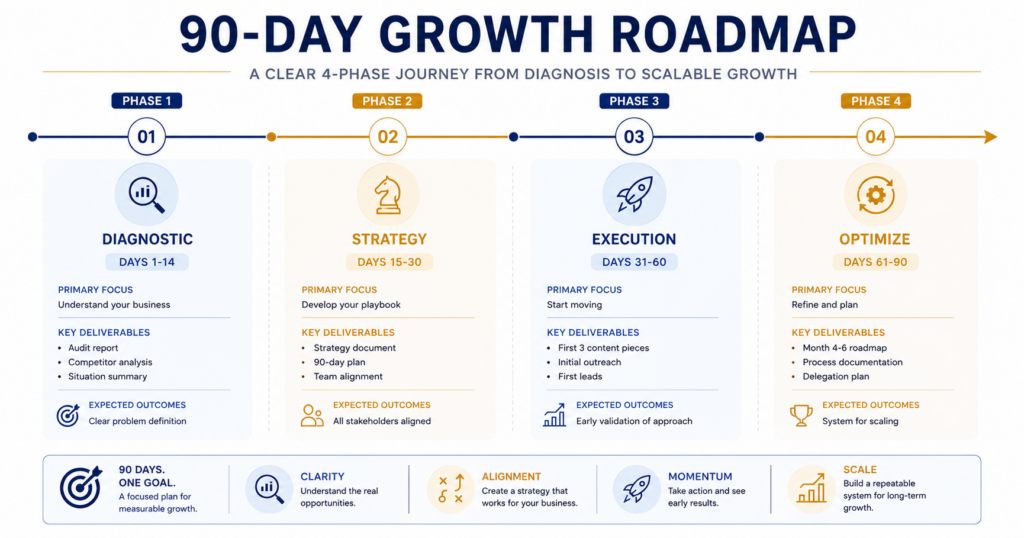
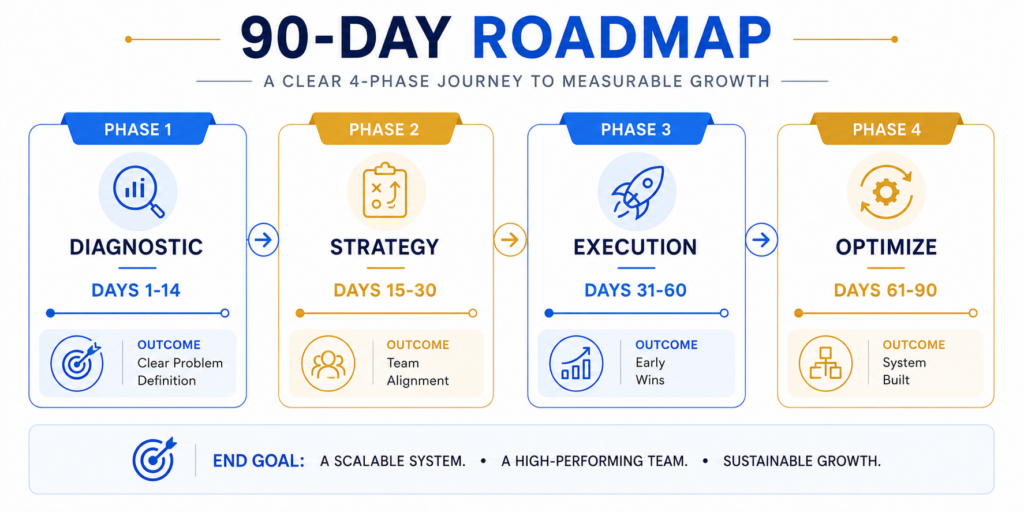
The diagnostic phase (Days 1-14) ensures clarity and correct diagnosis. The strategy phase (Days 15-30) gets everyone aligned. The execution phase (Days 31-60) delivers early wins for validation. The optimization phase (Days 61-90) builds a system that scales beyond day 90.
If you skip any of these, the engagement fails.
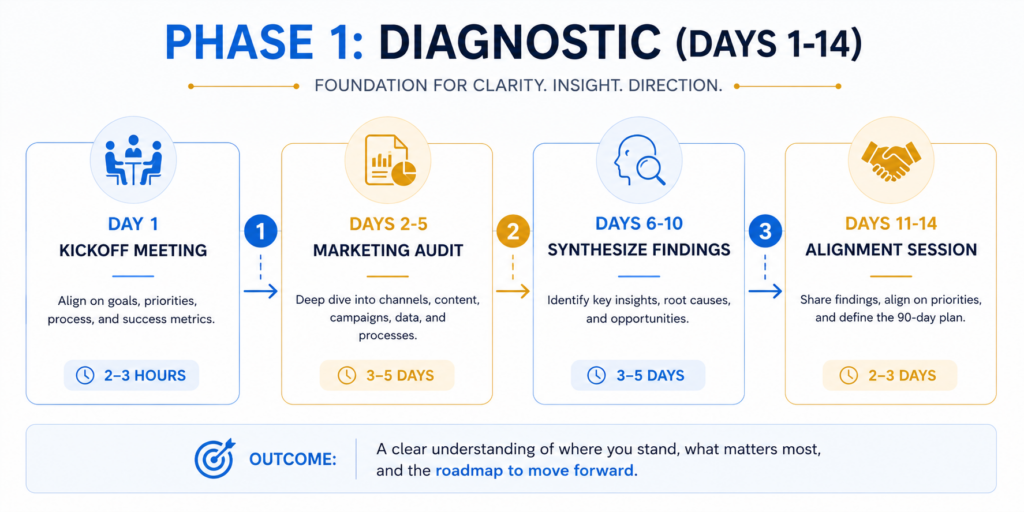
Days 1-14: The Diagnostic (What We Audit and Why)
Day 1: Kickoff meeting (2 hours)
This is not a “let’s meet and get to know each other” meeting.
This is a working session. We come with a specific list of questions.
What we do:
- Understand your business model (who buys, how much they spend, how long the sales cycle is)
- Map your current marketing spend (where’s the money going?)
- Identify your biggest revenue problem (is it awareness? Lead quality? Sales cycle?)
- Define success (what does winning look like in 90 days, 6 months, 12 months?)
- Establish working rhythm (weekly syncs, how we communicate, what you need from your team)
What you get:
- A shared understanding of the problem
- Clear definition of success
- Confirmed working relationship and cadence
Days 2-5: Audit your marketing
We conduct a full diagnostic:
Marketing channels audit:
- Where is your traffic coming from? (Google Analytics deep dive)
- What’s your cost per lead by channel?
- Which channels have highest CAC? Which have lowest?
- Where are you wasting money?
Content audit:
- How many blog posts do you have?
- Which ones get traffic? Which get none?
- What’s the conversion rate by piece?
- Do you have internal linking strategy?
Sales alignment audit:
- What does your sales team say about marketing leads?
- Are leads actually qualified?
- How long does sales cycle take?
- Where do deals stall?
Competitor audit:
- Who are your 5 main competitors?
- What’s their positioning?
- How are they different from you?
- What are they doing that you’re not?
Brand audit:
- How well known are you in your market?
- What are you known for?
- How does that compare to competitors?
What you get:
- 20-30 page audit report (not generic, specific to your business)
- Competitor comparison
- Marketing efficiency assessment
- Specific findings (not “improve your content” but “your 3 best performing blog posts are X, Y, Z because they solve problem A”)
Days 6-10: Synthesize findings
We:
- Analyze all the data
- Identify patterns (where are you winning? Where are you losing?)
- Find the root cause of your revenue problem (is it awareness? Lead quality? Sales process?)
- Identify 2-3 strategic opportunities (places where you can win big)
- Build initial recommendations
What you get:
- A clear problem diagnosis (not vague, specific)
- Identified opportunities (ranked by impact)
- Initial thinking on how to fix it
Days 11-14: Situation summary and alignment
We:
- Present findings in a working session
- Walk through the audit findings
- Get feedback and corrections
- Finalize problem diagnosis
- Get alignment from leadership (CEO, VP Sales, leadership team)
What you get:
- Full agreement on the problem
- Full agreement on success metrics
- Full agreement on approach
- Everyone on the same page (this matters—misalignment kills engagements)
Deliverable after Phase 1: Audit report + situation summary + agreed-upon success metrics
Days 15-30: Strategy Build and Alignment (The Playbook)
Days 15-18: Strategy development
Based on the audit, we build a 90-day + 6-month strategy.
We answer:
- What’s our core positioning? (What do we own in the market?)
- Who are we targeting? (Be specific: company size, role, pain point)
- What’s our lead generation strategy? (Which channels will drive qualified leads?)
- What’s our content strategy? (What will we create, when, and why?)
- What’s our sales enablement strategy? (How do we support the sales team?)
- What’s our revenue target? (How much pipeline do we need to generate?)
We build:
- 90-day action plan (what gets done weeks 5-12)
- 6-month roadmap (what gets done months 4-6)
- Marketing calendar (exactly what content, when)
- Budget allocation (where does the money go?)
- Success metrics (how we measure progress)
What you get:
- A comprehensive strategy document (not 50 pages of consulting fluff, but specific and actionable)
- A 90-day detailed plan
- A 6-month roadmap
- Clear budget breakdown
- Clear success metrics
Days 19-25: Team alignment and feedback
Strategy is useless if no one believes in it.
We:
- Present strategy to leadership team
- Walk through the logic (why this strategy, not that one?)
- Get feedback and iterate
- Build buy-in from marketing team, sales team, CEO
- Finalize the plan together
What you get:
- Full team alignment on strategy
- Internal buy-in and excitement
- Refinements based on team feedback
- Everyone knows what’s about to happen
Days 26-30: Planning and preparation
We:
- Sequence the work (what gets done first? Why?)
- Assign responsibilities (who owns what?)
- Set up systems (how do we track progress? How do we communicate?)
- Prepare templates (email templates, content templates, process templates)
- Build the execution calendar (day by day, week by week)
What you get:
- Clear execution plan
- Assigned ownership
- Systems in place
- First week of execution is detailed and ready
Deliverable after Phase 2: Strategy document + 90-day plan + 6-month roadmap + marketing calendar + team alignment
Days 31-60: Execution Kickoff and Early Signals (The Proof)
Days 31-45: First execution sprint
We:
- Launch first 3 content pieces (blog posts, LinkedIn content, email campaign)
- Start outreach for backlinks/partnerships
- Implement SEO improvements (internal linking, schema, technical fixes)
- Kick off founder thought leadership (LinkedIn strategy, podcast pitches)
- Run first campaign/ads test if applicable
What you see:
- Actual content published
- Outreach emails sent
- First partnerships/mentions in motion
- First SEO improvements live
- Founder building public profile
Days 46-60: Monitor and iterate
We:
- Track early metrics (traffic, engagement, leads)
- Analyze what’s working, what’s not
- Iterate on approach based on data (not gut feel)
- Adjust messaging based on early feedback
- Prepare next batch of content and initiatives
What you see:
- First leads coming from new strategy
- Traffic patterns emerging
- Early validation of positioning
- Proof that the strategy is working (or clear direction to adjust)
What you get:
- Early proof points (3-5 qualified leads, new backlinks, improved rankings, founder engagement)
- Weekly progress reports
- Monthly metric review
- Confidence that this is working
Deliverable after Phase 3: First 3 months of executed work + early metrics + adjusted strategy based on learnings
Days 61-90: Optimise, Delegate, and Set the 6-Month Roadmap (The System)
Days 61-75: Optimize what’s working
We:
- Identify which early initiatives worked best
- Scale what’s working (do more of it)
- Kill what’s not working (stop wasting time/money)
- Refine based on early data (positioning, messaging, audience targeting)
- Document processes (so your team can execute without us)
What you see:
- More effective execution
- Less wasted effort
- Clearer direction moving forward
- Your team getting more capable
Days 76-85: Build delegation playbooks
We:
- Document everything we’re doing
- Create playbooks for your team (so they can execute independently)
- Train your team on processes
- Build templates and systems
- Identify what you need to hire (if anything)
What you get:
- Playbooks your team can follow
- System documentation
- Trained, capable team
- Clear hiring recommendations (if needed)
Days 86-90: Set 6-month roadmap and handoff
We:
- Present months 4-6 plan
- Align on continued investment
- Discuss reduced fractional time (if appropriate)
- Establish ongoing cadence (maybe we move to monthly strategy calls instead of weekly)
- Ensure smooth transition to execution
What you get:
- Clear 6-month roadmap
- Reduced weekly time commitment (if appropriate)
- Confidence you can execute independently
- Plan for continued partnership
Deliverable after Phase 4: Documentation and playbooks + optimized processes + 6-month roadmap + trained team
What Good Looks Like at Day 90
At the end of 90 days, here’s what success looks like:
Metrics success:
- 20-30 qualified leads generated from new strategy
- 2-3 closed deals (or clear pipeline building)
- 3+ months of planned content and initiatives
- Team confident in execution without you
Process success:
- Your team can execute without consultant
- Playbooks are documented
- Processes are repeatable
- Budget is allocated and tracked
Strategic success:
- Clear problem diagnosis confirmed by early results
- Positioning locked in
- Target audience locked in
- Lead generation channels proven
- Team alignment maintained
Relationship success:
- You know exactly how we work
- You’ve seen results
- You trust the process
- You understand next steps clearly
Common outcomes at Day 90:
- Option 1: Continue with fractional CMO at reduced cadence (monthly strategy, weekly execution by your team)
- Option 2: Hire full-time marketer and transition to us mentoring them
- Option 3: Graduate from fractional CMO (you have the playbook, go execute independently)
- Option 4: Expand scope (fractional CMO + paid advertising + agency support)
All are successful. All are based on results and clarity.
Curious what Day 1 actually looks like for your company?
Let’s talk. Schedule a 30-min strategy call →