Every B2B founder has this argument with their team.
“We should focus on outbound.”
“No, inbound is the future. We need content.”
And the debate goes on. Usually forever. With no resolution.
Here’s why: Both are right. The real question is: Which one is right for YOUR stage?
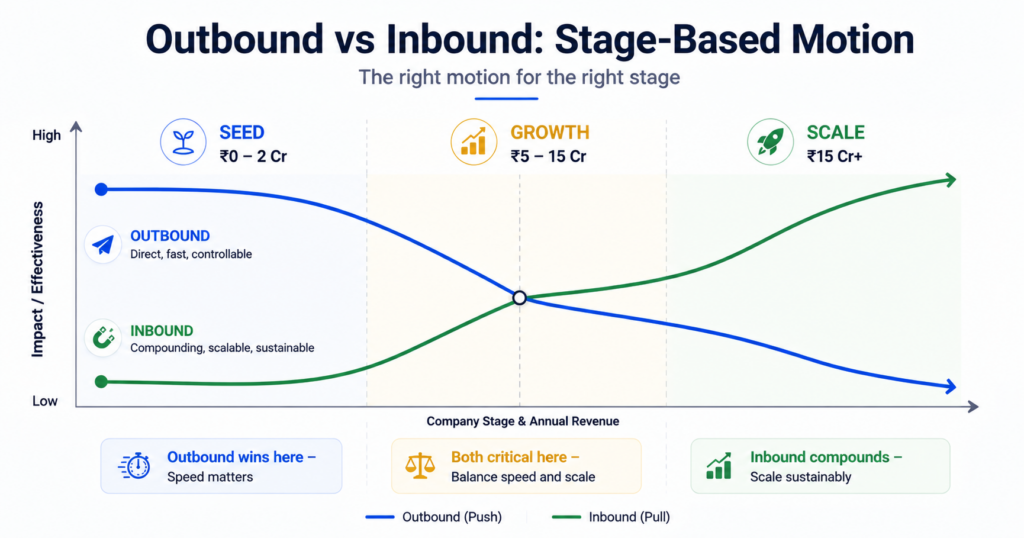
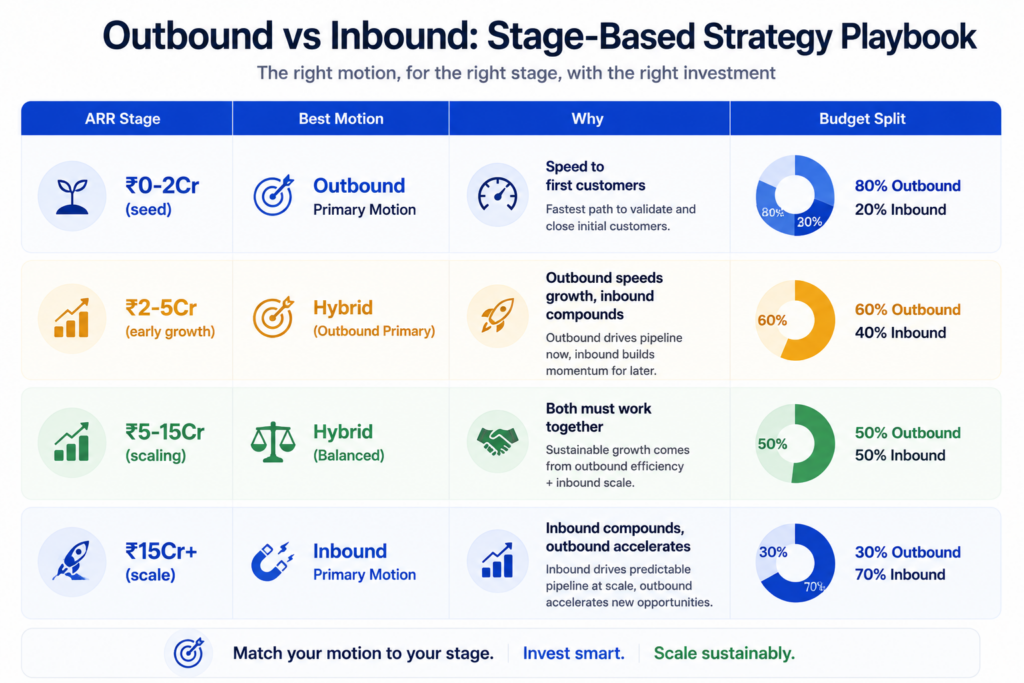
At ₹0-2Cr ARR, outbound makes sense.
At ₹5-15Cr ARR, inbound traffic becomes critical.
At ₹15Cr+ ARR, you need both.
The mistake most teams make: They don’t know this. They choose one and stick with it, regardless of what their business actually needs.
This is the framework that changes at every growth stage and how to run both without burning your team out.
Quick Decision Matrix (Table)
Why the Outbound vs Inbound Debate Misses the Point
The debate assumes you need to choose one.
You don’t.
The question isn’t “Which one?” but “When and how much of each?”
Here’s what each actually does:
Outbound: You initiate contact with a defined target list (sales team reaches out) Inbound: The buyer initiates contact after finding you (customers find you)
Both work. But they work differently at different stages.
At ₹1Cr ARR, you need customers NOW. Outbound delivers. At ₹10Cr ARR, you have enough customers. Inbound’s compounding matters.
The mistake: Choosing based on preference instead of stage.
“I believe in inbound” is a lovely philosophy. “We need ARR growth and inbound takes 6 months to work” is reality.
What Outbound Actually Delivers (And When)
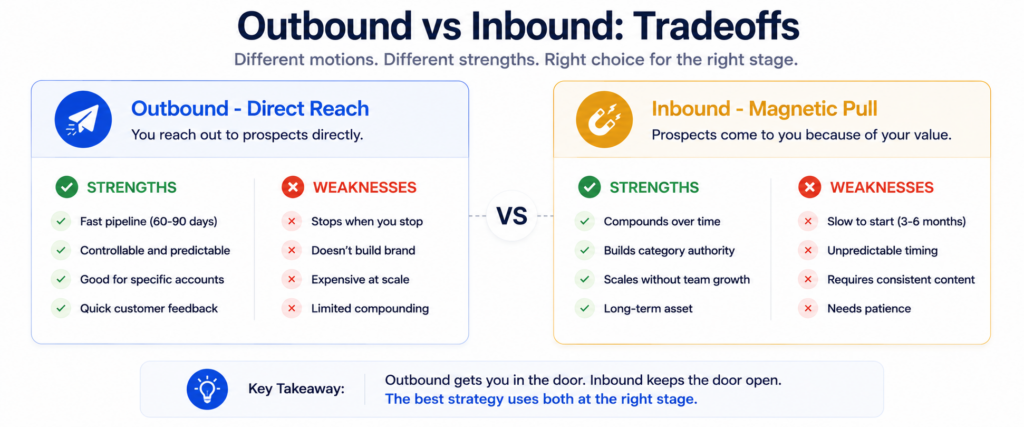
Outbound works because it’s fast and controllable.
You decide who to target. You reach out. You get meetings. You close deals.
Timeline: 60-90 days from outreach to closed deal (if your product is good)
When outbound makes sense:
Stage 1: ₹0-2Cr ARR (Seed)
- You need to prove product-market fit
- You need customers to understand the problem
- You can’t wait 6 months for inbound
- Your team is small (can execute outbound)
- Outbound gives you customer feedback fast
Stage 2: ₹2-5Cr ARR (Early Growth)
- You need predictable growth to hit milestones
- You have enough proof points to close deals
- Your sales team is small but effective
- Inbound is still ramping
- Outbound fills the gap
Stage 3: ₹5-15Cr ARR (Scaling)
- Both are needed
- Outbound on high-value accounts
- Inbound on product-market expansion
- Sales team scales with both motions
Stage 4: Scale (₹15Cr+ ARR)
- Inbound is now dominant
- Outbound focused only on strategic accounts
- Continue SDR team for high-value enterprise deals
- Outbound becomes tactical, not strategic
- Outbound helps close what inbound attracts
What outbound is NOT good for:
- Building brand awareness (it’s direct, not visible)
- Long-term compounding (stops when you stop)
- Scaling at ₹20Cr+ (you’d need massive sales team)
- Building category authority (it’s tactical, not strategic)
The key insight about outbound:
Outbound is a direct trade. You trade effort (sales team’s time) for immediate revenue (closed deals).
More sales team = more deals.
But at scale, this doesn’t work. You’d need a 500-person sales team to sustain ₹100Cr ARR through outbound alone.
What Inbound Actually Delivers (And When)
Inbound works because it compounds.
You publish content today. It attracts customers 6 months from now. And 12 months from now. And 24 months from now.
Timeline: 3-6 months to see results, then compounds
When inbound makes sense:
Stage 1: Pre-product (Build while building)
- You’re building. Publish content about your category
- Start building authority before you sell anything
- By launch, people already know you
Stage 2: Early growth (₹2-5Cr ARR)
- Content compounds now
- You still need outbound for quick pipeline
- But inbound provides foundation
Stage 3: Scaling (₹5-15Cr ARR)
- Inbound is now a major pipeline source
- Content is attracting inbound qualified leads
- Sales team closes them
- Less reliance on outbound reach
Stage 4: Scale (₹15Cr+ ARR)
- Inbound is primary pipeline
- Outbound used only for strategic accounts
- Content has compounded into authority
- Brand is known in category
What inbound is NOT good for:
- Getting fast traction when you’re unknown (takes time)
- Reaching specific high-value accounts (not targeted)
- Getting to market faster (it’s slow)
- Short-term ARR goals (too early to help)
The key insight about inbound:
Inbound is an asset builder. You build content assets. They work for you compoundingly.
More content = more inbound.
At scale, this is the lever. Content published in Year 1 is still generating inbound in Year 3.
The Stage-Based Decision Matrix (Detailed)
Here’s how to think about it at each stage:
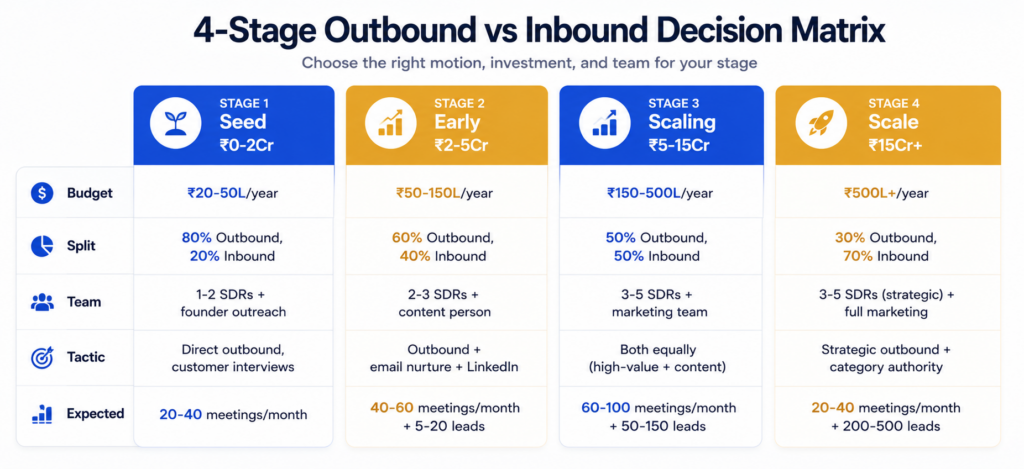
Stage 1: ₹0-2Cr ARR (Seed/Early)
Budget: ₹20-50L/year
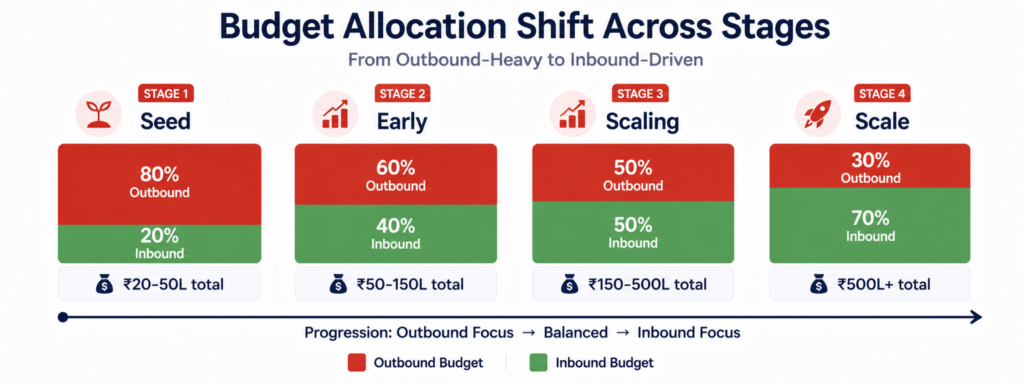
- Outbound: ₹16-40L (80% of effort)
- Inbound: ₹4-10L (20% of effort)
What to do:
- Hire SDR/BDR (1-2 people doing outbound)
- Have founder do a few customer interviews/month
- Start publishing 1 blog post/month (build for later)
Expected output:
- Outbound: 20-40 meetings/month, 2-5 deals/month
- Inbound: 0 leads (too early)
- Total pipeline: ₹15-25L/month influenced
Stage 2: ₹2-5Cr ARR (Early Growth)
Budget: ₹50-150L/year
- Outbound: ₹30-100L (60-70% of effort)
- Inbound: ₹20-50L (30-40% of effort)
What to do:
- Scale SDR team to 2-3 people
- Hire content person or agency (1-2 blog posts/week)
- Implement email nurture sequences
- Start LinkedIn thought leadership
Expected output:
- Outbound: 40-60 meetings/month, 4-10 deals/month
- Inbound: 5-20 leads/month (starting to compound)
- Total pipeline: ₹30-50L/month influenced
Stage 3: ₹5-15Cr ARR (Scaling)
Budget: ₹150-500L/year
- Outbound: ₹75-250L (50% of effort)
- Inbound: ₹75-250L (50% of effort)
What to do:
- Scale SDR team to 3-5 people
- Dedicate content person to 4-6 posts/month
- Build email automation and nurture systems
- Retargeting ads for warm audiences
- Track MQL to SQL conversion
Expected output:
- Outbound: 60-100 meetings/month, 10-20 deals/month
- Inbound: 50-150 leads/month (now meaningful)
- Total pipeline: ₹4-6Cr/month influenced
Stage 4: ₹15Cr+ ARR (Scale)
Budget: ₹500L+/year
- Outbound: ₹150-175L (30% of budget, focused on large accounts)
- Inbound: ₹325-350L (70% of budget, all channels)
What to do:
- Maintain 3-5 SDRs (focused on strategic accounts only)
- 8-12 blog posts/month (own your category)
- Full marketing stack (email, ads, content, events)
- Multiple inbound channels (content, webinars, partnerships)
Expected output:
- Outbound: 20-40 meetings/month (high-value accounts), 4-8 deals/month
- Inbound: 200-500+ leads/month (compounding)
- Total pipeline: ₹10-30Cr/month influenced
Note: These pipeline figures assume a 3-4x coverage ratio (total pipeline to ARR),
a 15-20% deal close rate, and an average deal size based on typical customer LTV at each stage.
How Stage Transitions Actually Look: A Client Example
Let’s make this concrete with a real client journey through stage transitions.
Client: B2B Data Analytics Platform (Started at ₹80L ARR, now at ₹8Cr)**
Year 1: ₹0.8-2Cr ARR (Seed stage 80% Outbound, 20% Inbound)**
Budget: ₹25L/year
Outbound activities:
– Founder and 1 SDR did direct outreach to 50 data engineers/month
– 20-30 meetings/month, 2-3 deals closed/month
– Focused on specific use cases (marketing analytics, product analytics)
– Got early customer feedback that shaped product direction
Inbound activities:
– Published 1 blog post/month on data engineering challenges
– Built small email list (under 100 subscribers)
– No traffic, no leads from inbound yet
– Goal: Build content foundation for later
Result: Hit ₹2Cr ARR in 12 months. Outbound drove 100% of pipeline. Inbound was prep work.
Year 2: ₹2-5Cr ARR (Early Growth stage — 60% Outbound, 40% Inbound)**
Budget: ₹80L/year
Outbound activities:
– Expanded SDR team to 2 people
– Same outbound playbook: 50+ outreach/month
– 30-40 meetings/month, 3-6 deals/month
Inbound activities:
– Hired content person: 2 posts/week (100 posts/year)
– Started email nurture sequences
– LinkedIn thought leadership: founder posting 2x/week
– Result: 5-15 inbound leads/month
Result: Hit ₹5Cr ARR. Outbound is still primary (60-70% of pipeline), but inbound is starting to contribute (30-40%).
Year 3: ₹5-15Cr ARR (Scaling stage 50% Outbound, 50% Inbound)**
Budget: ₹250L/year
Outbound activities:
– Scale SDR team to 3 people
– Focused on enterprise accounts (higher ACV)
– 40-60 meetings/month, 6-10 deals/month
Inbound activities:
– 4-6 blog posts/month (now 200+ posts in library)
– Email automation platform (HubSpot)
– Retargeting ads to warm audiences
– Content starting to rank for competitive keywords
– Result: 50-100 inbound leads/month
Result: Hit ₹8Cr ARR. Inbound and outbound now are equally important. The content library is compounding.
Key insight: The transition happened not because of philosophy but because the math changed. At ₹2Cr, they didn’t have time to wait for inbound. At ₹8Cr, they needed inbound to scale beyond what a small outbound team could deliver.
How to Run Both Without Burning Your Team Out
Most teams fail at hybrid because they try to do both poorly instead of doing each well.
Here’s how to structure it:
Separate teams, aligned goals
- Outbound team: SDRs, BDRs, sales (report to Head of Sales)
- Inbound team: Content, product marketing, email (report to CMO)
- Weekly sync: Align on pipeline, lead quality, strategy
Clear handoff points
- Outbound generates: Direct meetings, warm leads
- Inbound generates: Website traffic, email subscribers, content-engaged leads
- Sales team: Qualifies and closes both types
- CRM: Tracks source for every deal (essential)
Measure different things
- Outbound: Cost per meeting, meeting-to-pipeline rate, sales cycle length
- Inbound: Cost per lead, lead-to-pipeline rate, lead quality over time
- Both: Pipeline influenced, deal close rate, CAC
Invest in the right tools
- Outbound tools: Outreach, Salesloft (automation for outbound)
- Inbound tools: HubSpot, Marketo (email, nurture, automation)
- CRM: Salesforce or HubSpot for tracking
Avoid these mistakes:
Doing both without separating them
- Wrong: One person doing outbound + content
- Right: Dedicated teams for each
Not measuring the connection
- Wrong: Don’t know which leads come from which source
- Right: Every deal tracked to source (outbound vs inbound)
Neglecting one for other
- Wrong: “We’re inbound-first” then no outbound when inbound stalls
- Right: Both running, allocated based on stage
Not adjusting budget as you grow
- Wrong: Same spend at ₹2Cr and ₹15Cr
- Right: Shift budget as inbound compounds
The POV: It's Not Either/Or, It's Sequence
Here’s the Amplio position:
At each stage, the math changes:
– ₹0-2Cr ARR: Outbound drives growth. You need customers fast. Inbound builds the foundation for later.
– ₹2-5Cr ARR: Outbound is still primary. Inbound compounds. Both are needed.
– ₹5-15Cr ARR: Both are equally important. Run both with equal budget. Leverage inbound’s compounding.
– ₹15Cr+ ARR: Inbound is primary. Content compounds into category authority. Outbound is tactical (strategic accounts only). *
The key insight: AI search visibility is compressing the inbound ramp. Content built for AI citation (clear H2s, answer capsules, data) gets into search results faster. This changes when inbound becomes viable, it may now work in 2-3 months instead of 6. If your company is built for AI visibility, the stage math shifts earlier toward inbound.
The mistake: Treating this as a philosophy choice. It’s a business math choice. At seed, you need customers fast outbound deliveries. At scale, you need predictable growth inbound deliveries with compound growth.
Run both. Allocate based on stage. Own the stage transition timing. Adjust when your ARR band changes.
Not sure which motion is right for your stage? Let’s build a hybrid demand gen strategy tailored to where you are.