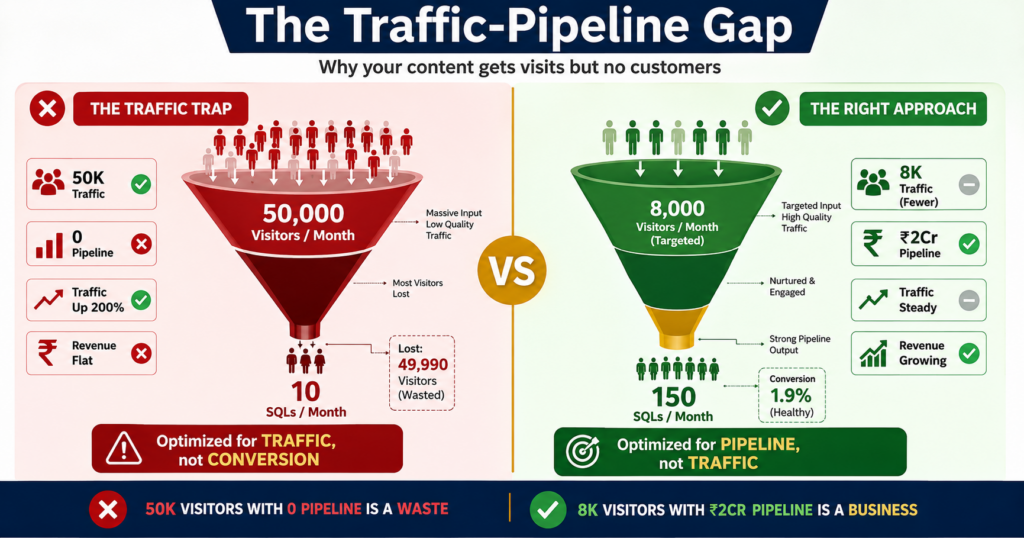
You have 50K visitors per month.
Your CEO asks, “How much pipeline did that drive?”
You pause. You check. You realize you have no idea.
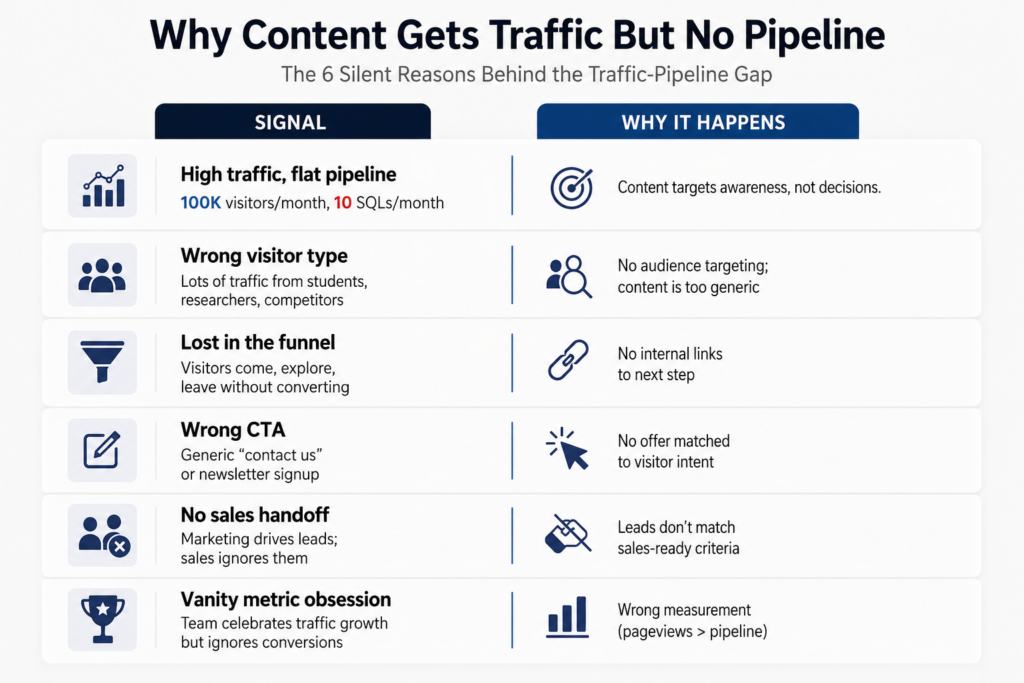
This is the traffic-pipeline gap. And it’s killing more B2B companies than you think.
You invested in content. It’s getting shared. People are visiting. Your Google Analytics looks great.
But your sales pipeline? Flat.
Your CMO thinks the problem is sales (they’re not following up on leads). Sales thinks the problem is marketing (the leads are garbage). Meanwhile, 50K visitors per month are walking through your door and your business isn’t growing.
Here’s what’s actually happening: Your content is optimized for traffic, not for pipeline.
Most B2B content strategies are.
Quick Situation Summary
The 4 Types of Traffic You Can Get (And Only 1 Converts)
Most B2B content strategies optimize for one thing: traffic.
Why?
Because traffic is easy to measure and easy to sell to leadership.
You can show your CEO: “We get 50K visitors per month. That’s up 200% from last year.”
Your CEO nods. Looks impressive.
But traffic doesn’t pay the bills. Revenue does.
See how one company went from 50K visitors to $10M pipeline
The problem: Most content is written for search engines, not for buyers.
Here’s how it goes wrong:
Step 1: Keyword research
Your content team finds high-volume keywords:
- “What is CRM software?”
- “How does marketing automation work?”
- “B2B SaaS trends 2024”
These keywords have 10K+ monthly searches. Looks great.
Step 2: Publish content
You write a 3,000-word guide titled “What is CRM software?” It’s comprehensive. It ranks.
Step 3: Get traffic
Month 1: 500 visitors Month 2: 2,000 visitors Month 3: 5,000 visitors
The post starts ranking #3 for the keyword. You’re winning.
Step 4: Realize the traffic is worthless
You check: Who’s visiting?
- 30% are students (writing papers)
- 20% are competitor researchers (evaluating your market)
- 15% are job seekers (researching the industry)
- 20% are early-stage explorers (just learning, not buying)
- 15% are actual prospects
So 85% of your traffic has zero buying intent. They’re not your customer. They never will be.
You optimized for keyword volume, not buyer intent.
The traffic-pipeline gap has opened.
The 4 Types of Traffic You Can Get (And Only 1 Converts)
Not all traffic is equal. Let’s map the four types:
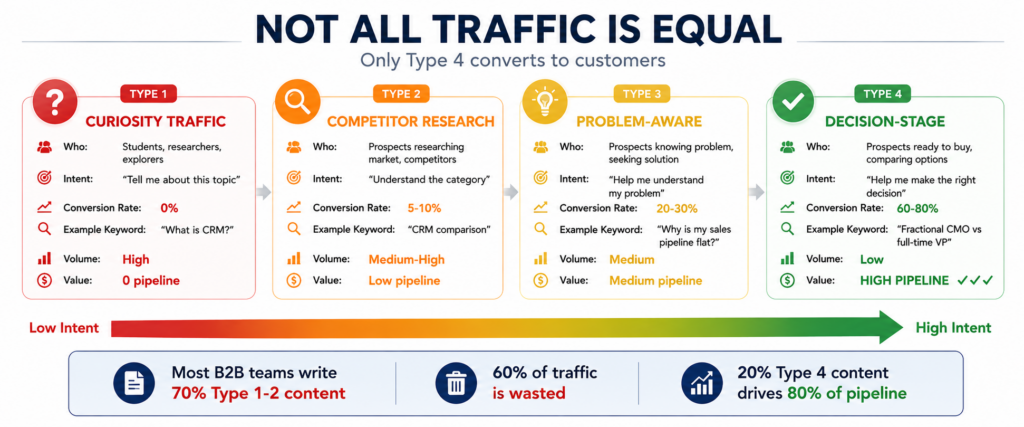
Type 1: Curiosity Traffic
Who: Students, researchers, career explorers, general learners
Intent: “Tell me about this topic.”
Likelihood to buy: 0%
Example keywords: “What is…”, “How does…”, “Introduction to…”, “Trends in…”
Example: Someone reads your “CRM Software Explained” post because they’re writing a college paper. They leave. They never buy anything.
Type 2: Competitor Research Traffic
Who: Prospects researching your market, competitors evaluating each other
Intent: “Understand the category so I can make smart decisions”
Likelihood to buy: 5-10% (if they’re prospects, they might convert later)
Example keywords: “Best CRM for [industry],” “CRM comparison,” “CRM alternatives”
Example: A prospect is evaluating CRM options. They read your post about CRM features. It’s helpful. They bookmark it. But they haven’t decided to buy yet.
Type 3: Problem-Aware Traffic
Who: Prospects who know they have a problem but don’t know the solution yet
Intent: “Help me understand my problem better.”
Likelihood to buy: 20-30% (they’re in discovery mode)
Example keywords: “Why is my sales pipeline flat?”, “How to improve lead quality” and “Sales cycle is too long”
Example: A VP of Sales is frustrated with their pipeline. They search “How to improve SQL quality.” They find your post. It resonates. They think, “This is us. We have this problem.”
Type 4: Solution-Aware, Decision-Stage Traffic
Who: Prospects who know they have a problem AND know a solution exists AND are comparing options
Intent: “Help me make the right decision between similar solutions.”
Likelihood to buy: 60-80% (they’re ready to buy)
Example keywords: “Fractional CMO vs in-house marketing,” “When to hire an agency vs hire full-time,” and “[Your service] vs [competitor]”
Example: A CEO knows they need a fractional CMO. They’re comparing three agencies. They read your post about how to evaluate an agency. It clearly positions your approach. They book a call.
See the post that converts decision-stage buyers
The gap:
Most B2B content targets Types 1-3 (awareness and early discovery). They get tons of traffic but low conversion.
To close the traffic-pipeline gap, you need more Type 4 content (high-intent decision-stage content).
The 4-Part Framework to Close the Gap
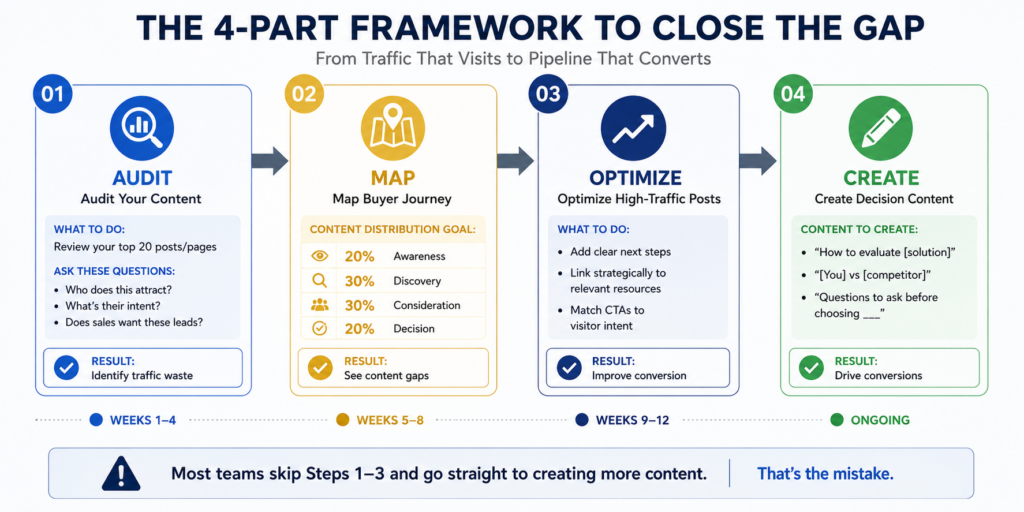
Part 1: Audit Your Existing Content
Look at your top 20 trafficked posts. For each one, ask:
- “Who is this attracting?” (Students? Competitors? Decision-makers?)
- “What is their buying intent?” (Just learning? Considering a purchase?)
- “Does our sales team want these leads?” (Yes or no?)
You’ll find:
- 60% attract wrong audience (curiosity traffic)
- 25% attract early-stage prospects (awareness, not ready to buy)
- 15% attract decision-stage buyers (high-intent)
Part 2: Map Your Content to the Buyer Journey
Create a content map:
[AWARENESS] “What is [solution]?”
↓
[DISCOVERY] “Why do I have this problem?”
↓
[CONSIDERATION] “How do I solve this? What are my options?”
↓
[DECISION] “Which vendor is best? How do I evaluate?”
Most B2B teams write tons of awareness content (70% of output). They neglect decision content (5% of output).
To close the gap, you need:
- 20% awareness
- 30% discovery
- 30% consideration
- 20% decision
Part 3: Optimize Your High-Traffic Posts
You have 50K visitors per month on awareness content. Don’t delete it.
Optimize it:
Add clear next steps: If someone reads “What is CRM software?” don’t leave them hanging. Link to “How to evaluate a CRM” or “CRM for [your industry].”
Add internal links strategically: Link from awareness → discovery → consideration → decision content.
Add CTAs that match intent: A student reading “What is CRM?” shouldn’t see “Book a CRM consultation.” They should see “Learn how companies use CRM to close faster” (a link to deeper content).
See how we optimized Post X from 50K visitors to Y SQLs
Part 4: Create Decision-Stage Content
This is where the conversion happens.
Create content that answers:
- “How do I evaluate this solution?”
- “What should I look for in [vendor]?”
- “[Your service] vs [competitor]”
- “Questions to ask when hiring [type of vendor]”
- “How to know if [solution] is right for you?”
This content should:
- Be specific (not generic)
- Show your methodology clearly
- Position your approach as best
- Include a clear CTA to sales
Example: If you’re a fractional CMO agency, create “12 Questions to Ask When Evaluating a Marketing Agency” (this is a post that converts because it targets decision-stage buyers).
The 5 Metrics That Actually Matter
Stop measuring traffic. Start measuring the pipeline.
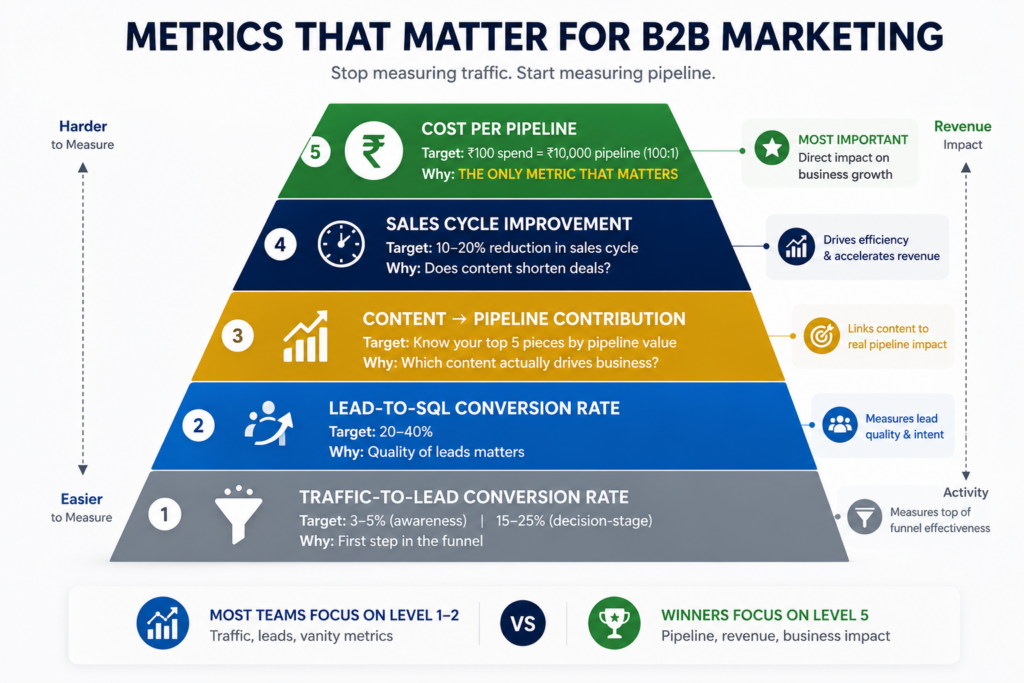
Metric 1: Traffic-to-Lead Conversion Rate
Visitors → Leads who opted in
Target: 3-5% for awareness content, 15-25% for decision content
How to measure: Set up conversion tracking on “contact us” form, email signup, or consultation booking
Metric 2: Lead-to-SQL Conversion Rate
Leads who engaged → Sales Qualified Leads
Target: 20-40% (higher for decision-stage content)
How to measure: Work with sales to tag leads by content source, track conversion to SQL
Metric 3: Content → Pipeline Contribution
Which content sources drive the most pipeline value?
Target: Know your top 5 content pieces by pipeline value
How to measure: Attribute pipeline to content source in your CRM
Example:
- “How to evaluate a marketing agency” post → 15 SQLs → ₹3.5Cr pipeline
- “Top B2B marketing trends” post → 200 visitors, 0 SQLs, ₹0 pipeline
The first is worth 10x more than the second.
Metric 4: Sales Cycle Improvement
Is content shortening your sales cycle?
Target: 10-20% reduction in sales cycle length
How to measure: Compare sales cycle for leads from content vs other sources
Metric 5: Cost Per Pipeline (from content)
How much are you spending on content to generate each ₹1 of pipeline?
Target: ₹100 in content spend = ₹10,000 in pipeline (100:1 ratio)
How to measure: Divide annual content budget by annual pipeline generated from content
How to Know It's Working
Signal 1: Sales team engagement increases
Your sales team stops ignoring leads from content. They say, “These leads are better than what we get from ads.”
Signal 2: Sales cycle shortens
Leads from decision-stage content close faster. Instead of 4 months, they close in 2-3 months.
Signal 3: CAC drops
Your cost to acquire a customer from organic content is lower than from ads (usually 40-60% lower).
Signal 4: Pipeline is predictable
You can say, “We generate ₹1 Cr of pipeline per ₹20 L of content spend.” You can forecast based on content.
Signal 5: Traffic growth decouples from lead growth
You can have flat traffic (or declining traffic) while leads grow. Because you’re attracting fewer visitors, but they’re higher intent.
This scenario is healthy.
You likely have a traffic-pipeline gap right now. Want to audit yours?