You look at the monthly report your agency sends.
The numbers look good.
“Impressions up 40%. Reach up to 30%. Engagement rate is 3.2% (above benchmark). Social media followers +500. The email list grew by 2,000. Blog traffic +25%.”
It’s all green arrows.
Then you talk to your sales team.
“We don’t have leads.”
There’s something wrong here. The agency is reporting growth. But your sales team has nothing to work with. You’re paying for results, but you’re not getting them.
You’re not crazy.
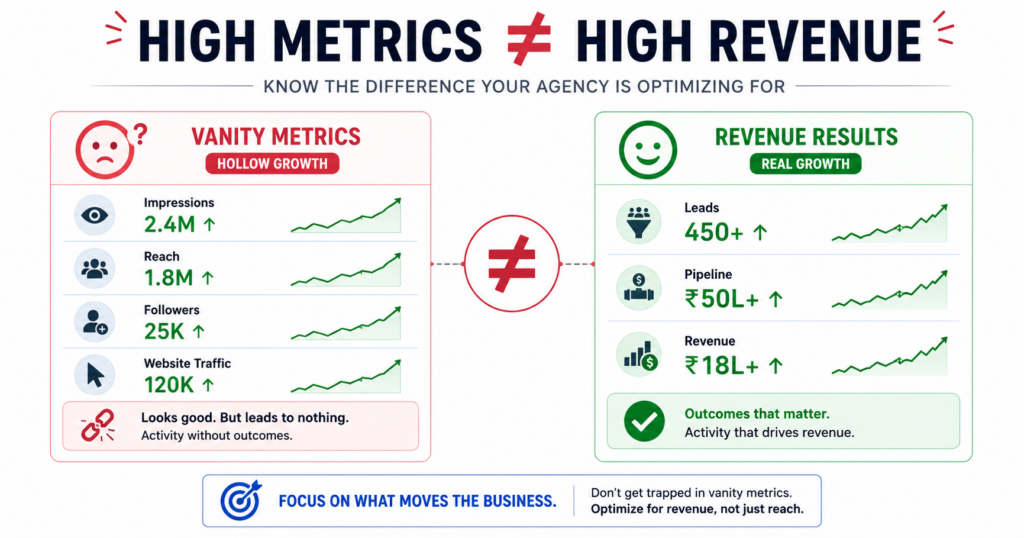
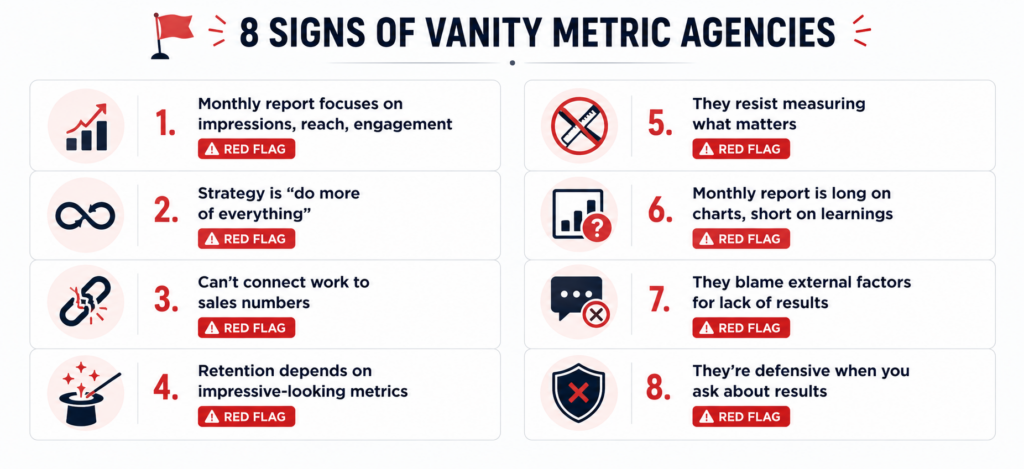
You’re experiencing what happens when your agency optimizes for vanity metrics instead of revenue.
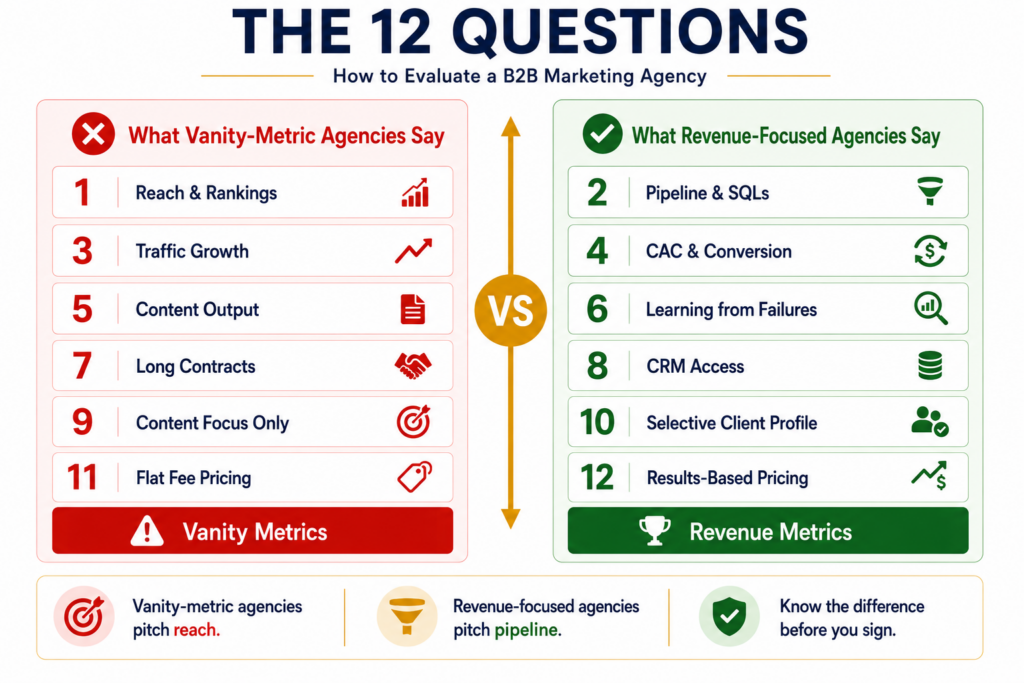
Quick Reference (Comparison Table)
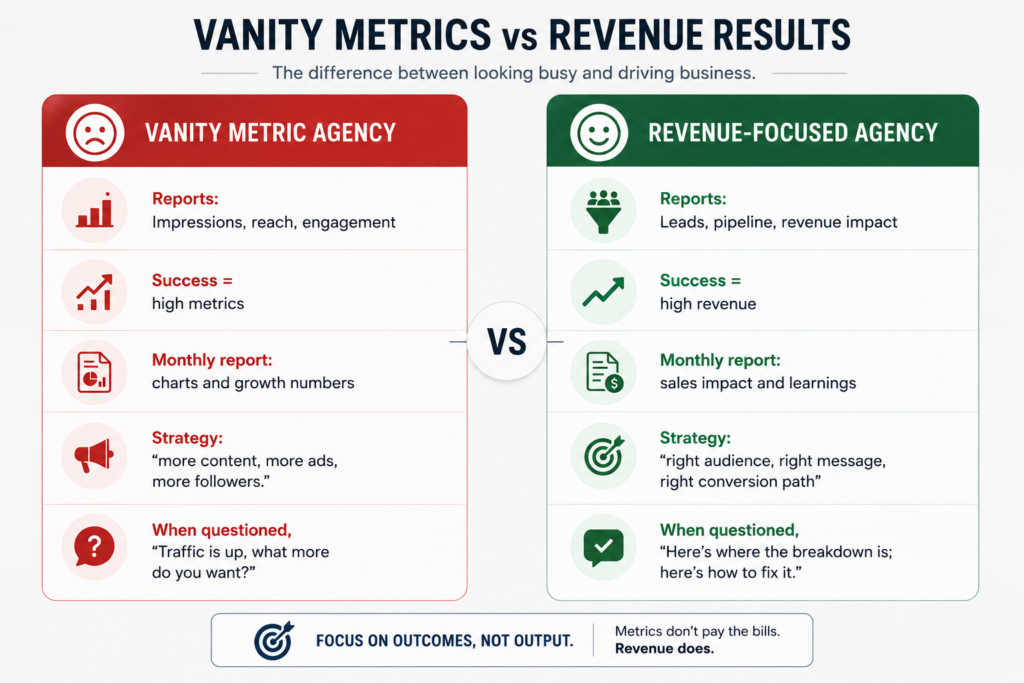
The Vanity Metric Trap (And Why Agencies Use It)
First, understand why this happens.
It’s not (usually) intentional deception.
Most agencies are compensated based on outputs, not outcomes. They get paid to deliver campaigns, not pipelines. So they naturally optimize for the metrics they’re paid on: impressions, reach, traffic, followers and engagement.
These metrics are easy to move.
Get someone to spend ₹1 lakh on paid ads? Your impressions go up 200,000. Instant win.
Get someone to create 20 pieces of content in a month? Traffic goes up. Blog followers go up. Engagement metrics go up. All looks good.
But none of this translates to:
- Qualified leads
- Meetings booked
- Opportunities created
- Revenue
The problem: vanity metrics feel like success, but they’re often the opposite.
High impressions with low conversion = wasted spend.
High traffic with low lead rate = no pipeline.
High followers with no sales = a hollow metric.
An agency can report amazing growth numbers while your pipeline stays flat.
And that’s exactly what’s happening if you’re experiencing these results.
8 Signs Your Agency Is Optimising for Vanity Metrics (Not Revenue)
Here’s how to identify if your agency is part of the problem:
Sign 1: Their monthly report focuses on impressions, reach, and engagement
A vanity metric agency’s report looks like this:
- “Impressions: 500,000” ✅
- “Reach: 75,000” ✅
- “Engagement rate: 2.8%” ✅
- “Followers gained: 250” ✅
- “Blog traffic: 5,000 visitors” ✅
A revenue-focused agency’s report looks like this:
- “Leads generated: 45” (20 qualified)
- “Meetings booked: 8”
- “Pipeline influenced: ₹50L”
- “Cost per qualified lead: ₹2,500”
- “Conversion rate (visitor → lead): 2.2%”
If your agency report is full of the first kind, that’s Sign 1.
Sign 2: Their strategy is “do more of everything.”
Vanity metric agencies think, “Traffic is down? Publish more content.”
“Engagement is low? Create more posts.”
“Followers aren’t growing? Buy more followers or run more ads.”
Revenue-focused agencies think, “Traffic is down? Who are we trying to reach? Are we reaching them? Is our message resonating? If not, why are we spending?”
The vanity metric agency’s answer to every problem is to do more. More content, more ads, more spending, more followers.
Revenue-focused agencies ask “Is this working?” first, then optimize.
If your agency’s answer to every challenge is “we need to do more,” that’s Sign 2.
Sign 3: They can’t connect their work to your sales numbers
You ask, “How much pipeline did our content marketing generate this quarter?”
Vanity metric agency: “We generated 50,000 impressions! Traffic is up 25%!”
Revenue-focused agency: “Of 120 leads we influenced this quarter, 35 came from content. Of those, 8 converted to pipeline. Here’s which content pieces drove the most pipeline.”
If your agency can’t connect their work to actual leads and pipelines, they’re not measuring what matters.
That’s Sign 3.
Sign 4: Their retention depends on showing you impressive-looking metrics
A vanity metric agency keeps you happy by showing you big numbers: “Look at all these followers!” “Look at all this traffic!” “Look at all these impressions!”
These numbers make you feel like something is happening. But nothing is actually happening for your business.
A revenue-focused agency keeps you happy by delivering results: “Here are the 8 new qualified leads.” “Here’s the ₹25L pipeline we influenced.” “Here’s what worked and what didn’t, so we can improve next month.”
If you feel like your agency is showing you impressive numbers to keep you happy (instead of delivering results), that’s Sign 4.
Sign 5: They resist measuring what matters
You ask, “Can you show me our conversion rate from visitor to lead?”
Vanity metric agency: “Conversion rates are hard to track. Everyone’s setup is different. Let’s focus on traffic growth instead.”
Translation: “I don’t want to measure this because it will show that my work isn’t converting.”
Revenue-focused agency: “Yes, your conversion rate is 1.8%. Industry average is 2-3%. Here’s what we’re doing to improve it.”
They measure conversion because that’s what matters.
If your agency resists measuring what matters (leads, conversion, and pipeline), that’s Sign 5.
Sign 6: The monthly report is long on charts, short on learnings
Vanity metric agency report:
- 15 pages of charts showing growth trends
- “All metrics are green!”
- No explanation of why
- No actionable insights
- No recommendations for next month
Revenue-focused agency report:
- 5 pages max
- “Here’s what worked; here’s what didn’t.”
- “Here’s why” (with specific data)
- “Here’s what we’ll do next month to improve.”
If your report is full of pretty charts but light on actual insights, that’s Sign 6.
Sign 7: They blame external factors for lack of results
When the pipeline is flat, vanity metric agencies say, “The market is slow.”
“Your ICP is too niche.”
“You need a bigger budget.”
“Content takes time.”
“Nobody buys in August.”
These are all maybe true. But they’re also excuses.
Revenue-focused agencies say, “The market is slow for everyone. Let’s look at what we’re doing differently and where we can improve.”
They take ownership instead of blaming.
If your agency makes excuses instead of adjusting strategy, that’s Sign 7.
Sign 8: They’re defensive when you ask about results
You ask: “Why don’t we have more leads if the traffic is up?”
Vanity metric agency: “Traffic is a leading indicator. Results take time. You need to trust the process.”
Translation: I don’t want to explain why my metrics aren’t translating to results.
Revenue-focused agency: “Good question. Let’s diagnose this together. Traffic is up, but conversion is down. Here are the three likely causes. Here’s how we’ll fix each.”
They’re collaborative, not defensive.
If your agency gets defensive when you ask about results, that’s Sign 8.
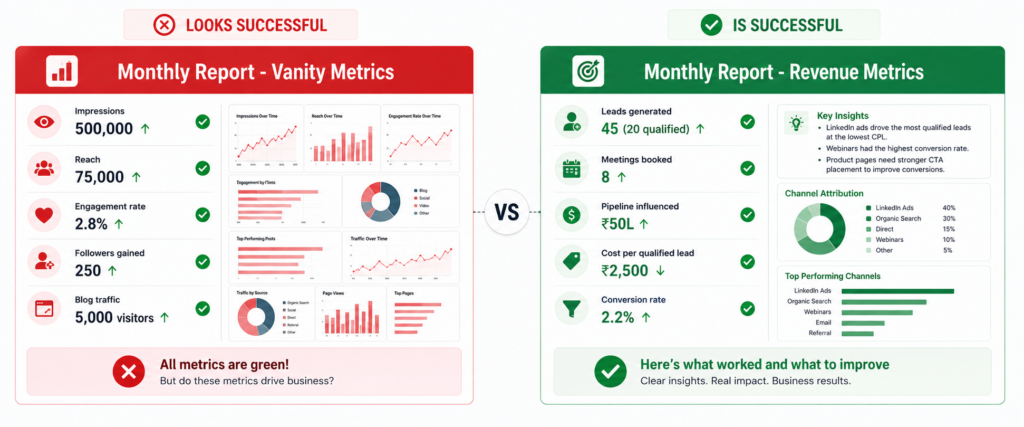
What a Revenue-Focused Agency Reports Instead
If you switch to a revenue-focused agency, here’s what your monthly report should look like:
The metrics that matter:
- Leads generated (total + qualified)
- Cost per qualified lead (CPQL)
- Lead quality (% that become pipeline)
- Pipeline influenced (by channel)
- Conversion rates (visitor → lead, lead → meeting)
- Cycle time improvements (if applicable)
- Revenue influenced (if you share this data)
Example revenue-focused report:
“This month:
- 65 total leads generated (38 qualified)
- Cost per qualified lead: ₹2,800
- 45% of qualified leads progressed to pipeline stage
- Content marketing influenced ₹40L in pipeline
- Email campaigns: 35% open rate, 8% click-through, 2 meetings booked
- LinkedIn retargeting: 12% conversion to leads
- Organic search: 25% of total leads
Breakdown of what’s working:
- Demand gen: Excellent (CPQL down 15%, quality up)
- Content: Good (traffic up, conversion steady)
- Email: Needs improvement (open rate down, analyzing why)
What we’ll fix next month:
- A/B test subject lines to improve email open rates
- Increase LinkedIn budget for high-converting audience segment
- Publish 2 new pieces on emerging keywords
You’re on track to hit a ₹3Cr pipeline this year. Current trajectory: ₹2.8Cr. Here’s what we need to do differently to close the gap.”
That’s a revenue-focused report.
Compare it to your agency’s report. Which one is yours closer to?
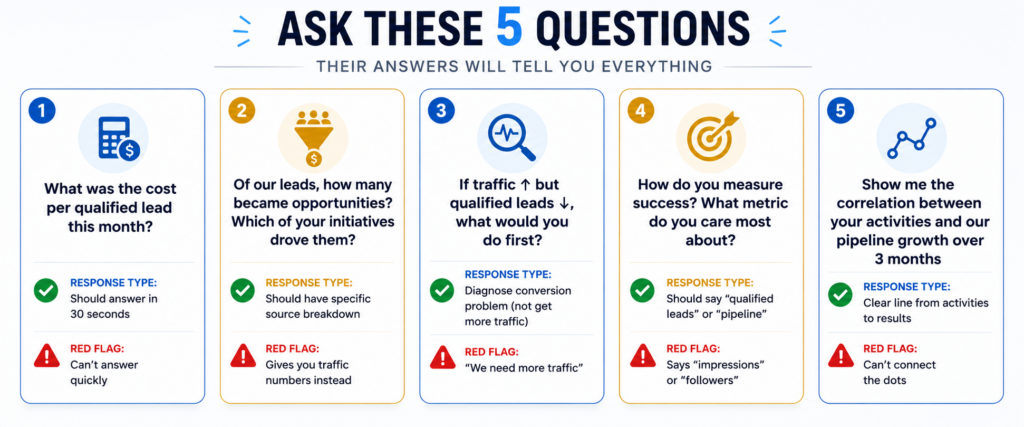
The Questions to Ask Your Agency on the Next Call
Don’t fire your agency based on this post alone. Ask them directly first.
Use these questions:
“What was the cost per qualified lead this month, and is it going up or down?”
If they can’t answer this question in 30 seconds, they’re not tracking what matters.
“Of all the leads we generated, how many became sales opportunities? And which of your initiatives drove those?”
A vanity metric agency will give you impressions and traffic numbers. A revenue-focused one will give you specific lead sources.
“If I told you traffic increased but qualified leads dropped, what would you do first?”
Vanity metric agency: “We’d focus on increasing traffic more to get more leads.”
Revenue-focused agency: “We’d diagnose why conversion went down. There’s a problem in the funnel, not with traffic.”
“How do you measure success? What metric do you care most about?”
If they say “impressions,” “reach,” “traffic,” or “followers,” they’re optimizing for the wrong thing.
If they say “qualified leads” or “pipeline,” you’re talking to someone who cares about your business.
“Show me the correlation between your activities and our pipeline growth over the last 3 months.”
A good agency can draw a line from “we published X content” to “it generated Y leads” to “it influenced the Z pipeline.”
A vanity metric agency can’t.
When to Fire Your Agency (And What to Do Next)
Fire your agency if:
- They can’t answer questions 1-5 above
- Their monthly report is full of vanity metrics but light on revenue metrics
- They get defensive when you ask about results
- They’ve been unable to improve results despite increasing budget
- They resist measuring conversion rates, lead quality, or pipeline impact
What to do next:
Step 1: Document what’s not working
Before you fire them, write down:
- What metrics did they promise?
- What did they actually deliver?
- How much have you spent?
- What’s the cost per lead?
- What’s the lead quality?
Step 2: Find a revenue-focused agency
Look for agencies that:
- Lead with “here’s how we’ll impact your pipeline” (not “here’s how we’ll grow your traffic”)
- Can show client case studies with revenue metrics (not just traffic)
- Measure conversion rates and lead quality (not just volume)
- Take ownership for results (don’t make excuses)
- Align their incentives with yours (they win when you win)
Step 3: Transition carefully
Don’t fire and go silent. You’ll lose momentum and context.
Before firing:
- Choose your new agency
- Have them review what the old agency was doing
- Plan what to keep, what to change
- Establish a transition period (2-4 weeks)
- Brief them on what’s working and what isn’t
After firing:
- Don’t pause all activities while you transition
- Maintain your content calendar
- Keep retargeting audiences alive
- Brief your sales team on changes
- Track the transition impact (some drop is normal)
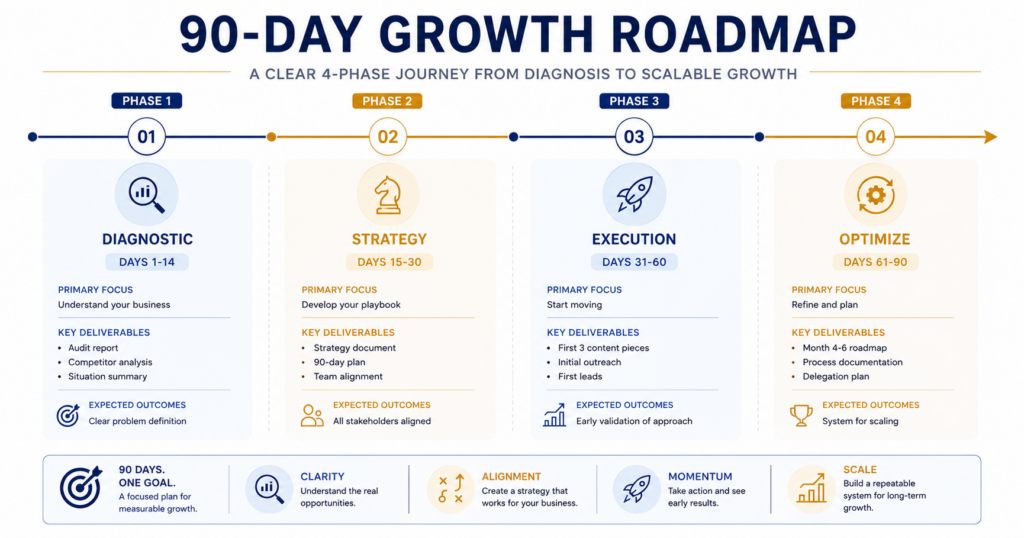
Step 4: Give the new agency 90 days
New strategies take time. But by 90 days, you should see:
- Better lead quality (not just volume)
- Improved conversion rates
- Clear correlation between activities and results
- A roadmap for improvement
If not, you picked wrong again.
If this post describes your current situation, you don’t have to live with it. We help companies transition from vanity-metric reporting to revenue-focused strategy.